
Modelling copper mobilization from low-grade ore controlled by mineral surface reactions
DOI:
https://doi.org/10.69631/q237yd92Keywords:
Coupled dissolution and reprecipitation, Copper leaching, Pore scale, Reactive-transport modelAbstract
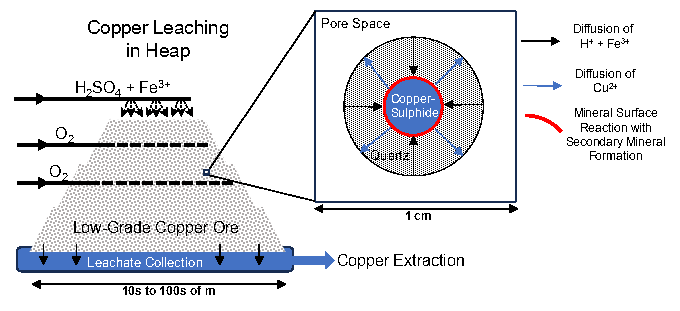
Many metals of economic value are commonly recovered from low grade ores through heap leaching at mine sites. The recovery of metals in heaps is often limited for multiple reasons including mineral overgrowth of targeted minerals resulting in suboptimal mineral dissolution rates. Chalcopyrite is a major copper iron sulfide mineral found in copper sulfide ores and its dissolution is controlled by multiple dissolution reaction mechanisms and potential mineral overgrowth. Traditional continuum scale reactive-transport models, including those applied to simulate heap leaching, do not account for local, mineral surface-controlled processes which may have implications for large-systems such as copper recovery in heaps. A new finite element, multicomponent reactive-transport model was developed and enabled the simulation of concurrent reactions at the discrete chalcopyrite surface and its surrounding gangue mineral and the fluid phase. The model predicts the rate of chalcopyrite dissolution controlled by different reaction mechanisms (proton- and ferric-iron promoted) as well as the rate of secondary mineral formation (jarosite) at the mineral surface. The latter may increasingly inhibit copper mobilization over time through surface passivation. The onset and growth of the surface passivation layer is largely controlled by the surrounding fluid composition and ion transport through the gangue mineral. The reduction in porosity of the surface passivation layer leads to the breakdown of ionic transport to the chalcopyrite surface and associated copper mobilization. Maximum copper recovery is achieved by high ferric iron concentrations and low pH and by preventing the formation of a passivation layer by keeping the sulfate concentration low.
Downloads
References
1. Altree-Williams, A., Pring, A., Ngothai, Y., & Brugger, J. (2015). Textural and compositional complexities resulting from coupled dissolution-reprecipitation reactions in geomaterials. Earth-Science Reviews, 150, 628–651. https://doi.org/10.1016/j.earscirev.2015.08.013
2. Ansah, E. O., Black, J. R., & Haese, R. R. (2025). Impact of mineral dissolution-precipitation on pore geometry during copper sulphide heap leaching. Minerals Engineering, 230, Article 109379. https://doi.org/10.1016/j.mineng.2025.109379
3. Bear, J. (1972). Dynamics of fluids in porous materials. Society of Petroleum Engineers.
4. Bouffard, S. C., & Dixon, D. G. (2001). Investigative study into the hydrodynamics of heap leaching processes. Metallurgical and Materials Transactions B, 32(5), 763–776. https://doi.org/10.1007/s11663-001-0063-1
5. Bouffard, S. C., & West-Sells, P. G. (2009). Hydrodynamic behavior of heap leach piles: Influence of testing scale and material properties. Hydrometallurgy, 98(1–2), 136–142. https://doi.org/10.1016/j.hydromet.2009.04.012
6. Brantley, S. L. (2008). Kinetics of mineral dissolution. In S. L. Brantley, J. D. Kubicki, & A. F. White (Eds.), Kinetics of water-rock interaction (pp. 151–210). Springer. https://doi.org/10.1007/978-0-387-73563-4_5
7. Cariaga, E., Concha, F., & Sepúlveda, M. (2005). Flow through porous media with applications to heap leaching of copper ores. Chemical Engineering Journal, 111(2–3), 151–165. https://doi.org/10.1016/j.cej.2005.02.019
8. Deng, H., Poonoosamy, J., & Molins, S. (2022). A reactive transport modeling perspective on the dynamics of interface-coupled dissolution-precipitation. Applied Geochemistry, 137, Article 105207. https://doi.org/10.1016/j.apgeochem.2022.105207
9. Dixon, D. G., & Hendrix, J. L. (1993). A mathematical model for heap leaching of one or more solid reactants from porous ore pellets. Metallurgical Transactions. Part B, 24(6), 1087–1102. https://doi.org/10.1007/BF02661000
10. Elshkaki, A., Graedel, T. E., Ciacci, L., & Reck, B. K. (2016). Copper demand, supply, and associated energy use to 2050. Global Environmental Change, 39, 305–315. https://doi.org/10.1016/j.gloenvcha.2016.06.006
11. Elwood Madden, M. E., Madden, A. S., Rimstidt, J. D., Zahrai, S., Kendall, M. R., & Miller, M. A. (2012). Jarosite dissolution rates and nanoscale mineralogy. Geochimica et Cosmochimica Acta, 91, 306–321. https://doi.org/10.1016/j.gca.2012.05.001
12. Emmanuel, S. (2022). Modeling the effect of mineral armoring on the rates of coupled dissolution-precipitation reactions: Implications for chemical weathering. Chemical Geology, 601, Article 120868. https://doi.org/10.1016/j.chemgeo.2022.120868
13. Hackl, R. P., Dreisinger, D. B., Peters, E., & King, J. A. (1995). Passivation of chalcopyrite during oxidative leaching in sulfate media. Hydrometallurgy, 39(1–3), 25–48. https://doi.org/10.1016/0304-386X(95)00023-A
14. Harlov, D. E., Wirth, R., & Hetherington, C. J. (2011). Fluid-mediated partial alteration in monazite: The role of coupled dissolution–reprecipitation in element redistribution and mass transfer. Contributions to Mineralogy and Petrology, 162(2), 329–348. https://doi.org/10.1007/s00410-010-0599-7
15. Hiroyoshi, N., Hirota, M., Hirajima, T., & Tsunekawa, M. (1997). A case of ferrous sulfate addition enhancing chalcopyrite leaching. Hydrometallurgy, 47(1), 37–45. https://doi.org/10.1016/S0304-386X(97)00032-7
16. Jyoti, A., & Haese, R. R. (2021). Validation of a multicomponent reactive-transport model at pore scale based on the coupling of COMSOL and PhreeqC. Computers and Geosciences, 156, Article 104870. https://doi.org/10.1016/j.cageo.2021.104870
17. Kelly, T. D., & Matos, G. R. (2014). Historical statistics for mineral and material commodities in the United States (2014), US Geological Survey Data, 140. Retrieved July 2025, https://www.usgs.gov/centers/national-minerals-information-center/historical-statistics-mineral-and-material-commodities
18. Kimball, B. E., Rimstidt, J. D., & Brantley, S. L. (2010). Chalcopyrite dissolution rate laws. Applied Geochemistry, 25(7), 972–983. https://doi.org/10.1016/j.apgeochem.2010.03.010
19. Leahy, M. J., & Schwarz, M. P. (2009). Modeling jarosite precipitation in isothermal chalcopyrite bioleaching columns. Hydrometallurgy, 98(1–2), 181–191. https://doi.org/10.1016/j.hydromet.2009.04.017
20. Li, Y., Kawashima, N., Li, J., Chandra, A. P., & Gerson, A. R. (2013). A review of the structure, and fundamental mechanisms and kinetics of the leaching of chalcopyrite. Advances in Colloid and Interface Science, 197–198, 1–32. https://doi.org/10.1016/j.cis.2013.03.004
21. Manecki, M., Kwaśniak-Kominek, M., Majka, J. M., & Rakovan, J. (2020). Model of interface-coupled dissolution-precipitation mechanism of pseudomorphic replacement reaction in aqueous solutions based on the system of cerussite PbCO3—Pyromorphite Pb5(PO4)3Cl. Geochimica et Cosmochimica Acta, 289, 1–13. https://doi.org/10.1016/j.gca.2020.08.015
22. Marty, N. C. M., Claret, F., Lassin, A., Tremosa, J., Blanc, P., Madé, B., Giffaut, E., Cochepin, B., & Tournassat, C. (2015). A database of dissolution and precipitation rates for clay-rocks minerals. Applied Geochemistry, 55, 108–118. https://doi.org/10.1016/j.apgeochem.2014.10.012
23. McBride, D., Croft, T. N., Cross, M., Bennett, C., & Gebhardt, J. E. (2014). Optimization of a CFD—Heap leach model and sensitivity analysis of process operation. Minerals Engineering, 63, 57–64. https://doi.org/10.1016/j.mineng.2013.11.010
24. McBride, D., Cross, M., & Gebhardt, J. E. (2012). Heap leach modeling employing CFD technology: A “process” heap model. Minerals Engineering, 33, 72–79. https://doi.org/10.1016/j.mineng.2011.10.003
25. McBride, D., Gebhardt, J., Croft, N., & Cross, M. (2018). Heap Leaching: Modeling and forecasting using CFD technology. Minerals, 8(1), 9. https://doi.org/10.3390/min8010009
26. Molins, S., Soulaine, C., Prasianakis, N. I., Abbasi, A., Poncet, P., Ladd, A. J. C., Starchenko, V., Roman, S., Trebotich, D., Tchelepi, H. A., & Steefel, C. I. (2021). Simulation of mineral dissolution at the pore scale with evolving fluid-solid interfaces: Review of approaches and benchmark problem set. Computational Geosciences, 25(4), 1285–1318. https://doi.org/10.1007/s10596-019-09903-x
27. Mostaghimi, P., Tollit, B. S., Neethling, S. J., Gorman, G. J., & Pain, C. C. (2014). A control volume finite element method for adaptive mesh simulation of flow in heap leaching. Journal of Engineering Mathematics, 87(1), 111–121. https://doi.org/10.1007/s10665-013-9672-3
28. Mudd, G. M., Weng, Z., & Jowitt, S. M. (2013). A detailed assessment of global Cu resource trends and endowments. Economic Geology, 108(5), 1163–1183. https://doi.org/10.2113/econgeo.108.5.1163
29. Nardi, A., Idiart, A., Trinchero, P., de Vries, L. M., & Molinero, J. (2014). Interface COMSOL-PHREEQC (iCP), an efficient numerical framework for the solution of coupled multiphysics and geochemistry. Computers and Geosciences, 69, 10–21. https://doi.org/10.1016/j.cageo.2014.04.011
30. Phukan, M., Vu, H. P., & Haese, R. R. (2021). Mineral dissolution and precipitation reactions and their net balance controlled by mineral surface area: An experimental study on the interactions between continental flood basalts and CO2-saturated water at 80 bars and 60 °C. Chemical Geology, 559, Article 119909. https://doi.org/10.1016/j.chemgeo.2020.119909
31. Putnis, A. (2002). Mineral replacement reactions: From macroscopic observations to microscopic mechanisms. Mineralogical Magazine, 66(5), 689–708. https://doi.org/10.1180/0026461026650056
32. Putnis, A. (2009). Mineral replacement reactions. In Reviews in Mineralogy and Geochemistry E. H. Oelkers & E. H. Schott (Eds.), Thermodynamics and kinetics of water-rock interactions, 70(1), 87–124. https://doi.org/10.2138/rmg.2009.70.3
33. Ren, Z., Chao, C., Krishnamoorthy, P., Asselin, E., Dixon, D. G., & Mora, N. (2022). The overlooked mechanism of chalcopyrite passivation. Acta Materialia, 236, Article 118111. https://doi.org/10.1016/j.actamat.2022.118111
34. Robertson, S. (2017). Development of an integrated heap leach solution flow and mineral leaching model. Hydrometallurgy, 169, 79–88. https://doi.org/10.1016/j.hydromet.2016.12.010
35. Ruiz-Agudo, E., Putnis, C. V., & Putnis, A. (2014). Coupled dissolution and precipitation at mineral-fluid interfaces. Chemical Geology, 383, 132–146. https://doi.org/10.1016/j.chemgeo.2014.06.007
36. Schipper, B. W., Lin, H.-C., Meloni, M. A., Wansleeben, K., Heijungs, R., & van der Voet, E. (2018). Estimating global copper demand until 2100 with regression and stock dynamics. Resources, Conservation and Recycling, 132, 28–36. https://doi.org/10.1016/j.resconrec.2018.01.004
37. Schulz, H. D. (2006). Quantification of early diagenesis: Dissolved constituents in pore water and signals in the solid phase. In H. D. Schulz, M. Zabel (Eds.), Marine geochemistry (pp. 73–124). Springer-Verlag. https://doi.org/10.1007/3-540-32144-6_3.
38. Silva, O., Nardi, A., Román-Ross, G., Molinero, J., & Quesada, P. (2014). Hydro-mechanical-chemical coupled modeling of copper heap leaching with iCP. Iberian COMSOL Multiphysics Conference, 26–28. https://www.comsol.com/paper/download/210581/IberianCOMSOLConference.pdf
39. Singer, P. C., & Stumm, W. (1970). The solubility of ferrous iron in carbonate-bearing waters. Journal AWWA, 62(3), 198–202. https://doi.org/10.1002/j.1551-8833.1970.tb03888.x
40. Soulaine, C. (2024). Micro-continuum modeling: An hybrid-scale approach for solving coupled processes in porous media. Water Resources Research, 60(2). https://doi.org/10.1029/2023WR035908
41. Teimouri, S., Herman Potgieter, J. H., & Billing, C. (2025). A comparison of the electrochemical oxidative dissolution of pyrite and chalcopyrite in dilute nitric acid solution. Chemistry Open, 14(5), Article e202400053. https://doi.org/10.1002/open.202400053
42. Velásquez-Yévenes, L., & Quezada-Reyes, V. (2018). Influence of seawater and discard brine on the dissolution of copper ore and copper concentrate. Hydrometallurgy, 180, 88–95. https://doi.org/10.1016/j.hydromet.2018.07.009
43. Wang, Z., Hu, M., & Steefel, C. (2024). Pore-scale modeling of reactive transport with coupled mineral dissolution and precipitation. Water Resources Research, 60(6). https://doi.org/10.1029/2023WR036122
Downloads
Published
Versions
- 2026-05-15 (2)
- 2026-03-18 (1)
Data Availability Statement
All modelling files are available at: https://github.com/jyotiapoorv/Modelling_Copper_Mobilization_Using_iCP.
Issue
Section
License
Copyright (c) 2026 Prof. Ralf Haese, Dr. Apoorv Jyoti

This work is licensed under a Creative Commons Attribution-NonCommercial-NoDerivatives 4.0 International License.
This article is published under the Creative Commons license indicated above. See the license link for details.
Article metadata are available under the CCo license.