
Comparative Evaluation of Models for Non-Fickian Transport in Unsaturated Porous Media
DOI:
https://doi.org/10.69631/fx3kjg18Keywords:
Non-Fickian transport, Unsaturated porous media, Pore-network modelling, Mobile Immobile model, Multirate Mass Transfer model, Continuous Time Random Walk model, Direct EstimationAbstract
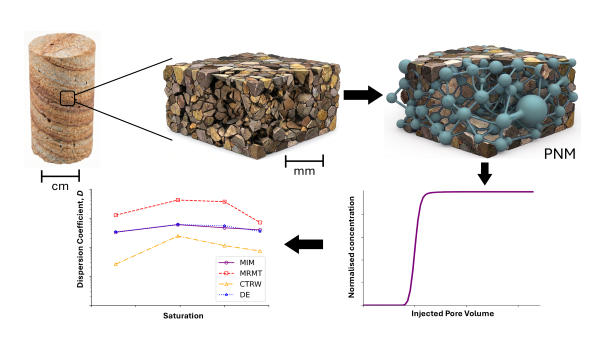
Understanding solute transport in unsaturated porous media is essential for a wide range of scientific and engineering applications. This study investigates non-Fickian transport in unsaturated porous media using pore-network modelling to simulate quasi-static two-phase flow and tracer trans-port. The pore-network model was first validated against experiments in glass bead packing. Then the validated model was used to simulate trans-port in three different hypothetical network structures with three different correlated pore-size distributions (characterized by correlation lengths), dif-ferent Péclet (Pe) numbers, and saturation values. Breakthrough curve (BTC) analysis reveals an expected shift from anomalous long-tailed behav-ior at low saturation to Fickian transport as saturation approaches unity.
The simulation results were interpreted using three continuum-scale approaches: Mobile-Immobile (MIM), Multirate Mass Transfer (MRMT), Continuous-Time Random Walk (CTRW), and their predictions were com-pared against each other and to direct estimations (DE) obtained from the pore-network simulations. Estimates of stagnant zone saturation from the MIM and MRMT models show strong sensitivity to saturation and flow con-ditions, at times yielding unrealistic values. Dispersion coefficients derived from the MIM and DE exhibit non-monotonic variation with saturation, con-sistent with both simulation trends and previously reported experimental observations, while the MRMT and CTRW models fail to capture this behav-ior. The DE analysis demonstrates that mass transfer coefficients vary with time, challenging the assumption of constant rates in the MIM and MRMT formulations. The findings underscore limitations of continuum-scale mod-els and emphasise the role of two-phase flow distributions, time-dependent mass transfer, and saturation-dependent dispersion in accurately predicting transport in unsaturated media.
WHY THIS PAPER MATTERSPredicting how dissolved substances move through partially saturated porous media is challenging because uneven flow can cause some material to move rapidly while some is retained for much longer. We use detailed pore-scale simulations to test whether commonly used larger-scale mod-els can reliably represent these underlying transport processes. Our results show that models can reproduce observed breakthrough behaviour while still producing parameters that do not accurately reflect the physical pro-cesses occurring within the pore space. This matters for improving predic-tions of solute and contaminant transport in environmental and engineering applications, including groundwater and subsurface systems.
Downloads
References
1. Khaled Al-Azani, Sidqi Abu-Khamsin, Ridha Al-Abdrabalnabi, Muhammad Shahzad Kamal, Shirish Patil, Xianmin Zhou, Syed Muhammad Shakil Hussain, and Emad Al Shalabi. Oil recovery performance by surfactant flooding: a perspective on multiscale evaluation methods. Energy & Fuels, 36(22):13451–13478, 2022. doi:10.1021/acs.energyfuels.2c02544.
2. M. H. G. Amin, S. J. Gibbs, R. J. Chorley, K. S. Richards, T. A. Carpenter, and L. D. Hall. Study of flow and hydrodynamic dispersion in a porous medium using pulsed–field–gradient magnetic resonance. Proceedings of the Royal Society of London. Series A: Mathematical, Physical and Engineering Sciences, 453(1958):489–513, 1997. doi:10.1098/rspa.1997.0028.
3. Senyou An, Hamidreza Erfani, Omar E. Godinez-Brizuela, and Vahid Niasar. Transition from viscous fingering to capillary fingering: Application of GPU-based fully implicit dynamic pore network modeling. Water Resources Research, 56(12):e2020WR028149, 2020. doi:10.1029/2020WR028149.
4. Senyou An, Sharul Hasan, Hamidreza Erfani, Masoud Babaei, and Vahid Niasar. Unravelling effects of the pore-size correlation length on the two-phase flow and solute transport properties: GPU-based pore-network modeling. Water Resources Research, 56(8):e2020WR027403, 2020. doi:10.1029/2020WR027403.
5. Rimsha Aziz, Vahid Joekar-Niasar, and Pedro Martinez-Ferrer. Pore-scale insights into transport and mixing in steady-state two-phase flow in porous media. International Journal of Multiphase Flow, 109:51–62, 2018. doi:10.1016/j.ijmultiphaseflow.2018.07.006.
6. M. Babaei and V. Joekar-Niasar. A transport phase diagram for pore-level correlated porous media.
Advances in Water Resources, 92:23–29, 2016. doi:10.1016/j.advwatres.2016.03.014.
7. Masoud Babaei and Akand Islam. Convective-reactive CO2 dissolution in aquifers with mass transfer with immobile water. Water Resources Research, 54(11):9585–9604, 2018. doi:10.1029/2018WR023150.
8. L. E. Baker. Effects of dispersion and dead-end pore volume in miscible flooding. Society of Petroleum Engineers Journal, 17(03):219–227, 1977. doi:10.2118/5632-PA.
9. Michael S. Bello, Roberta Rezzonico, and Pier Giorgio Righetti. Use of taylor-aris dispersion for measurement of a solute diffusion coefficient in thin capillaries. Science, 266(5186):773–776, 1994. doi:10.1126/science.266.5186.773.
10. Ilan Ben-Noah, Juan J. Hidalgo, Joaquin Jimenez-Martinez, and Marco Dentz. Solute trapping and the mechanisms of non-fickian transport in partially saturated porous media. Water Resources Research, 59(2):e2022WR033613, 2023. doi:10.1029/2022WR033613.
11. Brian Berkowitz, Andrea Cortis, Marco Dentz, and Harvey Scher. Modeling non-fickian transport in geological formations as a continuous time random walk. Reviews of Geophysics, 44(2), 2006. doi:10.1029/2005RG000178.
12. Brian Berkowitz, Andrea Cortis, Ishai Dror, and Harvey Scher. Laboratory experiments on dispersive transport across interfaces: The role of flow direction. Water Resources Research, 45(2), 2009. doi:10.1029/2008WR007342.
13. Brian Berkowitz, Simon Emmanuel, and Harvey Scher. Non-fickian transport and multiple-rate mass transfer in porous media. Water Resources Research, 44(3), 2008. doi:10.1029/2007WR005906.
14. Brian Berkowitz and Harvey Scher. Exploring the nature of non-fickian transport in laboratory experiments. Advances in Water Resources, 32(5):750–755, 2009. doi:10.1016/j.advwatres.2008.05.004.
15. J. W. Biggar and D. R. Nielsen. Diffusion effects in miscible displacement occurring in saturated and unsaturated porous materials. Journal of Geophysical Research, 65(9):2887–2895, 1960. doi:doi:10.1029/JZ065i009p02887.
16. Branko Bijeljic, Ali Raeini, Peyman Mostaghimi, and Martin J Blunt. Predictions of non-fickian solute transport in different classes of porous media using direct simulation on pore-scale images. Physical Review E—Statistical, Nonlinear, and Soft Matter Physics, 87(1):013011, 2013. doi:10.1103/PhysRevE.87.013011.
17. Melissa Bromly and Christoph Hinz. Non-fickian transport in homogeneous unsaturated repacked sand.
Water Resources Research, 40(7), 2004. doi:10.1029/2003WR002579.
18. Fabrizio Capuani, Daan Frenkel, and Christopher P. Lowe. Velocity fluctuations and dispersion in a simple porous medium. Phys. Rev. E, 67:056306, May 2003. doi:10.1103/PhysRevE.67.056306.
19. Rui Chen, Yunhui Ge, Zhongkui Chen, Jian Liu, Yanru Zhao, and Zuohua Li. Analytical solution for
one-dimensional contaminant diffusion through unsaturated soils beneath geomembrane. Journal of Hydrology, 568:260–274, 2019. doi:10.1016/j.jhydrol.2018.10.057.
20. K. H. Coats and B. D. Smith. Dead-end pore volume and dispersion in porous media. Society of Petroleum Engineers Journal, 4(01):73–84, 1964. doi:10.2118/647-PA.
21. A Cortis, S Emmanuel, S Rubin, K Willbrand, R Ben-Zvi, and A Nissan. The CTRW MATLAB toolbox v4.0. Department of Earth and Planetary Sciences, Weizmann Institute of Science(Wiezmann):Rehovot, Israel, 2017.
22. Andrea Cortis and Brian Berkowitz. Anomalous transport in “classical” soil and sand columns. Soil Science Society of America Journal, 68(5):1539–1548, 2004. doi:10.2136/sssaj2004.1539.
23. Andrea Cortis and Jens Birkholzer. Continuous time random walk analysis of solute transport in fractured porous media. Water Resources Research, 44(6), 2008. doi:10.1029/2007WR006596.
24. Marco Dentz and Brian Berkowitz. Transport behavior of a passive solute in continuous time random walks and multirate mass transfer. Water Resources Research, 39(5), 2003. doi:10.1029/2001WR001163.
25. Marco Dentz, Andrea Cortis, Harvey Scher, and Brian Berkowitz. Time behavior of solute transport in heterogeneous media: transition from anomalous to normal transport. Advances in Water Resources, 27(2):155–173, 2004. doi:10.1016/j.advwatres.2003.11.002.
26. Hu Dong and Martin J. Blunt. Pore-network extraction from micro-computerized-tomography images.
Physical Review E, 80(3):036307, 2009. PRE. doi:10.1103/PhysRevE.80.036307.
27. Zhi Dou, Songxuan Tang, Xueyi Zhang, Richeng Liu, Chao Zhuang, Jinguo Wang, and Zhifang Zhou. Influence of shear displacement on fluid flow and solute transport in a 3D rough fracture. Lithosphere, 2021(Special 4):1569736, 2021. doi:10.2113/2021/1569736.
28. Hamidreza Erfani, Vahid Joekar-Niasar, and Rouhi Farajzadeh. Impact of microheterogeneity on upscaling reactive transport in geothermal energy. ACS Earth and Space Chemistry, 3(9):2045–2057, 2019. doi:10.1021/acsearthspacechem.9b00056.
29. Carmine Fallico, F Chidichimo, Salvatore Straface, et al. Solute dispersion in porous media at different transport velocities and distances. International water technology journal, 2(2):100–109, 2012.
30. Guangyao Gao, Shaoyuan Feng, Hongbin Zhan, Guanhua Huang, and Xiaomin Mao. Evaluation of anomalous solute transport in a large heterogeneous soil column with mobile-immobile model. Journal of Hydrologic Engineering, 14(9):966–974, 2009. doi:10.1061/(ASCE)HE.1943-5584.0000071.
31. Guangyao Gao, Hongbin Zhan, Shaoyuan Feng, Guanhua Huang, and Xiaomin Mao. Comparison of alternative models for simulating anomalous solute transport in a large heterogeneous soil column. Journal of Hydrology, 377(3):391–404, 2009. doi:10.1016/j.jhydrol.2009.08.036.
32. J. W. Griffioen, D. A. Barry, and J. Y. Parlange. Interpretation of two-region model parameters. Water Resources Research, 34(3):373–384, 1998. doi:10.1029/97WR02027.
33. R Haggerty. STAMMT-L version 3.0 user manual. Department of Geosciences, Oregon State University(Oregon):Corvallis, Oregon, US, 2009.
34. Roy Haggerty and Steven M. Gorelick. Multiple-rate mass transfer for modeling diffusion and surface reactions in media with pore-scale heterogeneity. Water Resources Research, 31(10):2383–2400, 1995. doi:10.1029/95WR10583.
35. Roy Haggerty and Steven M. Gorelick. Modeling mass transfer processes in soil columns with pore-scale heterogeneity. Soil Science Society of America Journal, 62(1):62–74, 1998. doi:10.2136/sssaj1998.03615995006200010009x.
36. Roy Haggerty, Sean A. McKenna, and Lucy C. Meigs. On the late-time behavior of tracer test breakthrough curves. Water Resources Research, 36(12):3467–3479, 2000. doi:10.1029/2000WR900214.
37. Sharul Hasan, Vahid Joekar-Niasar, Nikolaos K. Karadimitriou, and Muhammad Sahimi. Saturation dependence of non-fickian transport in porous media. Water Resources Research, 55(2):1153–1166, 2019. doi:10.1029/2018WR023554.
38. Sharul Hasan, Vahid Niasar, Nikolaos K. Karadimitriou, Jose R. A. Godinho, Nghia T. Vo, Senyou An, Arash Rabbani, and Holger Steeb. Direct characterization of solute transport in unsaturated porous media using fast x-ray synchrotron microtomography. Proceedings of the National Academy of Sciences, 117(38):23443–23449, 2020. doi:10.1073/pnas.2011716117.
39. Mahnaz Hekmatzadeh, Mitra Dadvar, and Muhammad Sahimi. Pore-network simulation of unstable miscible displacements in porous media. Transport in Porous Media, 113(3):511–529, 2016. doi:10.1007/s11242-016-0708-9.
40. Marijke Huysmans and Alain Dassargues. Review of the use of péclet numbers to determine the relative importance of advection and diffusion in low permeability environments. Hydrogeology Journal, 13(5):895–904, 2005. doi:10.1007/s10040-004-0387-4.
41. Joaquin Jiménez-Martinez, Tanguy Le Borgne, Hervé Tabuteau, and Yves Méheust. Impact of saturation on dispersion and mixing in porous media: Photobleaching pulse injection experiments and
shear-enhanced mixing model. Water Resources Research, 53(2):1457–1472, 2017.
doi:10.1002/2016WR019849.
42. Nikolaos K. Karadimitriou, Vahid Joekar-Niasar, Masoud Babaei, and Craig A. Shore. Critical role of the immobile zone in non-fickian two-phase transport: A new paradigm. Environmental Science & Technology, 50(8):4384–4392, 2016. doi:10.1021/acs.est.5b05947.
43. Nikolaos K. Karadimitriou, Vahid Joekar-Niasar, and Omar Godinez Brizuela. Hydro-dynamic solute transport under two-phase flow conditions. Scientific Reports, 7(1):6624, 2017.
doi:10.1038/s41598-017-06748-1.
44. Stephen Leharne. Transfer phenomena and interactions of non-aqueous phase liquids in soil and groundwater. ChemTexts, 5(1):5, 2019. doi:10.1007/s40828-019-0079-2.
45. Yujie Li, German Farrher, and Rainer Kimmich. Sub-and superdiffusive molecular displacement laws in disordered porous media probed by nuclear magnetic resonance. Physical Review E—Statistical, Nonlinear, and Soft Matter Physics, 74(6):066309, 2006. doi:10.1103/PhysRevE.74.066309.
46. Rui Lima, Takuji Ishikawa, Yohsuke Imai, Motohiro Takeda, Shigeo Wada, and Takami Yamaguchi. Radial dispersion of red blood cells in blood flowing through glass capillaries: The role of hematocrit and geometry. Journal of Biomechanics, 41(10):2188–2196, 2008. doi:10.1016/j.jbiomech.2008.04.033.
47. Yang Liu, Han Xiao, Tomás Aquino, Marco Dentz, and Moran Wang. Scaling laws and mechanisms of hydrodynamic dispersion in porous media. Journal of Fluid Mechanics, 1001:R2, 2024. doi:10.1017/jfm.2024.1131.
48. Bingqing Lu, Yong Zhang, Chunmiao Zheng, T. Christopher Green, Charles O’Neill, Hong-Guang Sun, and Jiazhong Qian. Comparison of time nonlocal transport models for characterizing non-fickian transport: From mathematical interpretation to laboratory application. Water, 10(6), 2018. doi:10.3390/w10060778.
49. Mojtaba G. Mahmoodlu, Amir Raoof, Tom Bultreys, Jeroen Van Stappen, and Veerle Cnudde. Large-scale pore network and continuum simulations of solute longitudinal dispersivity of a saturated sand column. Advances in Water Resources, 144:103713, 2020. doi:10.1016/j.advwatres.2020.103713.
50. Munjed A. Maraqa, Roger B. Wallace, and Thomas C. Voice. Effects of degree of water saturation on dispersivity and immobile water in sandy soil columns. Journal of Contaminant Hydrology, 25(3):199–218, 1997. doi:10.1016/S0169-7722(96)00032-0.
51. S Mineo. Groundwater and soil contamination by lnapl: State of the art and future challenges. Science of The Total Environment, 874:162394, 2023. doi:10.1016/j.scitotenv.2023.162394.
52. Kishore K. Mohanty and Stephen J. Salter. Multiphase flow in porous media: Ii. pore-level modeling. In SPE Annual Technical Conference and Exhibition, pages SPE–11018–MS. Society of Petroleum Engineers, September 1982. doi:10.2118/11018-MS.
53. Muhammad Muniruzzaman and Massimo Rolle. Experimental investigation of the impact of compound-specific dispersion and electrostatic interactions on transient transport and solute breakthrough. Water Resources Research, 53(2):1189–1209, 2017. doi:10.1002/2016WR019727.
54. Akio Ogata and Robert Blackburn Banks. A solution of the differential equation of longitudinal dispersion in porous media: fluid movement in earth materials. US Government Printing Office, 1961.
55. Ingrid Y Padilla, TC Jim Yeh, and Martha H Conklin. The effect of water content on solute transport in unsaturated porous media. Water Resources Research, 35(11):3303–3313, 1999. doi:10.1029/1999WR900171.
56. Ali Q. Raeini, Branko Bijeljic, and Martin J. Blunt. Generalized network modeling: Network extraction as a coarse-scale discretization of the void space of porous media. Physical Review E, 96(1):013312, 2017. doi:10.1103/PhysRevE.96.013312.
57. A. Raoof and S. M. Hassanizadeh. Saturation-dependent solute dispersivity in porous media: Pore-scale processes. Water Resources Research, 49(4):1943–1951, 2013. doi:10.1002/wrcr.20152.
58. Ali Saeibehrouzi, Ran Holtzman, Petr Denissenko, and Soroush Abolfathi. Solute transport in unsaturated porous media with spatially correlated disorder. Advances in Water Resources, 191:104773, 2024. doi:10.1016/j.advwatres.2024.104773.
59. P. G. Saffman. A theory of dispersion in a porous medium. Journal of Fluid Mechanics, 6(3):321–349, 1959.
doi:10.1017/S0022112059000672.
60. Muhammad Sahimi. Nonlinear transport processes in disordered media. AIChE Journal, 39(3):369–386, 1993. doi:10.1002/aic.690390302.
61. H. Scher and M. Lax. Stochastic transport in a disordered solid. i. theory. Phys. Rev. B, 7:4491–4502, May 1973. doi:10.1103/PhysRevB.7.4491.
62. Kuldeep Singh and Victor Obi. Péclet number and transport length dependences of dispersion and dispersivity coefficients during the transition to fickian transport in homogeneous sands. Advances in Water Resources, 200:104975, 2025. doi:10.1016/j.advwatres.2025.104975.
63. M. Souzy, H. Lhuissier, Y. Méheust, T. Le Borgne, and B. Metzger. Velocity distributions, dispersion and stretching in three-dimensional porous media. Journal of Fluid Mechanics, 891:A16, 2020. doi:10.1017/jfm.2020.113.
64. Ninghu Su. Distributed-order infiltration, absorption and water exchange in mobile and immobile zones of swelling soils. Journal of Hydrology, 468-469:1–10, 2012. doi:10.1016/j.jhydrol.2012.07.033.
65. Jan Tecklenburg, Insa Neuweiler, Jesus Carrera, and Marco Dentz. Multi-rate mass transfer modeling of two-phase flow in highly heterogeneous fractured and porous media. Advances in Water Resources, 91:63–77, 2016. doi:10.1016/j.advwatres.2016.02.010.
66. Nobuo Toride, Mitsuhiro Inoue, and Feike J. Leij. Hydrodynamic dispersion in an unsaturated dune sand.
Soil Science Society of America Journal, 67(3):703–712, 2003. doi:10.2136/sssaj2003.0703.
67. Nobuo Toride, Leij Leij, and M. Th. van Genuchten. The CXTFIT code for estimating transport parameters from laboratory or field tracer experiments. version 2.0. Research Report No. 137, U. S. Salinity Laboratory(USDA):ARS, Riverside, CA, 1995.
68. Per H. Valvatne and Martin J. Blunt. Predictive pore-scale modeling of two-phase flow in mixed wet media. Water Resources Research, 40(7), 2004. doi:10.1029/2003WR002627.
69. M Th Van Genuchten, J Šimunek, FJ Leij, N Toride, and M Šejna. Stanmod: Model use, calibration, and validation. Transactions of the ASABE, 55(4):1355–1366, 2012.
70. M. Th. van Genuchten and P. J. Wierenga. Mass transfer studies in sorbing porous media i. analytical solutions. Soil Science Society of America Journal, 40(4):473–480, 1976. doi:10.2136/sssaj1976.03615995004000040011x.
71. Stefanie Van Offenwert, Veerle Cnudde, and Tom Bultreys. Pore-scale visualization and quantification of transient solute transport using fast microcomputed tomography. Water Resources Research, 55(11):9279–9291, 2019. doi:10.1029/2019WR025880.
72. Stefanie Van Offenwert, Veerle Cnudde, Sharon Ellman, and Tom Bultreys. Direct pore-scale comparison of solute transport in saturated and unsaturated porous media using fast micro-computed tomography. Transport in Porous Media, 151(10):2017–2039, 2024. doi:10.1007/s11242-024-02104-w.
73. Andrés Velásquez-Parra, Tomás Aquino, Matthias Willmann, Yves Méheust, Tanguy Le Borgne, and Joaquín Jiménez-Martínez. Sharp transition to strongly anomalous transport in unsaturated porous media. Geophysical Research Letters, 49(3):e2021GL096280, 2022. doi:10.1029/2021GL096280.
74. Qian Wang, Jianmin Bian, Hanli Wan, and Tianxue Gu. Non-fickian transport of ammonia nitrogen in vadose zone: experiments and modeling. Arabian Journal of Geosciences, 12(23):711, 2019. doi:10.1007/s12517-019-4941-8.
75. Seonkyoo Yoon and Peter K. Kang. Roughness, inertia, and diffusion effects on anomalous transport in rough channel flows. Phys. Rev. Fluids, 6:014502, Jan 2021. doi:10.1103/PhysRevFluids.6.014502.
76. Chunwei Zhang, Tetsuya Suekane, Kosuke Minokawa, Yingxue Hu, and Anindityo Patmonoaji. Solute transport in porous media studied by lattice boltzmann simulations at pore scale and x-ray tomography experiments. Phys. Rev. E, 100:063110, Dec 2019. doi:10.1103/PhysRevE.100.063110.
77. Luwen Zhuang, Amir Raoof, Mojtaba G. Mahmoodlu, Sara Biekart, Riemer de Witte, Lubna Badi, Martinus Th van Genuchten, and Kairong Lin. Unsaturated flow effects on solute transport in porous media. Journal of Hydrology, 598:126301, 2021. doi:10.1016/j.jhydrol.2021.126301.
78. Andrea Zoia, Marie-Christine Néel, and Andrea Cortis. Continuous-time random-walk model of transport in variably saturated heterogeneous porous media. Physical Review E, 81(3):031104, 2010. doi:10.1103/PhysRevE.81.031104.
Downloads
Additional Files
Published
Versions
- 2026-09-02 (2)
- 2026-04-20 (1)
Data Availability Statement
The data that support the findings of this study are available from the corresponding author upon reasonable request.
Issue
Section
License
Copyright (c) 2026 Sharul Hasan, Mehrdad Vasheghani Farahani, Stefanie Van Offenwert, Tom Bultreys, Vahid Niasar

This work is licensed under a Creative Commons Attribution-NonCommercial-NoDerivatives 4.0 International License.
This article is published under the Creative Commons license indicated above. See the license link for details.
Article metadata are available under the CCo license.