
Effect of fissure drainage on dispersive mixing in porous media gravity currents: an experimental investigation
DOI:
https://doi.org/10.69631/b5x6xn52Keywords:
Dispersion, Gravity current in porous media, Underground hydrogen storage, UHSAbstract
The prospect of storing hydrogen in depleted natural gas reservoirs requires that the dispersive mixing between injected hydrogen and the cushion gas resident within the porous medium be well understood. Motivated by this observation, we report a series of similitude laboratory experiments
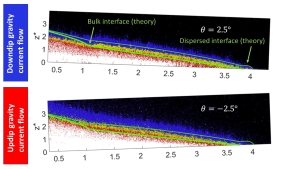
employing salt and fresh water; these experiments use optical techniques to characterize the dispersive mixing that results from porous media gravity current flow. Importantly, the gravity current is assumed to propagate over a "leaky" boundary, i.e. one containing an isolated fissure that allows drainage into an underlying (and dynamically-isolated) layer. Thus, we find that drainage and dispersion are connected: as more (relatively undiluted) fluid drains through the fissure, the remaining gravity current fluid is disproportionately comprised of fluid that has been significantly diluted through dispersive mixing. A novel metric for comparing the relative amount of dispersed fluid present is proposed. We then characterize the variation of this so-called dispersed buoyancy fraction with the gravity current density and source height, the dip angle and the fissure geometry. Thus dispersion increases sharply for down-dip flow whereas dispersion may plateau as the fissure area is increased. Select experimental data are contrasted against the predictions of a previously-published theoretical model. The implications of this comparison are then discussed e.g. in the context of model refinement.
Downloads
References
Amid, A., Mignard, D., & Wilkinson, M. (2016). Seasonal storage of hydrogen in a depleted natural gas reservoir. International Journal of Hydrogen Energy, 41(12), 5549–5558. https://doi.org/10.1016/j.ijhydene.2016.02.036
Bharath, K. S., Sahu, C. K., & Flynn, M. R. (2020). Isolated buoyant convection in a two-layered porous medium with an inclined permeability jump. Journal of Fluid Mechanics, 902, A22. https://doi.org/10.1017/jfm.2020.599
Blunt, M. J., Bazylak, A., Brook, M., Muggeridge, A., & Orr, F. M. (2024). Research needs in porous media for the energy transition. InterPore Journal, 1(1), ipj260424–2. https://doi.org/10.69631/ipj.v1i1nr14
Carden, P. O., & Paterson, L. (1979). Physical, chemical and energy aspects of underground hydrogen storage. International Journal of Hydrogen Energy, 4(6), 559–569. https://doi.org/10.1016/0360-3199(79)90083-1
Dong, W., & Selvadurai, A. P. S. (2006). Image processing technique for determining the concentration of a chemical in a fluid-saturated porous medium. Geotechnical Testing Journal, 29(5), 385–391. https://doi.org/10.1520/GTJ100024
Dullien, F. A. L. (1979). Porous media: Fluid transport and pore structure. Academic Press.
Dunn, S. (2002). Hydrogen futures: Toward a sustainable energy system. International Journal of Hydrogen Energy, 27(3), 235–264. https://doi.org/10.1016/S0360-3199(01)00131-8
Feldmann, F., Hagemann, B., Ganzer, L., & Panfilov, M. (2016). Numerical simulation of hydrodynamic and gas mixing processes in underground hydrogen storages. Environmental Earth Sciences, 75(16), 1165. https://doi.org/10.1007/s12665-016-5948-z
Hagemann, B., Panfilov, M., & Ganzer, L. (2016). Multicomponent gas rising through water with dissolution in stratified porous reservoirs–application to underground storage of h2 and CO2. Journal of Natural Gas Science and Engineering, 31, 198–213. https://doi.org/10.1016/j.jngse.2016.03.019
Happel, J., & Brenner, H. (1983). Low Reynolds number hydrodynamics. Martinus-Nijhoff Publishers. https://doi.org/10.1007/978-94-009-8352-6
Hassanpouryouzband, A., Joonaki, E., Edlmann, K., & Haszeldine, R. S. (2021). Offshore geological storage of hydrogen: Is this our best option to achieve net-zero? ACS Energy Letters, 6(6), 2181–2186. https://doi.org/10.1021/acsenergylett.1c00845
Hauck, T. E., & Arts, A. (2021). Salty stratigraphy: Salt caverns in the elk point group of alberta.
Heinemann, N., Alcalde, J., Miocic, J. M., Hangx, S. J. T., Kallmeyer, J., Ostertag-Henning, C., Hassanpouryouzband, A., Thaysen, E. M., Strobel, G. J., Schmidt-Hattenberger, C., Edlmann, K., Wilkinson, M., Bentham, M., Stuart Haszeldine, R., Carbonell, R., & Rudloff, A. (2021). Enabling large-scale hydrogen storage in porous media—The scientific challenges. Energy and Environmental Science, 14(2), 853–864. https://doi.org/10.1039/D0EE03536J
Hematpur, H., Abdollahi, R., Rostami, S., Haghighi, M., & Blunt, M. J. (2023). Review of underground hydrogen storage: Concepts and challenges. Advances in Geo-Energy Research, 7(2), 111–131. https://doi.org/10.46690/ager.2023.02.05
Hosseini, S. E., & Wahid, M. A. (2016). Hydrogen production from renewable and sustainable energy resources: Promising green energy carrier for clean development. Renewable and Sustainable Energy Reviews, 57, 850–866. https://doi.org/10.1016/j.rser.2015.12.112
Huppert, H. E., Neufeld, J. A., & Strandkvist, C. (2013). The competition between gravity and flow focusing in two-layered porous media. Journal of Fluid Mechanics, 720, 5–14. https://doi.org/10.1017/jfm.2012.623
Masoudi, M., Hassanpouryouzband, A., Hellevang, H., & Haszeldine, R. S. (2024). Lined rock caverns: A hydrogen storage solution. Journal of Energy Storage, 84, Article 110927. https://doi.org/10.1016/j.est.2024.110927
Muhammed, N. S., Haq, B., Al Shehri, D., Al-Ahmed, A., Rahman, M. M., & Zaman, E. (2022). A review on underground hydrogen storage: Insight into geological sites, influencing factors and future outlook. Energy Reports, 8, 461–499. https://doi.org/10.1016/j.egyr.2021.12.002
Muhammed, N. S., Haq, M. B., Al Shehri, D. A., Al-Ahmed, A., Rahman, M. M., Zaman, E., & Iglauer, S. (2023). Hydrogen storage in depleted gas reservoirs: A comprehensive review. Fuel, 337, Article 127032. https://doi.org/10.1016/j.fuel.2022.127032
Neufeld, J. A., Vella, D., & Huppert, H. E. (2009). The effect of a fissure on storage in a porous medium. Journal of Fluid Mechanics, 639, 239–259. https://doi.org/10.1017/S0022112009991030
Ozarslan, A. (2012). Large-scale hydrogen energy storage in salt caverns. International Journal of Hydrogen Energy, 37(19), 14265–14277. https://doi.org/10.1016/j.ijhydene.2012.07.111
Roes, M. A. (2014). Buoyancy-driven convection in a ventilated porous medium [Unpublished Master’s thesis]. University of Alberta.
Sahu, C. K., & Flynn, M. R. (2015). Filling box flows in porous media. Journal of Fluid Mechanics, 782, 455–478. https://doi.org/10.1017/jfm.2015.555
Sahu, C. K., & Neufeld, J. A. (2023). Experimental insights into gravity-driven flows and mixing in layered porous media. Journal of Fluid Mechanics, 956, A27. https://doi.org/10.1017/jfm.2022.1082
Sáinz-García, A., Abarca, E., Rubí, V., & Grandia, F. (2017). Assessment of feasible strategies for seasonal underground hydrogen storage in a saline aquifer. International Journal of Hydrogen Energy, 42(26), 16657–16666. https://doi.org/10.1016/j.ijhydene.2017.05.076
Sheikhi, S., & Flynn, M. R. (2024). Porous media gravity current flow over an interbed layer: The impact of dispersion and distributed drainage. Journal of Fluid Mechanics, 984, A33. https://doi.org/10.1017/jfm.2024.203
Sheikhi, S., Sahu, C. K., & Flynn, M. R. (2023). Dispersion effects in porous medium gravity currents experiencing local drainage. Journal of Fluid Mechanics, 975, A18. https://doi.org/10.1017/jfm.2023.805
Tarkowski, R. (2019). Underground hydrogen storage: Characteristics and prospects. Renewable and Sustainable Energy Reviews, 105, 86–94. https://doi.org/10.1016/j.rser.2019.01.051
Downloads
Additional Files
Published
Data Availability Statement
The data that support the findings of this study are available from the corresponding author upon reasonable request.
Issue
Section
License
Copyright (c) 2026 Mansimran Singh, Saeed Sheikhi, K.S. Bharath, Morris R. Flynn

This work is licensed under a Creative Commons Attribution-NonCommercial-NoDerivatives 4.0 International License.
This article is published under the Creative Commons license indicated above. See the license link for details.
Article metadata are available under the CCo license.