
Optimization of the Energy Extraction Process from Enhanced Geothermal Systems
DOI:
https://doi.org/10.69631/thzmfy53Keywords:
Enhanced geothermal systems (EGS), Hydrothermal simulation, Finite fracture, Economic optimization, Hot dry rock (HDR), Heat transfer in porous mediaAbstract
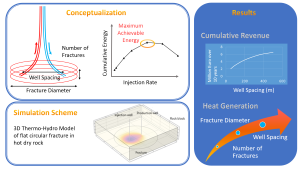
Enhanced Geothermal Systems (EGS) have emerged as a viable solution for sustainable energy extraction from hot dry rock reservoirs. In this study, numerical simulations are employed to investigate the optimization of energy extraction from enhanced geothermal systems, focusing on the effects of fracture geometry, the number of fractures, and well spacing on overall system performance and profitability. By validating the model against previously established semi-analytical and analytical models, this research explores the importance of the mentioned parameters in determining cumulative energy production and economic outcomes across different project lifespans. The results demonstrate that increased well spacing enhances energy output by delaying thermal breakthrough and increasing the optimal injection rates. Although small fractures have limited thermal capacity, the primary influence of fracture geometry is to limit the applicable distance between the wells. Deeper wells require more pumping power, which reduces net energy gain and lowers the optimal injection rate. Multiple fractures along the well enhance energy production, particularly at higher injection rates and for smaller fractures. Economic analyses underscore the importance of operational design (including the well placement and injection rate) in maximizing profitability.
Downloads
References
1. Aliyu, M. D., & Chen, H.-P. (2018). Enhanced geothermal system modelling with multiple pore media: Thermo-hydraulic coupled processes. Energy, 165, 931–948. https://doi.org/10.1016/j.energy.2018.09.129
2. Aliyu, M. D., Finkbeiner, T., Chen, H.-P., & Archer, R. A. (2023). A three-dimensional investigation of the thermoelastic effect in an enhanced geothermal system reservoir. Energy, 262, Article 125466. https://doi.org/10.1016/j.energy.2022.125466
3. Aliyu, M. D. et al. Numerical modelling of geothermal reservoirs with multiple pore media. In Proceedings of the 42nd Workshop on Geothermal Reservoir Engineering Stanford University, Stanford, CA. 2017.
4. Aljubran, M. J., & Horne, R. N. (2025). Techno-economics of geothermal power in the contiguous United States under baseload and flexible operations. Renewable and Sustainable Energy Reviews, 211, Article 115322. https://doi.org/10.1016/j.rser.2024.115322
5. Arbhabhirama, A., & Dinoy, A. A. (1973). Friction factor and Reynolds number in porous media flow. Journal of the Hydraulics Division, 99(6), 901–911. https://doi.org/10.1061/JYCEAJ.0003663
6. Bayer, P., Rybach, L., Blum, P., & Brauchler, R. (2013). Review on life cycle environmental effects of geothermal power generation. Renewable and Sustainable Energy Reviews, 26, 446–463. https://doi.org/10.1016/j.rser.2013.05.039
7. Cheng, Y., Zhang, Y., Yu, Z., Hu, Z., & Yang, Y. (2020). An investigation on hydraulic fracturing characteristics in granite geothermal reservoir. Engineering Fracture Mechanics, 237, Article 107252. https://doi.org/10.1016/j.engfracmech.2020.107252
8. Electricity price statistics. Eurostat. Retrieved July 1, 2025, https://ec.europa.eu/eurostat/statistics-explained/index.php?title=Electricity_price_statistics
9. Ghassemi, A., Tarasovs, S., & Cheng, A. H.-D. (2003). An integral equation solution for three-dimensional heat extraction from planar fracture in hot dry rock. International Journal for Numerical and Analytical Methods in Geomechanics, 27(12), 989–1004. https://doi.org/10.1002/nag.308
10. Gao, X., Li, T., Zhang, Y., Kong, X., & Meng, N. (2022). A review of simulation models of heat extraction for a geothermal reservoir in an enhanced geothermal system. Energies, 15(19), 7148. https://doi.org/10.3390/en15197148
11. Guo, T., Gong, F., Wang, X., Lin, Q., Qu, Z., & Zhang, W. (2019). Performance of enhanced geothermal system (EGS) in fractured geothermal reservoirs with CO2 as working fluid. Applied Thermal Engineering, 152, 215–230. https://doi.org/10.1016/j.applthermaleng.2019.02.024
12. He, R., Rong, G., Tan, J., Phoon, K.-K., & Quan, J. (2022). Numerical evaluation of heat extraction performance in enhanced geothermal system considering rough-walled fractures. Renewable Energy, 188, 524–544. https://doi.org/10.1016/j.renene.2022.02.067
13. Johnston, I. W., Narsilio, G. A., & Colls, S. (2011). Emerging geothermal energy technologies. KSCE Journal of Civil Engineering, 15(4), 643–653. https://doi.org/10.1007/s12205-011-0005-7
14. Keçebaş, A. (2011). Performance and thermo-economic assessments of geothermal district heating system: A case study in Afyon, Turkey. Renewable Energy, 36(1), 77–83. https://doi.org/10.1016/j.renene.2010.05.022
15. Kong, Y., Pang, Z., Shao, H., & Kolditz, O. (2017). Optimization of well-doublet placement in geothermal reservoirs using numerical simulation and economic analysis. Environmental Earth Sciences, 76(3), 1–7. https://doi.org/10.1007/s12665-017-6404-4
16. Li, H., Lu, Y., Peng, X., Lv, X., & Wang, L. (2016). Pressure drop calculation models of wellbore fluid in perforated completion horizontal wells. International Journal of Heat and Technology, 34(1), 65–72. https://doi.org/10.18280/ijht.340110
17. Li, K., Bian, H., Liu, C., Zhang, D., & Yang, Y. (2015). Comparison of geothermal with solar and wind power generation systems. Renewable and Sustainable Energy Reviews, 42, 1464–1474. https://doi.org/10.1016/j.rser.2014.10.049
18. Liu, G., Yuan, Z., Zhou, C., Fu, Z., Rao, Z., & Liao, S. (2023). Heat extraction of enhanced geothermal system: Impacts of fracture topological complexities. Applied Thermal Engineering, 219, Article 119236. https://doi.org/10.1016/j.applthermaleng.2022.119236
19. Liu, X., Falcone, G., & Alimonti, C. (2018). A systematic study of harnessing low-temperature geothermal energy from oil and gas reservoirs. Energy, 142, 346–355. https://doi.org/10.1016/j.energy.2017.10.058
20. Liu, Z., Wu, M., Zhou, H., Chen, L., & Wang, X. (2024). Performance evaluation of enhanced geothermal systems with intermittent thermal extraction for sustainable energy production. Journal of Cleaner Production, 434, Article 139954. https://doi.org/10.1016/j.jclepro.2023.139954
21. Lu, S.-M. (2018). A global review of enhanced geothermal system (EGS). Renewable and Sustainable Energy Reviews, 81, 2902–2921. https://doi.org/10.1016/j.rser.2017.06.097
22. Mahmoodpour, S., Singh, M., Bär, K., & Sass, I. (2022b). Thermo-hydro-mechanical modeling of an enhanced geothermal system in a fractured reservoir using carbon dioxide as heat transmission fluid-A sensitivity investigation. Energy, 254, Article 124266. https://doi.org/10.1016/j.energy.2022.124266
23. Mahmoodpour, S., Singh, M., Turan, A., Bär, K., & Sass, I. (2022a). Simulations and global sensitivity analysis of the thermo-hydraulic-mechanical processes in a fractured geothermal reservoir. Energy, 247, Article 123511. https://doi.org/10.1016/j.energy.2022.123511
24. Pandey, S. N., & Vishal, V. (2017). Sensitivity analysis of coupled processes and parameters on the performance of enhanced geothermal systems. Scientific Reports, 7(1), Article 17057. https://doi.org/10.1038/s41598-017-14273-4
25. Sajjadi, M., Javadi, M. H., Ashoorzadeh, Z., & Emami Niri, M. (2022). Economic optimization of enhanced geothermal systems using a fully analytical temperature profile. Energy Sources, Part B, 17(1), Article 2101713. https://doi.org/10.1080/15567249.2022.2101713
26. Sanyal, S. K. (2000). Review of the state-of-the-art of numerical simulation of enhanced geothermal systems. Geothermal Resources Council Transactions, 24, 181–186.
27. Sanyal, S. K., & Butler, S. J. (2005). An analysis of power generation prospects from enhanced geothermal systems. Geothermal Resources Council Transactions, 29, 131–138.
28. Xue, Z., Ma, H., Wei, Y., Wu, W., Sun, Z., Chai, M., Zhang, C., & Chen, Z. (2024). Integrated technological and economic feasibility comparisons of enhanced geothermal systems associated with carbon storage. Applied Energy, 359, Article 122757. https://doi.org/10.1016/j.apenergy.2024.122757
29. Zheng, J., Li, P., Dou, B., Fan, T., Tian, H., & Lai, X. (2022). Impact research of well layout schemes and fracture parameters on heat production performance of enhanced geothermal system considering water cooling effect. Energy, 255, Article 124496. https://doi.org/10.1016/j.energy.2022.124496
30. Zhou, D., Tatomir, A., Niemi, A., Tsang, C.-F., & Sauter, M. (2022). Study on the influence of randomly distributed fracture aperture in a fracture network on heat production from an enhanced geothermal system (EGS). Energy, 250, Article 123781. https://doi.org/10.1016/j.energy.2022.123781
Downloads
Published
Issue
Section
License
Copyright (c) 2026 Mohammad Norouzi Delaviz, Mozhdeh Sajjadi, Mohammad Emami Niri

This work is licensed under a Creative Commons Attribution-NonCommercial-NoDerivatives 4.0 International License.
This article is published under the Creative Commons license indicated above. See the license link for details.
Article metadata are available under the CCo license.