
MAGNET: Medial Axis Guided Network Extraction Tool
DOI:
https://doi.org/10.69631/g47x8w91Keywords:
Network extraction, Pore network modelling, Image processing, Permeability, Porous mediaAbstract
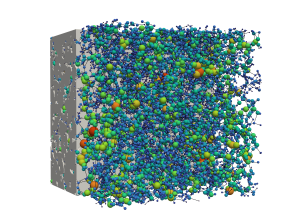
Pore network models are useful for studying transport in porous materials in a computationally efficient way. Extraction of networks from volumetric images has evolved over the years, starting with medial axis-based approaches to more recent watershed segmentation. This paper reconsiders the classic medial axis method, which offers several advantages such as speed and topological correctness, and develops a modernized, updated, and improved version. The new method is named Medial Axis Guided Network Extraction Tool (MAGNET). It works by analyzing the skeleton of a porous material to identify pore centers at junctions and endpoints. Additional pore bodies are found on long throats using two different approaches. This work includes an efficient tool for calculating the cross-sectional area of throats with irregular shape by using walkers with an infinite mean-free path to probe the geometry orthogonal to the medial axis at the point of the throat constriction. This extra step was critical for obtaining an equivalent diameter needed to calculate the permeability. Lastly, MAGNET was written with computational efficiency in mind. The skeletonization approach was itself 4.2X faster than the SNOW watershed segmentation for a 10003 image. Additionally, a parallelized skeletonization was applied by processing the image in blocks with sufficient overlap which resulted in a 5.5X speed-up compared to the serial approach. To validate the output, MAGNET was tested on a 4003 voxel image of a Berea sandstone, and the flow and capillary properties of the extracted network were compared to the results from SNOW and the lattice-Boltzmann method. Structural information such as pore and throat size distribution and mercury intrusion curves was compared, and noticeable similarity was achieved. Crucially, the permeability predicted by MAGNET was within 5% of the lattice-Boltzmann prediction on the same image.
Downloads
References
1. Akbari, M., Sinton, D., & Bahrami, M. (2011). Viscous flow in variable cross-section microchannels of arbitrary shapes. International Journal of Heat and Mass Transfer, 54(17–18), 3970–3978. https://doi.org/10.1016/j.ijheatmasstransfer.2011.04.028
2. Al-Raoush, R. I., & Willson, C. S. (2005). Extraction of physically realistic pore network properties from three-dimensional synchrotron X-ray microtomography images of unconsolidated porous media systems. Journal of Hydrology, 300(1–4), 44–64. https://doi.org/10.1016/j.jhydrol.2004.05.005
3. Al-Raoush, R., Thompson, K., & Willson, C. S. (2003). Comparison of network generation techniques for unconsolidated porous media. Soil Science Society of America Journal, 67(6), 1687–1700. https://doi.org/10.2136/sssaj2003.1687
4. Bakke, S., & Øren, P.-E. (1997). 3-D pore-scale modelling of sandstones and flow simulations in the pore networks. SPE Journal, 2(02), 136–149. https://doi.org/10.2118/35479-PA
5. Delgado-Friedrichs, O., Robins, V., & Sheppard, A. (2015). Skeletonization and partitioning of digital images using discrete morse theory. IEEE Transactions on Pattern Analysis and Machine Intelligence, 37(3), 654–666. https://doi.org/10.1109/TPAMI.2014.2346172
6. Dong, H., & Blunt, M. J. (2009). Pore-network extraction from micro-computerized-tomography images. Physical Review E, 80(3), 036307. https://doi.org/10.1103/PhysRevE.80.036307
7. Gostick, J., Khan, Z., Tranter, T., Kok, M., Agnaou, M., Sadeghi, M., & Jervis, R. (2019). PoreSpy: A python toolkit for quantitative analysis of porous media images. Journal of Open Source Software, 4(37), 1296. https://doi.org/10.21105/joss.01296
8. Gostick, J. T. (2017). Versatile and efficient pore network extraction method using marker-based watershed segmentation. Physical Review E, 96(2), 023307. https://doi.org/10.1103/PhysRevE.96.023307
9. Homann, H. (2007). Implementation of a 3D thinning algorithm. The Insight Journal. https://doi.org/10.54294/xjdr5f
10. Jiang, Z., Van Dijke, M. I. J., Sorbie, K. S., & Couples, G. D. (2013). Representation of multiscale heterogeneity via multiscale pore networks: Representation of Multiscale Heterogeneity. Water Resources Research, 49(9), 5437–5449. https://doi.org/10.1002/wrcr.20304
11. Jiang, Z., Wu, K., Couples, G., Van Dijke, M. I. J., Sorbie, K. S., & Ma, J. (2007). Efficient extraction of networks from three‐dimensional porous media. Water Resources Research, 43(12), 2006WR005780. https://doi.org/10.1029/2006WR005780
12. Khan, Z. A., Elkamel, A., & Gostick, J. T. (2020). Efficient extraction of pore networks from massive tomograms via geometric domain decomposition. Advances in Water Resources, 145, 103734. https://doi.org/10.1016/j.advwatres.2020.103734
13. Khan, Z. A., & Gostick, J. T. (2024). Enhancing pore network extraction performance via seed-based pore region growing segmentation. Advances in Water Resources, 183, 104591. https://doi.org/10.1016/j.advwatres.2023.104591
14. Lee, T. C., Kashyap, R. L., & Chu, C. N. (1994). Building skeleton models via 3-D medial surface axis thinning algorithms. CVGIP: Graphical Models and Image Processing, 56(6), 462–478. https://doi.org/10.1006/cgip.1994.1042
15. Liang, Z., Ioannidis, M. A., & Chatzis, I. (2000). Geometric and topological analysis of three-dimensional porous media: Pore space partitioning based on morphological skeletonization. Journal of Colloid and Interface Science, 221(1), 13–24. https://doi.org/10.1006/jcis.1999.6559
16. Lindquist, W.B. 1999. 3DMA General Users Manual. SUNY-Stony Brook technical report SUNYSB-AMS-99-20. Stony Brook, N.Y
17. Lindquist, W. B., Lee, S., Coker, D. A., Jones, K. W., & Spanne, P. (1996). Medial axis analysis of void structure in three‐dimensional tomographic images of porous media. Journal of Geophysical Research: Solid Earth, 101(B4), 8297–8310. https://doi.org/10.1029/95JB03039
18. Lindquist, W. B., & Venkatarangan, A. (1999). Investigating 3D geometry of porous media from high resolution images. Physics and Chemistry of the Earth, Part A: Solid Earth and Geodesy, 24(7), 593–599. https://doi.org/10.1016/S1464-1895(99)00085-X
19. Lindquist, W. B., Venkatarangan, A., Dunsmuir, J., & Wong, T. (2000). Pore and throat size distributions measured from synchrotron X‐ray tomographic images of Fontainebleau sandstones. Journal of Geophysical Research: Solid Earth, 105(B9), 21509–21527. https://doi.org/10.1029/2000JB900208
20. Ma, C. M., & Sonka, M. (1996). A fully parallel 3D thinning algorithm and its applications. Computer Vision and Image Understanding, 64(3), 420–433. https://doi.org/10.1006/cviu.1996.0069
21. Misaghian, N., Sadeghi, M. A., Lee, K. M., Roberts, E. P. L., & Gostick, J. T. (2023). Utilizing pore network modeling for performance analysis of multi-layer electrodes in vanadium redox flow batteries. Journal of The Electrochemical Society, 170(7), 070520. https://doi.org/10.1149/1945-7111/ace554
22. Morigi, M. P., & Albertin, F. (2022). X-ray digital radiography and computed tomography. Journal of Imaging, 8(5), 119. https://doi.org/10.3390/jimaging8050119
23. Niblack, C. W., Capson, D. W., & Gibbons, P. B. (1990). Generating skeletons and centerlines from the medial axis transform. (1990) Proceedings. 10th International Conference on Pattern Recognition, I, 881–885. https://doi.org/10.1109/ICPR.1990.118234
24. Palàgyi, K., & Kuba, A. (1998). A 3D 6-subiteration thinning algorithm for extracting medial lines. Pattern Recognition Letters, 19(7), 613–627. https://doi.org/10.1016/S0167-8655(98)00031-2
25. Prodanović, M., Lindquist, W. B., & Seright, R. S. (2006). Porous structure and fluid partitioning in polyethylene cores from 3D X-ray microtomographic imaging. Journal of Colloid and Interface Science, 298(1), 282–297. https://doi.org/10.1016/j.jcis.2005.11.053
26. Rabbani, A., & Babaei, M. (2019). Hybrid pore-network and lattice-Boltzmann permeability modelling accelerated by machine learning. Advances in Water Resources, 126, 116–128. https://doi.org/10.1016/j.advwatres.2019.02.012
27. Rabbani, A., Jamshidi, S., & Salehi, S. (2014). An automated simple algorithm for realistic pore network extraction from micro-tomography images. Journal of Petroleum Science and Engineering, 123, 164–171. https://doi.org/10.1016/j.petrol.2014.08.020
28. Schlüter, S., Sheppard, A., Brown, K., & Wildenschild, D. (2014). Image processing of multiphase images obtained via X‐ray microtomography: A review. Water Resources Research, 50(4), 3615–3639. https://doi.org/10.1002/2014WR015256
29. Sheppard, A., Sok, R., Averdunk, H., Robins, V., & Ghous, A. (2006). Analysis of Rock Microstructure using High-resolution X-ray Tomography. In C. P. C. (Ed.), Symposium Trondheim 2006 Proceedings (Peer Reviewed ed., pp. 1-12). Article SCA2006-26 Society of Core Analysts. https://www.researchgate.net/publication/267551268_Analysis_of_rock_microstructure_using_high-resolution_X-ray_tomography
30. Shin, H., Lindquist, W. B., Sahagian, D. L., & Song, S.-R. (2005). Analysis of the vesicular structure of basalts. Computers & Geosciences, 31(4), 473–487. https://doi.org/10.1016/j.cageo.2004.10.013
31. Silin, D., & Patzek, T. (2006). Pore space morphology analysis using maximal inscribed spheres. Physica A: Statistical Mechanics and Its Applications, 371(2), 336–360. https://doi.org/10.1016/j.physa.2006.04.048
32. Silversmith, W., & Hilei, P. (2024). Seung-lab/euclidean-distance-transform-3D: Zenodo release (Version 2.4.0) (Computer software). Zenodo. https://doi.org/10.5281/zenodo.10815871
33. Takahashi, M. , Ahn, C. , and M. Kato. Hydraulic Stress Effect on 3 Dimensional Pore Network and Permeability Change. Paper presented at the 12th ISRM Congress, Beijing, China, October 2011. ISRM-12CONGRESS-2011-248. https://onepetro.org/isrmcongress/proceedings-abstract/CONGRESS12/CONGRESS12/ISRM-12CONGRESS-2011-248/100339
34. Thompson, K. E., Willson, C. S., White, C. D., Nyman, S., Bhattacharya, J. P., & Reed, A. H. (2008). Application of a new grain-based reconstruction algorithm to microtomography images for quantitative characterization and flow modeling. SPE Journal, 13(02), 164–176. https://doi.org/10.2118/95887-PA
35. Thovert, J. F., Salles, J., & Adler, P. M. (1993). Computerized characterization of the geometry of real porous media: Their discretization, analysis and interpretation. Journal of Microscopy, 170(1), 65–79. https://doi.org/10.1111/j.1365-2818.1993.tb03324.x
36. Tranter, T. G., Kok, M. D. R., Lam, M., & Gostick, J. T. (2019). Pytrax: A simple and efficient random walk implementation for calculating the directional tortuosity of images. SoftwareX, 10, 100277. https://doi.org/10.1016/j.softx.2019.100277
37. Xiong, Q., Baychev, T. G., & Jivkov, A. P. (2016). Review of pore network modelling of porous media: Experimental characterisations, network constructions and applications to reactive transport. Journal of Contaminant Hydrology, 192, 101–117. https://doi.org/10.1016/j.jconhyd.2016.07.002
38. Yi, Z., Lin, M., Jiang, W., Zhang, Z., Li, H., & Gao, J. (2017). Pore network extraction from pore space images of various porous media systems. Water Resources Research, 53(4), 3424–3445. https://doi.org/10.1002/2016WR019272
39. Zhang, T. Y., & Suen, C. Y. (1984). A fast parallel algorithm for thinning digital patterns. Communications of the ACM, 27(3), 236–239. https://doi.org/10.1145/357994.358023
Downloads
Published
Data Availability Statement
The network extraction tool MAGNET has been added to the open-source PoreSpy library and is available at https://github.com/PMEAL/porespy.
Issue
Section
License
Copyright (c) 2025 Michael McKague, Hamed Fathiannasab, Mohammad Amin Sadeghi, Jeff Gostick

This work is licensed under a Creative Commons Attribution-NonCommercial-NoDerivatives 4.0 International License.
This article is published under the Creative Commons license indicated above. See the license link for details.
Article metadata are available under the CCo license.