
Design of a Laboratory Setup to Determine the Dispersion Parameter in a Single-Well Chemical Tracer Test
DOI:
https://doi.org/10.69631/dev9c518Keywords:
Single well chemical tracer test (SWCTT), Oil Saturation, Hydrodynamic Dispersion Coefficient, Partitioning Coefficient, Chromatographic, UTCHEMAbstract
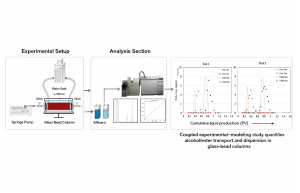
The Single Well Chemical Tracer Test (SWCTT) is a precise in-situ method for estimating residual oil saturation (Sor) based on the chromatographic delay between a partitioning tracer (ester) and its hydrolyzed product (alcohol). In this study, laboratory flooding experiments were designed and conducted in a glass-bead packed system at a constant temperature of 149°F to determine the dispersion and kinetic parameters of Ethyl Acetate (EtAc). The experiments were performed under two salinity conditions (5,000 ppm and 50,000 ppm) and simulated using a 1D model in the UTCHEM simulator with a 1 mm cell size. The results demonstrated that salinity significantly influences reaction kinetics and transport properties. Increasing salinity from 5,000 to 50,000 ppm resulted in an increase in the partition coefficient (KD) from 3 to 5.1 and the hydrolysis rate (KH) from 0.1 to 0.5/day. Furthermore, the hydrodynamic dispersion coefficient was determined through matching to be 0.003 ft2/day for the test conducted at a salinity of 5000 ppm and 0.01 ft2/day for the test conducted at a salinity of 50,000 ppm, resulting in accurate agreement between the simulated and experimental data. The Sor values of 0.2414 and 0.2303 obtained from the combined analysis of the model and experimental data showed excellent agreement with the reference value determined by material balance. This consistency serves as robust validation of the laboratory setup and confirms that the developed methodology reliably quantifies both Sor and hydrodynamic dispersion. Crucially, these findings establish a solid foundation for upscaling the methodology to pilot tests and reservoir-scale applications.
Downloads
References
1. AlAbbad, M. A., Sanni, M. L., Kokal, S., Krivokapic, A., Dye, C., Dugstad, Ø., Hartvig, S. K., & Huseby, O. K. (2018). A step change for single-well chemical-tracer tests: Field pilot testing of new sets of novel tracers. SPE Reservoir Evaluation and Engineering, 22(1), 253–265. https://doi.org/10.2118/181408-pa
2. Al-Shalabi, E. W., Luo, H., Delshad, M., & Sepehrnoori, K. (2017). Single-well chemical-tracer modeling of low-salinity-water injection in carbonates. SPE Reservoir Evaluation and Engineering, 20(1), 118–133. https://doi.org/10.2118/173994-PA
3. Deans, H. (1971). Method of determining fluid saturations in reservoirs.
4. Deans, H. A., & Carlisle, C. T. (1986). Single-well tracer test in complex pore systems. SPE Enhanced Oil Recovery Symposium, SPE-14886-MS. https://doi.org/10.2118/14886-MS
5. Huseby, O., Galdiga, C., Hartvig, S., Zarruk, G., & Dugstad, Ø. (2019). A new generation of single well chemical tracer tests–tracers and methodologies. In IOR 2019–20th European symposium on improved oil recovery (pp. 1–10). European Association of Geoscientists & Engineers. https://doi.org/10.3997/2214-4609.201900064
6. Khaledialidusti, R., Kleppe, J., & Skrettingland, K. (2015). Numerical interpretation of single well chemical tracer (SWCT) tests to determine residual oil saturation in snorre reservoir. SPE Europec featured at EAGE Conference and Exhibition. https://doi.org/10.2118/174378-MS
7. Koryakin, F. A., Tretyakov, N. Y., Vershinin, V. E., & Ponomarev, R. Y. (2021). Evaluation of residual oil saturation with use of single well chemical tracer test (SWCT) for estimation of EOR efficiency. From theory to experiment. https://doi.org/10.2118/206421-MS
8. Mechergui, A., Agenet, N., Romero, C., Nguyen, M., & Batias, J. (2013). Design, operation, and laboratory work for single-well tracer test campaign in Handil Field Indonesia. SPE Asia and the Pacific Enhanced Oil Recovery Conference. https://doi.org/10.2118/165227-MS
9. Murphy, R. P., Foster, G. T., & Owens, W. W. (1977). Evaluation of waterflood residual oil saturations using log-inject-log procedures. Journal of Petroleum Technology, 29(2), 178–186. https://doi.org/10.2118/5804-PA
10. Ogbeiwi, P., Aladeitan, Y., & Udebhulu, D. (2018). An approach to waterflood optimization: Case study of the reservoir X. Journal of Petroleum Exploration and Production Technology, 8(1), 271–289. https://doi.org/10.1007/s13202-017-0368-5
11. Patidar, A. K., Joshi, D., Dristant, U., & Choudhury, T. (2022). A review of tracer testing techniques in porous media specially attributed to the oil and gas industry. Journal of Petroleum Exploration and Production Technology, 12(12), 3339–3356. https://doi.org/10.1007/s13202-022-01526-w
12. Sheely, C. Q. (1978). Description of field tests to determine residual oil saturation by single-well tracer method. Journal of Petroleum Technology, 30(2), 194–202. https://doi.org/10.2118/5840-PA
13. Sheng, J. J. (2010). Modern chemical enhanced oil recovery: Theory and practice. Gulf Professional Publishing.
14. Tomich, J. F., Dalton, Jr., R. L., Deans, H. A., & Shallenberger, L. K. (1973). Single-well tracer method to measure residual oil saturation. Journal of Petroleum Technology, 25(2), 211–218. https://doi.org/10.2118/3792-PA
Downloads
Additional Files
Published
Data Availability Statement
The data can be provided upon request.
Issue
Section
License
Copyright (c) 2026 Mostafa Ramezani, Rohaldin Miri

This work is licensed under a Creative Commons Attribution-NonCommercial-NoDerivatives 4.0 International License.
This article is published under the Creative Commons license indicated above. See the license link for details.
Article metadata are available under the CCo license.