
Heat-activated epoxy foam for permeability alteration in fractured geothermal fields: proof of concept
DOI:
https://doi.org/10.69631/3mjx5y19Keywords:
Geothermal energy, Epoxy foam, Permeability reductionAbstract
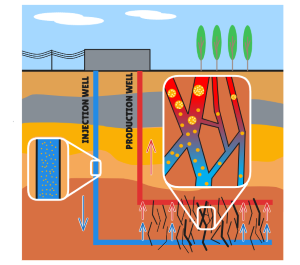
Geothermal energy plays a growing role in the transition to renewable and carbon free energy sources. A challenge for many geothermal operations is how to enhance water-rock heat exchange, either by creation of new fractures in a tight rock or by blocking short-circuiting large conduits. Here we report a novel approach for blocking large aperture (cm scale) fractures using heat-activated epoxy resin foam. The foam is injected as discrete inert resin droplets that are transported to regions of the geothermal field and activated upon reaching sufficiently high temperatures, where they undergo foaming and curing, thereby locally reducing permeability. In contrast to alternative methods for reducing rock permeability such as silicate gels or heat responsive polymer microbeads that target fractures of small apertures (< 0.1 mm), the epoxy foam can reduce permeability of fractures with large apertures (∼ 10 mm) while attaining mechanical strength and thermal stability. Results from laboratory aluminum-glass fracture models provide insights by visualizing the transport phase of resin droplets and their subsequent temperature-induced foaming and curing transformations with associated flow pathway blocking. Modeling results for transport and foaming in a simple fracture considering rheological properties and foaming (volume expansion) behavior are compared with measurements of permeability changes. Challenges associated with upscaling to fracture networks and large transport distances of resin droplets are discussed.
Downloads
References
1. Bisdom, K., Bertotti, G., & Nick, H. M. (2016). The impact of in-situ stress and outcrop-based fracture geometry on hydraulic aperture and upscaled permeability in fractured reservoirs. Tectonophysics, 690, 63–75. https://doi.org/10.1016/j.tecto.2016.04.006
2. Cui, Y., Zhang, Y., Jia, P., Wang, Y., Huang, J., Cui, J., & Lai, W. T. (2018). Three-dimensional particle tracking velocimetry algorithm based on tetrahedron vote. Experiments in Fluids, 59(2), 31. https://doi.org/10.1007/s00348-017-2485-9
3. D’Eusanio, V., Rombolà, A. G., Coralli, I., Fabbri, D., Tassi, L., & Marchetti, A. (2025). Thermal degradation pathways in multi-component epoxy composites. Journal of Analytical and Applied Pyrolysis, 189, Article 107107. https://doi.org/10.1016/j.jaap.2025.107107
4. Fame, C. M., Ueda, T., Ntjam Minkeng, M. A., & Wu, C. (2024). Durability of epoxy and vinyl ester polymers in wet, seawater, and seawater sea sand concrete environments: Molecular dynamics simulations. Construction and Building Materials, 451, Article 138645. https://doi.org/10.1016/j.conbuildmat.2024.138645
5. Fu, P., Hao, Y., Walsh, S. D. C., & Carrigan, C. R. (2016). Thermal drawdown-induced flow channeling in fractured geothermal reservoirs. Rock Mechanics and Rock Engineering, 49(3), 1001–1024. https://doi.org/10.1007/s00603-015-0776-0
6. Gee, B., Gracie, R., & Dusseault, M. B. (2021). Multiscale short-circuiting mechanisms in multiple fracture enhanced geothermal systems. Geothermics, 94, Article 102094. https://doi.org/10.1016/j.geothermics.2021.102094
7. Gu, Y., Kojima, H., & Miki, N. (2011). Theoretical analysis of 3d emulsion droplet generation by a device using coaxial glass tubes. Sensors and Actuators A, 169(2), 326–332. https://doi.org/10.1016/j.sna.2011.02.043
8. Guo, B., Fu, P., Hao, Y., Peters, C. A., & Carrigan, C. R. (2016). Thermal drawdown-induced flow channeling in a single fracture in egs. Geothermics, 61, 46–62. https://doi.org/10.1016/j.geothermics.2016.01.004
9. Gupta, A., Murshed, S. M. S., & Kumar, R. (2009). Droplet formation and stability of flows in a microfluidic T-junction. Applied Physics Letters, 94(16). https://doi.org/10.1063/1.3116089
10. Gussenov, I., Nuraje, N., & Kudaibergenov, S. (2019). Bulk gels for permeability reduction in fractured and matrix reservoirs. Energy Reports, 5, 733–746. https://doi.org/10.1016/j.egyr.2019.06.012
11. Hesabi, M., Salimi, A., & Beheshty, M. H. (2017). Effect of tertiary amine accelerators with different substituents on curing kinetics and reactivity of epoxy/dicyandiamide system. Polymer Testing, 59, 344–354. https://doi.org/10.1016/j.polymertesting.2017.02.023
12. Horne, R., Genter, A., McClure, M., Ellsworth, W., Norbeck, J., & Schill, E. (2025). Enhanced geothermal systems for clean firm energy generation. Nature Reviews Clean Technology, 1(2), 148–160. https://doi.org/10.1038/s44359-024-00019-9
13. Huenges, E. (2025). Enhanced geothermal systems: Review and status of research and development. In Geothermal power generation (pp. 451–473). Elsevier. https://doi.org/10.1016/B978-0-443-24750-7.00012-9
14. Hughes, R. G., & Blunt, M. J. (2001). Network modeling of multiphase flow in fractures. Advances in Water Resources, 24(3–4), 409–421. https://doi.org/10.1016/S0309-1708(00)00064-6
15. Khodayar, M., & Björnsson, S. (2024). Conventional geothermal systems and unconventional geothermal developments: An overview. Open Journal of Geology, 14(2), 196–246. https://doi.org/10.4236/ojg.2024.142012
16. Krishna, R., Méheust, Y., & Neuweiler, I. (2025). A two-dimensional depth-integrated model for immiscible two-phase flow in open rough fractures. Journal of Fluid Mechanics, 1011, A43. https://doi.org/10.1017/jfm.2025.404
17. Leveille, G. (2024). Hydraulically fractured horizontal wells: A technology poised to deliver another energy-related breakthrough of enormous scale. Journal of Petroleum Technology, 76(2), 12–15. https://doi.org/10.2118/0224-0012-JPT
18. Ma, Q., Lei, J., He, J., Chen, Z., & Li, W. (2024). Epoxy resin for solidification/stabilization of soil contaminated with copper (ii): Leaching, mechanical, and microstructural characterization. Environmental Research, 240(1), Article 117512. https://doi.org/10.1016/j.envres.2023.117512
19. Maddinelli, G., Bartosek, M., Carminati, S., Moghadasi, L., Manfredini, N., & Moscatelli, D. (2020). Design of thermoresponsive polymers to selective permeability reduction in porous media. In Abu Dhabi International Petroleum Exhibition and Conference, page D011S016R001. https://doi.org/10.2118/203492-MS
20. McLean, M. L., & Espinoza, D. N. (2023). Thermal destressing: Implications for short-circuiting in enhanced geothermal systems. Renewable Energy, 202, 736–755. https://doi.org/10.1016/j.renene.2022.11.102
21. Mebane, D. S., Kress, J. D., Storlie, C. B., Fauth, D. J., Gray, M.M. L., & Li, K. (2013). Transport, zwitterions, and the role of water for CO2 adsorption in mesoporous silica-supported amine sorbents. The Journal of Physical Chemistry C, 117(50), 26617–26627. https://doi.org/10.1021/jp4076417
22. Nastasović, A. B., Ekmeščić, B. M., Sandić, Z. P., Ranđelović, D. V., Mozetič, M., Vesel, A., & Onjia, A. E. [CD]. (2016). Mechanism of Cu(II), Cd(II) and Pb(II) ions sorption from aqueous solutions by macroporous poly(glycidyl methacrylate-co-ethylene glycol dimethacrylate). Applied Surface Science, 385, 605–615. https://doi.org/10.1016/j.apsusc.2016.05.165
23. Norbeck, J. H., & Latimer, T. (2023). Commercial-scale demonstration of a first-of-a-kind enhanced geothermal system.
24. Pandey, S. N., Vishal, V., & Chaudhuri, A. (2018). Geothermal reservoir modeling in a coupled thermo-hydro-mechanical-chemical approach: A review. Earth-Science Reviews, 185, 1157–1169. https://doi.org/10.1016/j.earscirev.2018.09.004
25. Parker, R. (1999). The rosemanowes hdr project 1983–1991. Geothermics, 28(4–5), 603–615. https://doi.org/10.1016/S0375-6505(99)00031-0
26. Pollack, A., & Mukerji, T. (2019). Accounting for subsurface uncertainty in enhanced geothermal systems to make more robust techno-economic decisions. Applied Energy, 254, Article 113666. https://doi.org/10.1016/j.apenergy.2019.113666
27. Rahimi, M., Shams Khorrami, A. S., & Rezai, P. (2019). Effect of device geometry on droplet size in co-axial flow-focusing microfluidic droplet generation devices. Colloids and Surfaces A, 570, 510–517. https://doi.org/10.1016/j.colsurfa.2019.03.067
28. Rangel-Jurado, N., Hawkins, A. J., & Fulton, P. M. (2023). Influence of extreme fracture flow channels on the thermal performance of open-loop geothermal systems at commercial scale. Geothermal Energy, 11(1), 19. https://doi.org/10.1186/s40517-023-00261-7
29. Ren, Q., Xu, H., Yu, Q., & Zhu, S. (2015). Development of epoxy foaming with CO2 as latent blowing agent and principle in selection of amine curing agent. Industrial and Engineering Chemistry Research, 54(44), 11056–11064. https://doi.org/10.1021/acs.iecr.5b03069
30. Said, R. B., Kolle, J. M., Essalah, K., Tangour, B., & Sayari, A. (2020). A unified approach to CO2-amine reaction mechanisms. ACS Omega, 5(40), 26125–26133. https://doi.org/10.1021/acsomega.0c03727
31. Sharmin, T., Khan, N. R., Akram, M. S., & Ehsan, M. M. (2023). A state-of-the-art review on geothermal energy extraction, utilization, and improvement strategies: Conventional, hybridized, and enhanced geothermal systems. International Journal of Thermofluids, 18, Article 100323. https://doi.org/10.1016/j.ijft.2023.100323
32. Zimmerman, R. W., & Bodvarsson, G. S. (1996). Hydraulic conductivity of rock fractures. Transport in Porous Media, 23(1), 1–30. https://doi.org/10.1007/BF00145263
Downloads
Additional Files
Published
Versions
- 2026-05-15 (2)
- 2026-03-10 (1)
Issue
Section
License
Copyright (c) 2026 Dani Or, Rishi Parashar, Ying Yang, Manish Bishwokarma, Satish Karra, Yutong Cui

This work is licensed under a Creative Commons Attribution-NonCommercial-NoDerivatives 4.0 International License.
This article is published under the Creative Commons license indicated above. See the license link for details.
Article metadata are available under the CCo license.