
Unraveling salt precipitation mechanisms in geological CO2 storage: Insights into dominant driving forces
DOI:
https://doi.org/10.69631/zhna7r09Keywords:
Geological CO2 Storage, Salt precipitation, Injectivity impairment, Capillary number, Reservoir heterogeneityAbstract
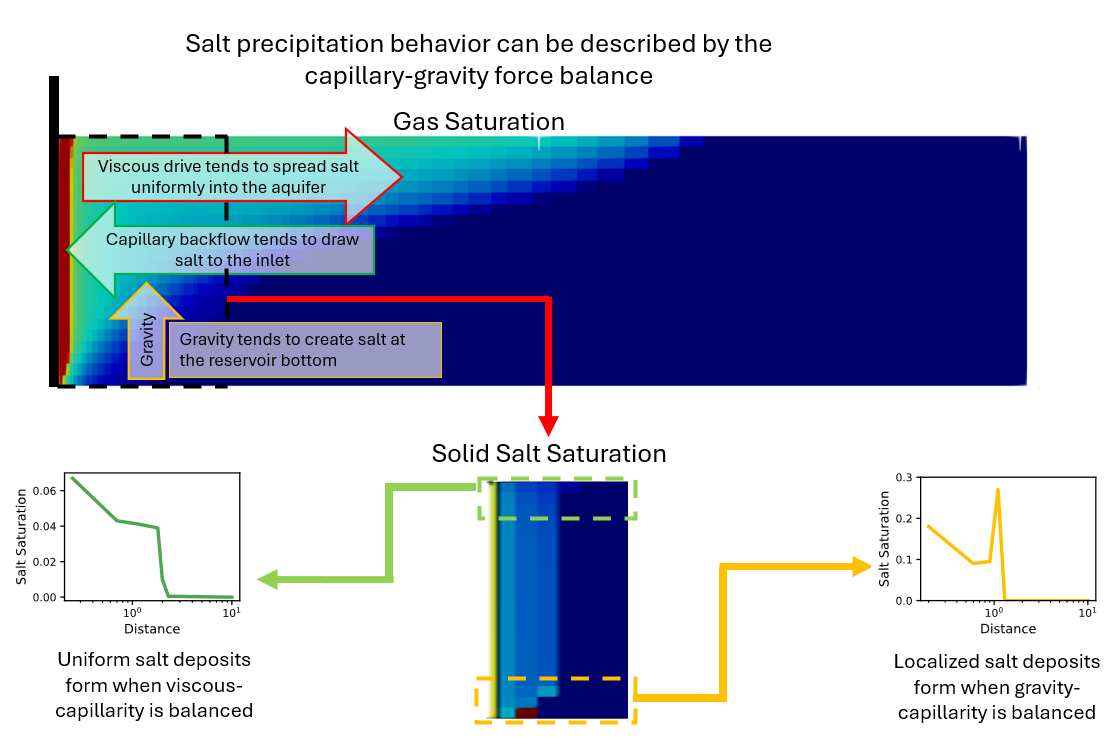
Salt precipitation during geological CO2 storage (GCS) in saline aquifers can impair the injectivity of large-scale projects. Laboratory studies indicate that this process is sensitive to capillary force, but scaling-up to field conditions is complex due to radial flow, gravity, and geological heterogeneity. This study utilizes 3D simulations to characterize salt precipitation mechanisms in realistic storage formations. Non-dimensional groups, e.g., capillary number (Ca) and gravity number (Gr), are used to characterize the relative impact of capillary, viscous, and gravity forces on salt formation. Three distinct regimes emerge for homogeneous systems: 1) capillary-dominated regime for Ca < 1 with severe salt precipitation at the inlet; 2) viscous-dominated regime for Ca > 1 and Gr < 0.2 with low-to-moderate salt precipitation; and 3) gravity-dominated regime for Ca > 1 and Gr > 0.2 where gravity override leads to localization of salt deposits inside the reservoir. The Ca-Gr regimes generally hold for heterogeneous systems. Additional complexity includes increased salt precipitation in high-permeability zones due to lower Ca enhanced by capillary-induced imbibition of saline water from low-permeability zones. Tortuous flow paths can also emerge, further exacerbating pressure build-up. These novel characterizations can assist practitioners in designing mitigation strategies for injectivity impairment in large-scale operations.
Downloads
References
1. Akindipe, D., Saraji, S., & Piri, M. (2021). Salt precipitation during geological sequestration of supercritical CO2 in saline aquifers: A pore-scale experimental investigation. Advances in Water Resources, 155, 104011. https://doi.org/10.1016/J.ADVWATRES.2021.104011
2. Bacci, G., Korre, A., & Durucan, S. (2011). Experimental investigation into salt precipitation during CO2 injection in saline aquifers. Energy Procedia, 4, 4450–4456. https://doi.org/10.1016/J.EGYPRO.2011.02.399
3. Baumann, G., Henninges, J., & De Lucia, M. (2014). Monitoring of saturation changes and salt precipitation during CO2 injection using pulsed neutron-gamma logging at the Ketzin pilot site. International Journal of Greenhouse Gas Control, 28, 134–146. https://doi.org/10.1016/J.IJGGC.2014.06.023
4. Chao, L., Jialin, Y., Zihao, Z., Chaofu, F., Songze, L., Nanxin, Y., Cen, C., & Hun, L. (2024). Implications and problems of research on salt precipitation during CO2 injection into saline sandstone: a comprehensive review. Environmental Earth Sciences 2024 83:14, 83(14), 427-. https://doi.org/10.1007/S12665-024-11733-9
5. Chen, X.-S., Hu, R., Zhou, C.-X., Xiao, Y., Yang, Z., & Chen, Y.-F. (2024). Capillary-Driven Backflow During Salt Precipitation in a Rough Fracture. https://doi.org/10.1029/2023WR035451
6. Cui, G., Hu, Z., Ning, F., Jiang, S., & Wang, R. (2023). A review of salt precipitation during CO2 injection into saline aquifers and its potential impact on carbon sequestration projects in China. Fuel, 334, 126615. https://doi.org/10.1016/J.FUEL.2022.126615
7. Dabrowski, K., Nooraiepour, M., Masoudi, M., Smulski, R., Hellevang, H., & Nagy, S. (2025). Understanding Salt Precipitation Dynamics during CO2 Injection into Saline Aquifers using Microfluidic Experiments. 2025(1), 1–5. https://doi.org/10.3997/2214-4609.202510377
8. Egberts, P. J. P., Nair, R., & Twerda, A. (2018). Salt Precipitation in the Near Well Bore Region of Gas Wells. Proceedings - SPE International Symposium on Formation Damage Control, 2018-February. https://doi.org/10.2118/189541-MS
9. Guo, H., Song, K., & Hilfer, R. (2022). A Brief Review of Capillary Number and its Use in Capillary Desaturation Curves. Transport in Porous Media, 144(1), 3–31. https://doi.org/10.1007/S11242-021-01743-7/TABLES/3
10. Guyant, E., Han, W. S., Kim, K. Y., Park, M. H., & Kim, B. Y. (2015). Salt precipitation and CO2/brine flow distribution under different injection well completions. International Journal of Greenhouse Gas Control, 37, 299–310. https://doi.org/10.1016/J.IJGGC.2015.03.020
11. He, D., Jiang, P., & Xu, R. (2019). Pore-Scale Experimental Investigation of the Effect of Supercritical CO2 Injection Rate and Surface Wettability on Salt Precipitation. Environmental Science and Technology, 53(24), 14744–14751. https://doi.org/10.1021/ACS.EST.9B03323/SUPPL_FILE/ES9B03323_SI_010.AVI
12. Ho, T. H. M., & Tsai, P. A. (2020). Microfluidic salt precipitation: implications for geological CO2 storage. Lab on a Chip, 20(20), 3806–3814. https://doi.org/10.1039/D0LC00238K
13. Ji, T., Haghi, A. H., Jiang, P., Chalaturnyk, R., & Xu, R. (2025). Capillary-Driven Transport and Precipitation of Salt in Heterogeneous Structures During Carbon Sequestration. Geophysical Research Letters, 52(13), e2024GL114388. https://doi.org/10.1029/2024GL114388;CTYPE:STRING:JOURNAL
14. Kelly, H. L., & Mathias, S. A. (2018). Capillary processes increase salt precipitation during CO2 injection in saline formations. Journal of Fluid Mechanics, 852, 398–421. https://doi.org/10.1017/JFM.2018.540
15. Kim, K. Y., Han, W. S., Oh, J., Kim, T., & Kim, J. C. (2012). Characteristics of Salt-Precipitation and the Associated Pressure Build-Up during CO2 Storage in Saline Aquifers. Transport in Porous Media, 92(2), 397–418. https://doi.org/10.1007/S11242-011-9909-4/METRICS
16. Kopp, A., Class, H., & Helmig, R. (2009). Investigations on CO2 storage capacity in saline aquifers: Part 1. Dimensional analysis of flow processes and reservoir characteristics. International Journal of Greenhouse Gas Control, 3(3), 263–276. https://doi.org/10.1016/J.IJGGC.2008.10.002
17. Krevor, S., De Coninck, H., Gasda, S. E., Ghaleigh, N. S., De Gooyert, V., Hajibeygi, H., Juanes, R., Neufeld, J., Roberts, J. J., & Swennenhuis, F. (2023). Subsurface carbon dioxide and hydrogen storage for a sustainable energy future. Nature Reviews Earth & Environment, 4, 102–118. https://doi.org/10.1038/s43017-022-00376-8
18. Landa-Marbán, D., Zamani, N., Sandve, T. H., & Gasda, S. E. (2024). Impact of Intermittency on Salt Precipitation During CO2 Injection. Society of Petroleum Engineers - SPE Norway Subsurface Conference, BERG 2024. https://doi.org/10.2118/218477-MS
19. Miri, R., & Hellevang, H. (2016). Salt precipitation during CO2 storage-A review. International Journal of Greenhouse Gas Control, 51, 136–147. https://doi.org/10.1016/j.ijggc.2016.05.015
20. Moridis, G. J., Reagan, M. T., Huang, T., & Blasingame, T. A. (2023). Practical Aspects and Implications of Long-Term CO2 Sequestration in Saline Aquifers Using Vertical Wells. SPE Latin American and Caribbean Petroleum Engineering Conference Proceedings, 2023-June. https://doi.org/10.2118/213168-MS
21. Muller, N., Qi, R., Mackie, E., Pruess, K., & Blunt, M. J. (2009). CO2 injection impairment due to halite precipitation. Energy Procedia, 1(1), 3507–3514. https://doi.org/10.1016/J.EGYPRO.2009.02.143
22. Nooraiepour, M., Fazeli, H., Miri, R., & Hellevang, H. (2018). Effect of CO2 Phase States and Flow Rate on Salt Precipitation in Shale Caprocks - A Microfluidic Study. Environmental Science and Technology, 52(10), 6050–6060. https://doi.org/10.1021/ACS.EST.8B00251/SUPPL_FILE/ES8B00251_SI_003.AVI
23. Norouzi, A. M., Babaei, M., Han, W. S., Kim, K. Y., & Niasar, V. (2021). CO2-plume geothermal processes: A parametric study of salt precipitation influenced by capillary-driven backflow. Chemical Engineering Journal, 425, 130031. https://doi.org/10.1016/J.CEJ.2021.130031
24. Oh, J., Kim, K. Y., Han, W. S., Kim, T., Kim, J. C., & Park, E. (2013). Experimental and numerical study on supercritical CO2/brine transport in a fractured rock: Implications of mass transfer, capillary pressure and storage capacity. Advances in Water Resources, 62, 442–453. https://doi.org/10.1016/J.ADVWATRES.2013.03.007
25. Ott, H., Roels, S. M., & de Kloe, K. (2015). Salt precipitation due to supercritical gas injection: I. Capillary-driven flow in unimodal sandstone. International Journal of Greenhouse Gas Control, 43, 247–255. https://doi.org/10.1016/J.IJGGC.2015.01.005
26. Pawar, R. J., Bromhal, G. S., Carey, J. W., Foxall, W., Korre, A., Ringrose, P. S., Tucker, O., Watson, M. N., & White, J. A. (2015). Recent advances in risk assessment and risk management of geologic CO2 storage. International Journal of Greenhouse Gas Control, 40, 292–311. https://doi.org/10.1016/J.IJGGC.2015.06.014
27. Perez-Perez, A., & Berthelot, A. (2025). Assessing Well Impairment Due to Halite Precipitation in Saline Aquifers During CO2 Injection Scenarios. Society of Petroleum Engineers - SPE Europe Energy Conference and Exhibition, EURO 2025. https://doi.org/10.2118/225572-MS
28. Peysson, Y., André, L., & Azaroual, M. (2014). Well injectivity during CO2 storage operations in deep saline aquifers—Part 1: Experimental investigation of drying effects, salt precipitation and capillary forces. International Journal of Greenhouse Gas Control, 22, 291–300. https://doi.org/10.1016/J.IJGGC.2013.10.031
29. Piao, J., Han, W. S., Choung, S., & Kim, K. Y. (2018). Dynamic Behavior of CO2 in a Wellbore and Storage Formation: Wellbore-Coupled and Salt-Precipitation Processes during Geologic CO2 Sequestration. Geofluids, 2018(1), 1789278. https://doi.org/10.1155/2018/1789278
30. Pruess, K. (2004). The TOUGH Codes—A Family of Simulation Tools for Multiphase Flow and Transport Processes in Permeable Media. Vadose Zone Journal, 3(3), 738–746. https://doi.org/10.2136/VZJ2004.0738
31. Pruess, K., & Müller, N. (2009). Formation dry-out from CO2 injection into saline aquifers: 1. effects of solids precipitation and their mitigation. Water Resources Research, 45(3). https://doi.org/10.1029/2008WR007101
32. Rangriz Shokri, A., Talman, S., Chalaturnyk, R. J., & Nickel, E. (2021). On the temporal evolution of non-isothermal injectivity behaviour at an active CO₂ injection site. In Proceedings of the 55th U.S. Rock Mechanics/Geomechanics Symposium (ARMA 2021), Houston, TX, United States. American Rock Mechanics Association. https://www.researchgate.net/publication/355684546_On_the_Temporal_Evolution_of_Non-Isothermal_Injectivity_Behaviour_at_an_Active_CO2_Injection_Site
33. Shiran, B. S., Sadaak, B., Solbakken, J., Toigo, C., & Zamani, N. (2024). Impact of Salt Precipitation on Porosity-Permeability Correlations: Implications for CO2 Storage. 5th EAGE Global Energy Transition Conference and Exhibition, GET 2024, 2024(1), 1–5. https://doi.org/10.3997/2214-4609.202421174/CITE/REFWORKS
34. Sokama-Neuyam, Y. A., Yusof, M. A. M., Owusu, S. K., Darkwah-Owusu, V., Turkson, J. N., Otchere, A. S., & Ursin, J. R. (2023). Experimental and theoretical investigation of the mechanisms of drying during CO2 injection into saline reservoirs. Scientific Reports 2023 13:1, 13(1), 1–11. https://doi.org/10.1038/s41598-023-36419-3
35. Talman, S., Shokri, A. R., Chalaturnyk, R., & Nickel, E. (2020). Salt Precipitation at an Active CO2 Injection Site. Gas Injection into Geological Formations and Related Topics, 183–199. https://doi.org/10.1002/9781119593324.CH11
36. Tang, Y., Yang, R., Du, Z., & Zeng, F. (2015). Experimental Study of Formation Damage Caused by Complete Water Vaporization and Salt Precipitation in Sandstone Reservoirs. Transport in Porous Media, 107(1), 205–218. https://doi.org/10.1007/S11242-014-0433-1/FIGURES/13
37. Wapperom, M., Lyu, X., & Voskov, D. (2022). Accurate modeling of near-wellbore effects induced by supercritical CO2 injection. European Conference on the Mathematics of Geological Reservoirs 2022, ECMOR 2022, 2022(1), 1–13. https://doi.org/10.3997/2214-4609.202244092/CITE/REFWORKS
38. Webb, S. W. (2000). A simple extension of two-phase characteristic curves to include the dry region. Water Resources Research, 36(6), 1425–1430. https://doi.org/10.1029/2000WR900057
39. Yan, L., Niftaliyev, R., Voskov, D., & Farajzadeh, R. (2025). Dynamics of salt precipitation at pore scale during CO2 subsurface storage in saline aquifer. Journal of Colloid and Interface Science, 678, 419–430. https://doi.org/10.1016/J.JCIS.2024.08.265
40. Zamani, N., Oldenburg, C. M., Solbakken, J., Aarra, M. G., Kowollik, P., Alkan, H., Amro, M. M., Nassan, T. H., Estrada, J. K. P., & Burachok, O. (2024). CO2 flow modeling in a coupled wellbore and aquifer system: Details of pressure, temperature, and dry-out. International Journal of Greenhouse Gas Control, 132, 104067. https://doi.org/10.1016/j.ijggc.2024.104067
41. Zamani, N., Rangriz Shokri, A., Chalaturnyk, R. J., Gasda, S., & Berenblyum, R. (2024). Significance of the Joule-Thomson Cooling Effect for Geological CO2 Storage in Depleted Gas Reservoirs. SSRN Electronic Journal. https://doi.org/10.2139/SSRN.5070337
42. Zamani, N., Shokri, A. R., Chalaturnyk, R., Solbakken, J., & Berenblyum, R. (2024). Modelling of Non-Isothermal Effects on Salt Precipitation during Geological CO2 Storage. 2024(1), 1–5. https://doi.org/10.3997/2214-4609.202410834/CITE/REFWORKS
43. Zeidouni, M., Pooladi-Darvish, M., & Keith, D. (2009). Analytical solution to evaluate salt precipitation during CO2 injection in saline aquifers. International Journal of Greenhouse Gas Control, 3(5), 600–611. https://doi.org/10.1016/J.IJGGC.2009.04.004
44. Zhang, S., & Liu, H. H. (2016). Porosity–permeability relationships in modeling salt precipitation during CO2 sequestration: Review of conceptual models and implementation in numerical simulations. International Journal of Greenhouse Gas Control, 52, 24–31. https://doi.org/10.1016/J.IJGGC.2016.06.013
Downloads
Additional Files
Published
Versions
- 2026-05-15 (2)
- 2026-03-18 (1)
Data Availability Statement
The datasets generated and analyzed during the current study are available from the corresponding author upon request.
The files used for the simulations and analysis is openly available at: https://github.com/cssr-tools/saltprectough2
All relevant methodological details and protocols are described within the article and its Supporting Information.
Issue
Section
License
Copyright (c) 2026 Nematollah Zamani, David Landa Marban, Tor Harald Sandve, Sarah Eileen Gasda

This work is licensed under a Creative Commons Attribution-NonCommercial-NoDerivatives 4.0 International License.
This article is published under the Creative Commons license indicated above. See the license link for details.
Article metadata are available under the CCo license.