
Multiphase Image Segmentation of Naturally Fractured Media: Benchmarking Deep Learning and Conventional Approaches
DOI:
https://doi.org/10.69631/j6zv1891Keywords:
Naturally Fractured Rocks, Digital Rock Physics, Segmentation, U-Net, Watershed, Multi-OtsuAbstract
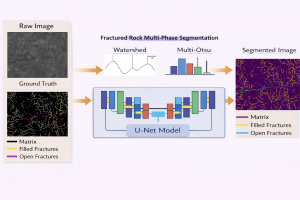
Characterizing subsurface reservoirs, more specifically naturally fractured subsurface reservoir rocks, is essential for the study of subsurface reservoir properties. Image segmentation is an important aspect of digital rock physics (DRP) workflows. Traditional image segmentation techniques are less accurate than deep learning-based segmentation algorithms. In this paper, we investigate the segmentation accuracy of a convolutional neural network U-net and compare it with traditional methods of Watershed and multi-Otsu thresholding for multiphase segmentation of grayscale images from a naturally fractured coal sample. The segmentation target involved multiphase classification of the matrix, fully-filled fractures with minerals, and open fractures. The results reveal that U-net outperformed the others with an Intersection over Union metric of 94.9%, a Dice metric of 97%, and a Recall metric of 97.5%. The results support the importance of multiphase, deep learning-based segmentation techniques to support DRP studies of naturally fractured rocks.
Downloads
References
1. Alqahtani, N. J., Niu, Y., Wang, Y. D., Chung, T., Lanetc, Z., Zhuravljov, A., Armstrong, R. T., & Mostaghimi, P. (2022). Super-resolved segmentation of X-ray images of carbonate rocks using deep learning. Transport in Porous Media, 143(2), 497–525. https://doi.org/10.1007/s11242-022-01781-9
2. Alzubaidi, F., Makuluni, P., Clark, S. R., Lie, J. E., Mostaghimi, P. et al. (2021). Automated fracture detection and characterization from unwrapped drill-core images using Mask R-CNN. 3rd AEGC: Geosciences for Sustainable World (pp. 1–4) [Online]. Retrieved September 13–17, https://doi.org/10.1053/j.petrol.2021.109471
3. Angelina, C. L., & Rospawan, A. (2025). A benchmark study of DeepLabV3+, U-Net++, and Attention U-Net for blood cell segmentation. Green Intelligent Systems and Applications, 5(1), 61–73. https://doi.org/10.53623/gisa.v5i1.607
4. Azad, R., Aghdam, E. K., Rauland, A., Jia, Y., Avval, A. H., Bozorgpour, A., Karimijafarbigloo, S., Cohen, J. P., Adeli, E., & Merhof, D. (2024) [Advance online publication]. Medical image segmentation review: The success of U-Net. IEEE Transactions on Pattern Analysis and Machine Intelligence, 46(12), 10076–10095. https://doi.org/10.1109/TPAMI.2024.3435571
5. Beucher, S., & Lantuéjoul, C. (1979). Use of watersheds in contour detection. Paper presented at the International Workshop on Image Processing, Real-Time Edge and Motion Detection/Estimation. Rennes, France.
6. Buda, M., Maki, A., & Mazurowski, M. A. (2018). A systematic study of the class imbalance problem in convolutional neural networks. Neural Networks, 106, 249–259. https://doi.org/10.1016/j.neunet.2018.07.011
7. Byun, H., Kim, J., Yoon, D., Kang, I.-S., & Song, J.-J. (2021). A deep convolutional neural network for rock fracture image segmentation. Earth Science Informatics, 14(4), 1937–1951. https://doi.org/10.1007/s12145-021-00650-1
8. Cao, K., Wei, C., Gaidon, A., Arechiga, N., & Ma, T. (2019). Learning imbalanced datasets with label-distribution-aware margin loss. In Advances in Neural Information Processing Systems (NeurIPS). https://arxiv.org/abs/1909.07413
9. Cohen, J. (1960). A coefficient of agreement for nominal scales. Educational and Psychological Measurement, 20(1), 37–46. https://doi.org/10.1177/001316446002000104
10. Denney, D. (2010, July). Modeling well performance in shale-gas reservoirs. Journal of Petroleum Technology, 62(7), 47–48. https://doi.org/10.2118/0710-0047-JPT
11. Esfandi, T., Sadeghnejad, S., & Jafari, A. (2024). Effect of reservoir heterogeneity on well placement prediction in CO2-EOR projects using machine learning surrogate models: Benchmarking of boosting-based algorithms. Geoenergy Science and Engineering, 233, Article 212564. https://doi.org/10.1016/j.geoen.2023.212564
12. Espinoza, D. N., Shovkun, I., Makni, O., & Lenoir, N. (2016). Natural and induced fractures in coal cores imaged through X-ray computed microtomography: Impact on desorption time. International Journal of Coal Geology, 154–155, 165–175. https://doi.org/10.1016/j.coal.2015.12.012
13. Feng, H., Wang, Y., Li, Z., Zhang, N., Zhang, Y., & Gao, Y. (2023). Information leakage in deep learning-based hyperspectral image classification: A survey. Remote Sensing, 15(15), 3793. https://doi.org/10.3390/rs15153793
14. Feng, Y., Jia, L., Zhang, J., & Chen, J. (2024). FFSwinNet: CNN-transformer combined network with FFT for shale core SEM image segmentation. IEEE Access, 12, 73021–73032. https://doi.org/10.1109/ACCESS.2024.3392421
15. Fleiss, J. L. (1971). Measuring nominal scale agreement among many raters. Psychological Bulletin, 76(5), 378–382. https://doi.org/10.1037/h0031619
16. Foody, G. M. (2023). Challenges in the real world use of classification accuracy metrics: From recall and precision to the Matthews correlation coefficient. PLOS One, 18(10), Article e0291908. https://doi.org/10.1371/journal.pone.0291908
17. Gong, L., Liu, K., & Ju, W. (2023) [Editorial]. Editorial: Advances in the study of natural fractures in deep and unconventional reservoirs. Frontiers in Earth Science, 10, Article 1096643. https://doi.org/10.3389/feart.2022.1096643
18. He, C., Sadeghpour, H., Shi, Y., Mishra, B., & Roshankhah, S. (2024). Mapping distribution of fractures and minerals in rock samples using Res-VGG-UNet and threshold segmentation methods. Computers and Geotechnics, 175, Article 106675, Article 106675. https://doi.org/10.1016/j.compgeo.2024.106675
19. He, H., & Garcia, E. A. (2009). Learning from imbalanced data. IEEE Transactions on Knowledge and Data Engineering, 21(9), 1263–1284. https://doi.org/10.1109/TKDE.2008.239
20. Idowu, N. A. A., Nardi, C., Long, H., Varslot, T., & Øren, P. E. E. (2014). Effects of segmentation and skeletonization algorithms on pore networks and predicted multiphase-transport properties of reservoir-rock samples. SPE Reservoir Evaluation and Engineering, 17(4), 473–483. https://doi.org/10.2118/166030-PA
21. Jamshidi Gohari, M. S., Emami Niri, M., Sadeghnejad, S., & Ghiasi-Freez, J. (2023). An ensemble-based machine learning solution for imbalanced multiclass dataset during lithology log generation. Scientific Reports, 13(1), Article 21622. https://doi.org/10.1038/s41598-023-49080-7
22. Jamshidi Gohari, M. S., Niri, M. E., Sadeghnejad, S., & Ghiasi-Freez, J. (2023). Synthetic graphic well log generation using an enhanced deep learning workflow: Imbalanced multiclass data, sample size, and scalability challenges. SPE Journal, 29(1), 1–20. https://doi.org/10.2118/217466-PA
23. Khan, M. S., Ali, H., Villazan Garcia, L., Badshah, N., Trattnig, S., Schwarzhans, F., Woitek, R., & Zaric, O. (2025). Variational U-Net with local alignment for joint tumor extraction and registration (VALOR-Net) of breast MRI data acquired at two different field strengths. arXiv. arXiv:2501.13690. https://doi.org/10.48550/arXiv.2501.13690
24. Li, C., Zou, C., Peng, C., Lan, X., & Zhang, Y. (2024). Intelligent identification and segmentation of fractures in images of ultrasonic image logging based on transfer learning. Fuel, 369, Article 131694, Article 131694. https://doi.org/10.1016/j.fuel.2024.131694
25. Li, Z., Zhang, G., Zhang, X., Zhang, X., Long, Y., Sun, Y., & Lin, C. (2025). EILnet: An intelligent model for the segmentation of multiple fracture types in karst carbonate reservoirs using electrical image logs. Natural Gas Industry B, 12(2), 158–173. https://doi.org/10.1016/j.ngib.2025.03.002
26. Lin, W., Li, X., Yang, Z., Lin, L., Xiong, S., Wang, Z., Wang, X., & Xiao, Q. (2018). A new improved threshold segmentation method for scanning images of reservoir rocks considering pore fractal characteristics. Fractals, 26(2), Article 1840003. https://doi.org/10.1142/S0218348X18400030
27. Ma, Z., He, X., Sun, S., Yan, B., Kwak, H. et al. (2023). Zero-shot digital rock image segmentation with a fine-tuned segment anything model [Preprint]. arXiv. https://doi.org/10.48550/arXiv.2311.10865
28. Marques, A., Racolte, G., de Souza, E. M., Domingos, H. V., Horota, R. K., Motta, J. G., Zanotta, D. C., Cazarin, C. L., Gonzaga, L., & Veronez, M. R. (2021). Deep learning application for fracture segmentation over outcrop images from UAV-based digital photogrammetry. In Proceedings of the IEEE International Geoscience and Remote Sensing Symposium (IGARSS) (pp. 4692–4695). IEEE. https://doi.org/10.1109/IGARSS47720.2021.9553232
29. Meyer, F. (1994). Topographic distance and watershed lines. In Signal Processing, 38(1), (113–125). https://doi.org/10.1016/0165-1684(94)90060-4
30. Mousavi, S. M., Bakhtiarimanesh, P., Enzmann, F., Kersten, M., & Sadeghnejad, S. (2024, January 10). Machine-learned surrogate models for efficient oil well placement under operational reservoir constraints. SPE Journal, 29(1), 518–537. https://doi.org/10.2118/217467-PA
31. Nande, S. B., & Patwardhan, S. D. (2024). Automated reservoir characterization of carbonate rocks using deep learning image segmentation approach. SPE Journal, 29(8), 4356–4375. https://doi.org/10.2118/219769-PA
32. Otsu, N. (1979). A threshold selection method from gray-level histograms. IEEE Transactions on Systems, Man, and Cybernetics, 9(1), 62–66. https://doi.org/10.1109/TSMC.1979.4310076
33. Phan, J., Ruspini, L. C., & Lindseth, F. (2021). Automatic segmentation tool for 3D digital rocks by deep learning. Scientific Reports, 11(1), Article 19123. https://doi.org/10.1038/s41598-021-98697-z
34. Pun, T. (1980). A new method for grey-level picture thresholding using the entropy of the histogram. Signal Processing, 2(3), 223–237. https://doi.org/10.1016/0165-1684(80)90020-1
35. Punn, N. S., & Agarwal, S. (2022). Modality specific U-Net variants for biomedical image segmentation: A survey. Artificial Intelligence Review, 55(7), 5845–5889. https://doi.org/10.1007/s10462-022-10152-1
36. Rahman, M. A., & Wang, Y. (2016). Optimizing intersection-over-union in deep neural networks for image segmentation. In G. Bebis (Eds.), Advances in visual computing (pp. 234–244). Springer. https://doi.org/10.1007/978-3-319-50835-1_22
37. Reinhardt, M., Jacob, A., Sadeghnejad, S., Cappuccio, F., Arnold, P., Frank, S., Enzmann, F., & Kersten, M. (2022). Benchmarking conventional and machine learning segmentation techniques for digital rock physics analysis of fractured rocks. Environmental Earth Sciences, 81(3), 71. https://doi.org/10.1007/s12665-021-10133-7
38. Sadeghnejad, S., Hupfer, S., Pingel, J., Lanyon, B., Schneeberger, R., Blechschmidt, I., Alonso, U., Hauser, W., Kraft, S., Geckeis, H., & Schäfer, T. (2025). Bentonite mass loss in fractured crystalline rock quantified from CT scans using digital rock physics and machine learning: Case study from the Grimsel Test Site (Switzerland). Applied Clay Science, 276, Article 107915. https://doi.org/10.1016/j.clay.2025.107915
39. Sadeghnejad, S., Masihi, M., & King, P. R. (2013). Dependency of percolation critical exponents on the exponent of power law size distribution. Physica. Part A, 392(24), 6189–6197. https://doi.org/10.1016/j.physa.2013.08.022
40. Satapathy, S. C., Sri Madhava Raja, N., Rajinikanth, V., Ashour, A. S., & Dey, N. (2018). Multi-level image thresholding using Otsu and chaotic bat algorithm. Neural Computing and Applications, 29(12), 1285–1307. https://doi.org/10.1007/s00521-016-2645-5
41. Shafiabadi, M., & Kamkar-Rouhani, A. (2025). Comparison of edge detection algorithms for automatic identification of fractures in hydrocarbon reservoirs with image logs. Journal of Mining and Environment (JME), 16(2), 689–704. https://doi.org/10.22044/jme.2024.14190.2642
42. Sudre, C. H., Li, W., Vercauteren, T., Ourselin, S., & Cardoso, M. J. (2017). Generalised Dice overlap as a deep learning loss function for highly unbalanced segmentations. In M. J. Cardoso et al. (Eds.), DLMIA/ML-CDS 2017 (LNCS, vol. 10553, pp. 240–248). Springer. https://doi.org/10.1007/978-3-319-67558-9_28
43. Tatbul, N., Lee, T. J., Zdonik, S., Alam, M., & Gottschlich, J. (2018). In. Precision And Recall For Time Series. Proceedings of the 32nd Conference on Neural Information Processing Systems (NeurIPS 2018), Montréal, Canada.
44. Teimouri, A., Sadeghnejad, S., & Dehaghani, A. H. S. (2020). Investigation of acid pre-flushing and pH-sensitive microgel injection in fractured carbonate rocks for conformance control purposes. Oil & Gas Science and Technology—Revue d’IFP Energies Nouvelles, 75, Article 52. https://doi.org/10.2516/ogst/2020048
45. Truong, Q. B., & Lee, B. R. (2013). Automatic multi-thresholds selection for image segmentation based on evolutionary approach. International Journal of Control, Automation and Systems, 11(4), 834–844. https://doi.org/10.1007/s12555-011-0055-0
46. Wang, F., & Zai, Y. (2023). Image segmentation and flow prediction of digital rock with U-net network. Advances in Water Resources, 172, Article 104384, Article 104384. https://doi.org/10.1016/j.advwatres.2023.104384
47. Wang, H., Guo, R., Leng, J., Hosseini, S. A., & Fan, M. (2023). A comparative study of deep learning models for fracture and pore space segmentation in synthetic fractured digital rocks. In (S. P. E. Paper (Ed.) (pp. 1–12). San Antonio, TX. https://doi.org/10.2118/215117-MS
48. Wang, Y., Jia, B., & Xian, C. (2023). Machine learning and UNet++ based microfracture evaluation from CT images. Geoenergy Science and Engineering, 226, Article 211726. https://doi.org/10.1016/j.geoen.2023.211726
49. Wang, Z., Ning, X., & Blaschko, M. B. (2023). Jaccard metric losses: Optimizing the Jaccard index with soft labels. In Proceedings of the 37th Conference on Neural Information Processing Systems (NeurIPS 2023).
50. Wang, Z., Zhang, Z., Bai, L., Yang, Y., & Ma, Q. (2022). Application of an improved U-Net neural network on fracture segmentation from outcrop images. In IEEE International Geoscience and Remote Sensing Symposium (IGARSS), 2022, (3512–3515). https://doi.org/10.1109/IGARSS46834.2022.9883208
51. Wu, B.-F., Chen, Y.-L., & Chiu, C.-C. (2005). A discriminant analysis based recursive automatic thresholding approach for image segmentation. IEICE Transactions on Information and Systems, E88–D(7), 1716–1723. https://doi.org/10.1093/ietisy/e88-d.7.1716
52. Xu, Y., Cavalcante Filho, J. S. A., Yu, W., & Sepehrnoori, K. (2017). Discrete-fracture modeling of complex hydraulic-fracture geometries in reservoir simulators. SPE Reservoir Evaluation and Engineering, 20(2), 403–422. https://doi.org/10.2118/183647-PA
53. Yin, X.-X., Sun, L., Fu, Y., Lu, R., & Zhang, Y. (2022). U-Net-based medical image segmentation. Journal of Healthcare Engineering, 2022, Article 4189781, 16 pages. https://doi.org/10.1155/2022/4189781
54. Zhang, Z., Wu, C., Coleman, S., & Kerr, D. (2020). DENSE-Inception U-net for medical image segmentation. Computer Methods and Programs in Biomedicine, 192, Article 105395. https://doi.org/10.1016/j.cmpb.2020.105395
55. Zhao, L., Zhang, H., Sun, X., Ouyang, Z., Xu, C., & Qin, X. (2024). Application of ResUNet-CBAM in thin-section image segmentation of rocks. Information, 15(12), Article 788. https://doi.org/10.3390/info15120788
56. Zheng, J., Qi, Z., Liu, J., Ma, D., & Ju, Y. (2022). Segmentation of micro-cracks in fractured coal based on convolutional neural network. Mining Science and Technology, 7(6), 680–688. https://doi.org/10.19606/j.cnki.jmst.2022.06.005
57. Zhou, Z., Zheng, C., Liu, X., Tian, Y., Chen, X., Chen, X., & Dong, Z. (2023). A dynamic effective class balanced approach for remote sensing imagery semantic segmentation of imbalanced data. Remote Sensing, 15(7), 1768. https://doi.org/10.3390/rs15071768
Downloads
Published
Data Availability Statement
The datasets generated and the source code are available in the following repository: https://github.com/behradtp/Image-Segmentation_Interpore
Issue
Section
License
Copyright (c) 2026 Behrad Tabrizipour, Saeid Sadeghnejad, Mastaneh Hajipour, Thorsten Schäfer

This work is licensed under a Creative Commons Attribution-NonCommercial-NoDerivatives 4.0 International License.
This article is published under the Creative Commons license indicated above. See the license link for details.
Article metadata are available under the CCo license.