
A Comparative SPH Analysis of Interaction Between Viscous Debris Flow and Two Types of Barriers with Basal Clearance
DOI:
https://doi.org/10.69631/qkep8004Keywords:
Debris flow, Geohazard mitigation, Curved barrier, Basal clearance, Smoothed Particle Hydrodynamics (SPH)Abstract
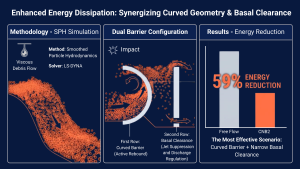
Debris flows are a type of geophysical flow and are known as one of the most destructive geohazards. To control and mitigate damage to residential areas and infrastructure downstream, rigid barriers are installed along the flow path to dissipate the momentum and energy of the flow. While basal clearance and curved barriers have shown potential for granular flows, their combined application to viscous debris flows has remained unstudied. Therefore, this study aims to incorporate the advantages of barriers with basal clearance and curved geometries for application to viscous debris flows. To this end, a series of seven numerical simulations were performed using the smoothed particle hydrodynamics (SPH) method in LS-DYNA[1] to compare the performance of vertical and curved barriers with a basal clearance in the second row. The results indicate that curved barriers enhance the interaction process through rebounding, reducing the maximum kinetic energy by 59% in the most effective scenario (CNB2) compared to free flow conditions. Consequently, a system featuring a curved barrier in the first row and a narrow basal clearance in the second row was found to be the most practical. Furthermore, a single curved barrier reduced momentum by 16% more than a single vertical wall, performing similarly to dual vertical systems. Finally, it is noted that where site constraints or costs preclude two-barrier systems, a well-designed single curved barrier offers a viable alternative.
Downloads
References
1. Aaron, J., Langham, J., Spielmann, R., Hirschberg, J., McArdell, B., Boss, S., Johnson, C. G., & Gray, J. M. N. T. (2025). Detailed observations reveal the genesis and dynamics of destructive debris-flow surges. Communications Earth & Environment, 6(1), 556. https://doi.org/10.1038/s43247-025-02488-7
2. Aghagoli, A., & Sadeghi, H. (2025). A review of the physics of debris flows and the significance of employing the unsaturated soil conditions in estimating the erosion volume. Sharif Journal of Civil Engineering, 41(2), 90–103. https://doi.org/10.24200/j30.2024.64086.3304
3. Batra, R. C., & Zhang, G. M. (2007). SSPH basis functions for meshless methods, and comparison of solutions with strong and weak formulations. Computational Mechanics, 41(4), 527–545. https://doi.org/10.1007/s00466-007-0209-3
4. Chen, H.-X., Li, J., Feng, S.-J., Gao, H.-Y., & Zhang, D.-M. (2019). Simulation of interactions between debris flow and check dams on three-dimensional terrain. Engineering Geology, 251, 48–62. https://doi.org/10.1016/j.enggeo.2019.02.001
5. Chen, J., Zhang, W., Cao, C., Yin, H., Wang, J., Li, W., & Zheng, Y. (2024). The effect of the check dam on the sediment transport and control in debris flow events. Engineering Geology, 329, 107397. https://doi.org/10.1016/j.enggeo.2023.107397
6. Choi, C. E., Cui, Y., Liu, L. H. D., Ng, C. W. W., & Lourenço, S. D. N. (2017). Impact mechanisms of granular flow against curved barriers. Géotechnique Letters, 7(4), 330–338. https://doi.org/10.1680/jgele.17.00068
7. Choi, C. E., Ng, C. W. W., Au-Yeung, S. C. H., & Goodwin, S. R. (2015). Froude characteristics of both dense granular and water flows in flume modelling. Landslides, 12(6), 1197–1206. https://doi.org/10.1007/s10346-015-0628-8
8. Choi, C.E., Ng, C. W. W., Law, R. P. H., Song, D., Kwan, J. S. H., & Ho, K. K. S. (2015). Computational investigation of baffle configuration on impedance of channelized debris flow. Canadian Geotechnical Journal, 52(2), 182–197. https://doi.org/10.1139/cgj-2013-0157
9. Choi, C. E., Ng, C. W. W., Liu, H., & Wang, Y. (2020). Interaction between dry granular flow and rigid barrier with basal clearance: Analytical and physical modelling. Canadian Geotechnical Journal, 57(2), 236–245. https://doi.org/10.1139/cgj-2018-0622
10. Feng, S.-J., Gao, H.-Y., Gao, L., Zhang, L. M., & Chen, H.-X. (2019). Numerical modeling of interactions between a flow slide and buildings considering the destruction process. Landslides, 16(10), 1903–1919. https://doi.org/10.1007/s10346-019-01220-9
11. Gomez-Gesteira, M., Crespo, A. J. C., Rogers, B. D., Dalrymple, R. A., Dominguez, J. M., & Barreiro, A. (2012). SPHysics – development of a free-surface fluid solver – Part 2: Efficiency and test cases. Computers & Geosciences, 48, 300–307. https://doi.org/10.1016/j.cageo.2012.02.028
12. Hallquist, J. O. (Ed.). (2006). LS-DYNA: Theory manual. Livermore Software Technology Corp. https://lsdyna.ansys.com/manuals-download/
13. Hübl, J., Suda, J., Proske, D., Kaitna, R., & Scheidl, C. (2009). Debris Flow Impact Estimation. Proceedings of the 11th International Symposium on Water Management and Hydraulic Engineering, Ohrid, Macedonia. https://scholar.google.ca/citations?view_op=view_citation&hl=en&user=qbHTg4kAAAAJ&citation_for_view=qbHTg4kAAAAJ:KxtntwgDAa4C
14. Iverson, R. M. (1997). The physics of debris flows. Reviews of Geophysics, 35(3), 245–296. https://doi.org/10.1029/97RG00426
15. Iverson, R. M. (2014). Debris flows: Behaviour and hazard assessment. Geology Today, 30(1), 15–20. https://doi.org/10.1111/gto.12037
16. Iverson, R. M., George, D. L., & Logan, M. (2016). Debris flow runup on vertical barriers and adverse slopes. Journal of Geophysical Research: Earth Surface, 121(12), 2333–2357. https://doi.org/10.1002/2016JF003933
17. Iverson, R. M., Reid, M. E., & LaHusen, R. G. (1997). Debris-flow mobilization from landslides. Annual Review of Earth and Planetary Sciences, 25(1), 85–138. https://doi.org/10.1146/annurev.earth.25.1.85
18. Jiang, Z., Wang, J., Zhou, L., Yuan, R., Wei, T., & Zhang, Y. (2024). Formation-evolutionary mechanism of large debris flow in semi-arid region, the northeastern Tibetan Plateau. Landslides, 21(7), 1515–1530. https://doi.org/10.1007/s10346-024-02233-9
19. Liu, H., Choi, C. E., Poudyal, S., Jia, Z., & Ng, C. W. W. (2024). A new overflow number for analyzing and designing dual rigid barriers with basal clearance. Journal of Geotechnical and Geoenvironmental Engineering, 150(6), 04024036. https://doi.org/10.1061/JGGEFK.GTENG-11873
20. Ng, C. W. W., Choi, C. E., & Goodwin, S. R. (2019). Froude characterization for unsteady single-surge dry granular flows: Impact pressure and runup height. Canadian Geotechnical Journal, 56(12), 1968–1978. https://doi.org/10.1139/cgj-2018-0529
21. Ng, C. W. W., Li, Z., Poudyal, S., De Silva, W. A. R. K., Bhatta, A., & Liu, H. (2024). Experimental and SPH modeling of debris-flow impact on dual rigid barriers with deflector. Journal of Geotechnical and Geoenvironmental Engineering, 150(5), 04024023. https://doi.org/10.1061/JGGEFK.GTENG-12192
22. Ng, C. W. W., Majeed, U., & Choi, C. E. (2024). Effects of solid fraction of saturated granular flows on overflow and landing mechanisms of rigid barriers. Géotechnique, 74(1), 27–41. https://doi.org/10.1680/jgeot.21.00170
23. Ng, C. W. W., Majeed, U., Choi, C. E., & De Silva, W. A. R. K. (2021). New impact equation using barrier Froude number for the design of dual rigid barriers against debris flows. Landslides, 18(6), 2309–2321. https://doi.org/10.1007/s10346-021-01631-7
24. Otsu, N. (1979). A Threshold Selection Method from Gray-Level Histograms. IEEE Transactions on Systems, Man, and Cybernetics, 9(1), 62–66. https://doi.org/10.1109/TSMC.1979.4310076
25. Shen, W., Luo, G., & Zhao, X. (2022). On the impact of dry granular flow against a rigid barrier with basal clearance via discrete element method. Landslides, 19(2), 479–489. https://doi.org/10.1007/s10346-021-01805-3
26. Song, D., Chen, X., Sadeghi, H., Zhong, W., Hu, H., & Liu, W. (2023). Impact behavior of dense debris flows regulated by pore‐pressure feedback. Journal of Geophysical Research: Earth Surface, 128(12), e2023JF007074. https://doi.org/10.1029/2023JF007074
27. Wang, J., Wang, X., Yao, Q., Xu, G., Luo, Y., & Li, H. (2025). Mechanism of bed scour erosion in narrow and steep debris-flow channels based on SPH–DEM–FEM coupling. Engineering Geology, 354, 108182. https://doi.org/10.1016/j.enggeo.2025.108182
28. Xiong, H., Hao, M., Zhao, D., Qiu, Y., & Chen, X. (2024). Study of the dynamics of water-enriched debris flow and its impact on slit-type barriers by a modified SPH–DEM coupling approach. Acta Geotechnica, 19(2), 1019–1045. https://doi.org/10.1007/s11440-023-02106-w
29. Yang, X. F., Peng, S. L., & Liu, M. B. (2014). A new kernel function for SPH with applications to free surface flows. Applied Mathematical Modelling, 38(15–16), 3822–3833. https://doi.org/10.1016/j.apm.2013.12.001
30. Zhang, B., & Huang, Y. (2024). Impact behaviour of dry granular flow against baffle structure: Coupled effect of Froude and particle characteristics. Géotechnique, 74(10), 947–958. https://doi.org/10.1680/jgeot.21.00360
Downloads
Additional Files
Published
Data Availability Statement
The data that support the findings of this study are available from the corresponding author upon reasonable request.
Issue
Section
License
Copyright (c) 2026 Anahita Aghagoli, Hamed Sadeghi

This work is licensed under a Creative Commons Attribution-NonCommercial-NoDerivatives 4.0 International License.
This article is published under the Creative Commons license indicated above. See the license link for details.
Article metadata are available under the CCo license.