
Exploring the Inter-Relationship between Climatic Conditions and Heat-Water Transfer in Deformable Cracked Surface Strata
DOI:
https://doi.org/10.69631/rk5nyd57Keywords:
Arid climate, Cracked soil, Heat conduction, Water advection, DeformationAbstract
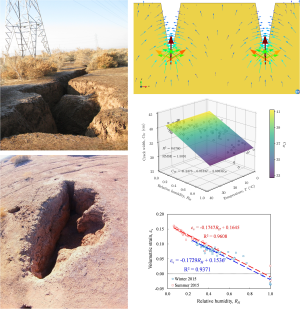
Climate-induced soil desiccation and cracking present escalating challenges to infrastructure stability, necessitating comprehensive investigations of soil-climate interactions. Hence, this study presents a thermo-hydro-mechanical (THM) modeling framework to investigate the response of desiccation-cracked soil to climatic variations. The model was constructed using field observations and statistical analysis and incorporated three years of meteorological data from a susceptible area in Iran. The analysis explored heat conduction, water advection, mechanical deformation, and crack evolution under prolonged environmental conditions. Results revealed that heat flux was highly dependent on temperature gradients and crack geometry. Heat migrates upward from the subsurface when air temperature is lower than soil temperature or during rainfall, conditions typically associated with wet or cold seasons, whereas during warmer periods heat is transferred into the soil. Water flux exhibited strong seasonal variability, with rainfall-driven infiltration through the surface and enhanced evaporation near cracks during dry periods. During rainfall, water flow velocity in soil pores was at least 50 times higher than during warm weather. Moreover, a direct relationship between volumetric strain, temperature, and relative humidity was identified. Crack deformation intensified, and long-term climatic exposure resulted in cumulative shrinkage, increasing on average from 12.5% in the first year to 17.5% in the third year.
Downloads
References
1. Akbari Garakani, A., Tahajomi Banafshehvaragh, S., Saheb, S., & Sadeghi, H. (2025). Assessing the vulnerability of power transmission towers to land subsidence and forecasting future trends using multi-source datasets: insights from Moein Abad, Iran. Innovative Infrastructure Solutions, 10(4), pp.1-23. https://doi.org/10.1007/s41062-025-01958-3
2. Alonso, E. E., Vaunat, J., & Gens, A. (1999). Modelling the mechanical behaviour of expansive clays. Engineering Geology, 54(1-2), 173-183. https://doi.org/10.1016/S0013-7952(99)00079-4
3. Amarasiri, A.L., Kodikara, J.K., & Costa, S. (2011). Numerical modelling of desiccation cracking. International Journal for Numerical and Analytical Methods in Geomechanics, 35(1), pp.82-96. https://doi.org/10.1002/nag.894
4. Bernier, F., Li, X. L., & Bastiaens, W. (2011). Twenty-five years’ geotechnical observation and testing in the Tertiary Boom Clay format. In Stiff Sedimentary Clays: Genesis and Engineering Behaviour: Géotechnique Symposium in Print 2007 (pp. 223-231). Thomas Telford Ltd. https://doi.org/10.1680/geot.2007.57.2.229
5. De Bruyn, D., & Labat, S. (2002). The second phase of ATLAS: the continuation of a running THM test in the HADES underground research facility at Mol. Engineering Geology, 64(2-3), 309-316. https://doi.org/10.1016/S0013-7952(01)00109-0
6. Delage, P., Sultan, N., & Cui, Y. J. (2000). On the thermal consolidation of Boom clay. Canadian Geotechnical Journal, 37(2), 343-354. https://doi.org/10.1139/t99-105
7. Feng, H., Xing, X., Su, L., Zhang, C., Wang, Y., Li, Y., & Wang, W. (2025). Insights into saline soil cracking subjected to drying-wetting cycles. Acta Geophysica, 73(1), 619-633. https://doi.org/10.1007/s11600-024-01375-7
8. Gambolati, G., & Teatini, P. (2015). Geomechanics of subsurface water withdrawal and injection. Water Resources Research, 51(6), 3922-3955. https://doi.org/10.1002/2014WR016841
9. Gao, H., An, R., Zhang, X., Wang, G., Liu, X., & Xu, Y. (2024). Dynamic evolution of desiccation cracks and their relationship with the hydraulic properties of expansive soil. International Journal of Geomechanics, 24(3), 04023299. https://doi.org/10.1061/IJGNAI.GMENG-9299
10. Gens, A., Vaunat, J., Garitte, B., & Wileveau, Y. (2007). In situ behaviour of a stiff layered clay subject to thermal loading: observations and interpretation. In Stiff Sedimentary Clays: Genesis and Engineering Behaviour: Géotechnique Symposium in Print 2007 (pp. 123-144). Thomas Telford Ltd. https://doi.org/10.1680/ssc.41080.0011
11. Ghandilou, M. J., Tourchi, S., & Sadeghi, H. (2023). Numerical investigation of cyclic wetting and drying of Boom clay based on the Barcelona Expansive Model. In 84th EAGE Annual Conference & Exhibition (Vol. 2023, No. 1, pp. 1-5). European Association of Geoscientists & Engineers. https://doi.org/10.3997/2214-4609.202310400
12. Huang, Q., & Azam, S. (2023). Modeling of weather-induced volumetric changes in cracked expansive clays. Geotechnical and Geological Engineering, 41(2), 861-879. https://doi.org/10.1007/s10706-022-02310-7
13. Iran Meteorological Organization. (n.d.). Data portal. https://data.irimo.ir/
14. Jabbarzadeh, M. (2024). Thermo-hydro-mechanical modeling of heterogeneous subsidence in desiccation-cracked clayey strata under soil-atmosphere interactions. M.Sc. Thesis. Sharif University of Technology.
15. Jabbarzadeh, M., & Sadeghi, H. (2024). A novel analytical-statistical-numerical hybrid framework for investigating the thermo-hydro-mechanical behavior of heterogeneous subsidence phenomena, moisture and temperature variations in cracked soils under soil-atmosphere interaction. Sharif Journal of Mechanical Engineering. https://doi.org/10.24200/j40.2024.65047.1718
16. Jabbarzadeh, M., & Sadeghi, H. (2026). Multi-physical modeling of climate-driven elasto-plastic deformation, stress redistribution, and water potential in desiccation-cracked soils of arid regions. Journal of Rock Mechanics and Geotechnical Engineering, 18(1), 772-791. https://doi.org/10.1016/j.jrmge.2025.05.018
17. Jabbarzadeh, M., Sadeghi, H., Tourchi, S., & Darzi, A. G. (2024). Thermo-hydraulic analysis of desiccation cracked soil strata considering ground temperature and moisture dynamics under the influence of soil-atmosphere interactions. Geomechanics for Energy and the Environment, 38, 100558. https://doi.org/10.1016/j.gete.2024.100558
18. Liu, W., Song, X., Wan, S., Hu, X., & Zeng, X. (2025). Critical moisture content model and application to the formation of soil desiccation cracks. Bulletin of Engineering Geology and the Environment, 84(3), 147. https://doi.org/10.1007/s10064-025-04175-5
19. Mousavi, Z., & Jabbarzadeh, M. (2025). 3D DEM-based analysis of cylindrical rock specimen failure and micro-fracturing: impact of stiffness and tensile strength. Discover Geoscience, 3(1), 1-21. https://doi.org/10.1007/s44288-025-00126-5
20. Olivella, S., Carrera, J., Gens, A., & Alonso, E. E. (1994). Nonisothermal multiphase flow of brine and gas through saline media. Transport in Porous Media, 15, 271-293. https://doi.org/10.1007/BF00613282
21. Olivella, S., Gens, A., Carrera, J., & Alonso, E. E. (1996). Numerical formulation for a simulator (CODE_BRIGHT) for the coupled analysis of saline media. Engineering Computations, 13(7), 87-112. https://doi.org/10.1108/02644409610151575
22. Peron, H., Hueckel, T., Laloui, L., & Hu, L. (2009). Fundamentals of desiccation cracking of fine-grained soils: experimental characterisation and mechanisms identification. Canadian Geotechnical Journal, 46(10), pp.1177-1201. https://doi.org/10.1139/T09-054
23. Poulsen, T.G. (2022). Predicting evaporation from moist, cracked soil, based on near‐surface wind speed, crack width and crack distance. European Journal of Soil Science, 73(1), p.e13215. https://doi.org/10.1111/ejss.13215
24. Poulsen, T.G., Cai, W., & Garg, A. (2020). Water evaporation from cracked soil under moist conditions as related to crack properties and near‐surface wind speed. European Journal of Soil Science, 71(4), pp.627-640. https://doi.org/10.1111/ejss.12926
25. Qi, W., Zhang, Z. Y., Wang, C., Chen, Y., & Zhang, Z. M. (2020). Crack closure and flow regimes in cracked clay loam subjected to different irrigation methods. Geoderma, 358, 113978. https://doi.org/10.1016/j.geoderma.2019.113978
26. Sadeghi, H., Darzi, A. G., Voosoghi, B., Garakani, A. A., Ghorbani, Z., & Mojtahedi, S. F. F. (2023). Assessing the vulnerability of Iran to subsidence hazard using a hierarchical FUCOM-GIS framework. Remote Sensing Applications: Society and Environment, 31, 100989. https://doi.org/10.1016/j.rsase.2023.100989
27. Sadeghi, H., Jabbarzadeh, M., & Tourchi, S. (2024). Thermo-hydro-mechanical modelling of the heterogeneous subsidence and swelling in the desiccation cracked clayey strata. Engineering Geology, 343, 107798. https://doi.org/10.1016/j.enggeo.2024.107798
28. Sadeghi, H., Kolahdooz, A., & Ahmadi, M.M. (2022). Slope stability of an unsaturated embankment with and without natural pore water salinity subjected to rainfall infiltration. Rock and Soil Mechanics, 43(8), p.5. https://doi.org/10.16285/j.rsm.2021.00155
29. Tourchi, S., Jabbarzadeh, M., & Sadeghi, H. (2024). Thermo-hydro-mechanical analysis of soil strata suffered from desiccation cracking. In: Geotechnical Engineering Challenges to Meet Current and Emerging Needs of Society (pp. 1362-1367). CRC Press. https://doi.org/10.1201/9781003431749-249
30. Tourchi, S., Jabbarzadeh, M., Lavasan, A. A., Sadeghi, H., & Racek, O. (2024). Thermo-hydro-mechanical dynamics of a rock slope: Integrated field and numerical analysis at the Požáry test site in the Czech Republic. Journal of Rock Mechanics and Geotechnical Engineering. https://doi.org/10.1016/j.jrmge.2024.09.052
31. Tran, D. K., Ralaizafisoloarivony, N., Charlier, R., Mercatoris, B., Léonard, A., Toye, D., & Degré, A. (2019). Studying the effect of desiccation cracking on the evaporation process of a Luvisol–From a small-scale experimental and numerical approach. Soil and Tillage Research, 193, 142-152. https://doi.org/10.1016/j.still.2019.05.018
32. Valipour, M., Jabbarzadeh, M., Sadeghi, H., & Roghangar, K. (2024). Volumetric Behavior of a Soil Column Subjected to Freeze-Thaw Cycles Under Coupled Thermo-Hydro-Mechanical Conditions. GeoMontréal 2024. https://www.researchgate.net/publication/384431981
33. Van Genuchten, M. T. (1980). A closed‐form equation for predicting the hydraulic conductivity of unsaturated soils. Soil Science Society of America Journal, 44(5), 892-898. https://doi.org/10.2136/sssaj1980.03615995004400050002x
34. Vicente-Serrano, S. M., N. G. Pricope, A. Toreti, E. Morán-Tejeda, J. Spinoni, A. Ocampo-Melgar, E. Archer, A. Diedhiou, T. Mesbahzadeh, N. H. Ravindranath, R. S. Pulwarty & S. Alibakhshi, (2024). The Global Threat of Drying Lands: Regional and global aridity trends and future projections. A Report of the Science-Policy Interface. United Nations Convention to Combat Desertification (UNCCD). Bonn, Germany.
35. Yan, C., & Wang, T. (2025). A 3D discrete model for soil desiccation cracking in consideration of moisture diffusion. Journal of Rock Mechanics and Geotechnical Engineering, 17(1), 614-635. https://doi.org/10.1016/j.jrmge.2023.12.024
36. Zeng, H., Tang, C. S., Zhu, C., Cheng, Q., Lin, Z. Z., & Shi, B. (2022). Investigating soil desiccation cracking using an infrared thermal imaging technique. Water Resources Research, 58(1), e2021WR030916. https://doi.org/10.1029/2021WR030916
37. Zeng, H., Tang, C. S., Zhu, C., Vahedifard, F., Cheng, Q., & Shi, B. (2022). Desiccation cracking of soil subjected to different environmental relative humidity conditions. Engineering Geology, 297, 106536. https://doi.org/10.1016/j.enggeo.2022.106536
38. Zeng, Z. J., Tang, C. S., Cheng, Q., An, N., Chen, X. Y., & Shi, B. (2023). A numerical model of water evaporation from cracked soil. Computers and Geotechnics, 162, 105641. https://doi.org/10.1016/j.compgeo.2023.105641
39. Zhou, H., Liu, H., Hu, D., Zhang, F., Yang, F., & Lu, J. (2016). Estimation of the effective thermal properties of cracked rocks. European Journal of Environmental and Civil Engineering, 20(8), 954-970. https://doi.org/10.1080/19648189.2015.1084386
40. Zhou, Z., Zhang, J., Ning, F., Luo, Y., Chong, L., & Sun, K. (2020). Large-scale test model of the progressive deformation and failure of cracked soil slopes. Journal of Earth Science, 31, 1097-1108.. https://doi.org/10.1007/s12583-020-1342-6
41. Zhuo, Z., Cai, W., Zhu, C., Tang, C. S., & Roksana, K. (2024). Morphology characterization of unsaturated soils under drying-wetting cycles: crack opening and closure. Acta Geotechnica, 1-20. https://doi.org/10.1007/s11440-024-02347-3
Downloads
Additional Files
Published
Data Availability Statement
The data that support the findings of this study are available from the corresponding author upon reasonable request.
Issue
Section
License
Copyright (c) 2026 Milad Jabbarzadeh, Hamed Sadeghi

This work is licensed under a Creative Commons Attribution-NonCommercial-NoDerivatives 4.0 International License.
This article is published under the Creative Commons license indicated above. See the license link for details.
Article metadata are available under the CCo license.