
A Deep-Learning Iterative Stacked Approach for Prediction of Reactive Dissolution in Porous Media
DOI:
https://doi.org/10.69631/j1re7z03Keywords:
Reactive Dissolution, Deep learning, Iterative Stacking, Time-Series DataAbstract
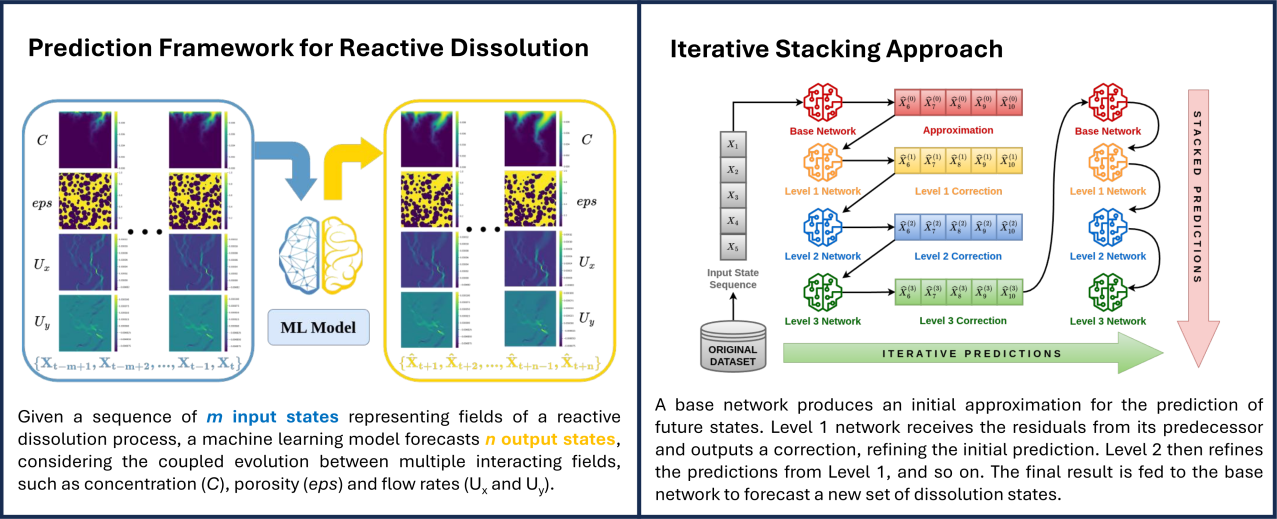
Simulating reactive dissolution of solid minerals in porous media has many subsurface applications, including carbon capture and storage (CCS), geothermal systems and oil and gas recovery. As traditional direct numerical simulators are computationally expensive, it is of paramount importance to develop faster and more efficient alternatives. Deep-learning-based solutions, most of them built upon convolutional neural networks (CNNs), have been recently designed to tackle this problem. However, these solutions were limited to approximating one field over the domain (e.g. velocity field), not accounting for the coupled evolution of multiple interacting fields, including concentration, porosity and flow rates. In this manuscript, we present a novel deep learning approach that incorporates both temporal and spatial information to predict the future states of the dissolution process at a fixed time-step horizon, given a sequence of input states. The overall performance, in terms of speed and prediction accuracy, is demonstrated on a numerical simulation dataset, comparing its prediction results against state-of-the-art approaches, also achieving a speedup around 104 over traditional numerical simulators.
WHY THIS PAPER MATTERSPredicting how underground rocks dissolve over time is essential for technologies such as carbon capture and storage (CCS) and geothermal energy, but traditional computer simulations based on physical models are often slow and computationally expensive. In this work, we developed an artificial intelligence approach that learns from existing data how the dissolution process evolves over time, enabling predictions of future conditions up to 10,000 times faster than conventional methods. Our work could help scientists and engineers exploring climate and energy solutions evaluate more scenarios, accelerating the development of sustainable subsurface technologies.
Downloads
References
1. Raghad Al-Shabandar, Ali Jaddoa, Panos Liatsis, and Abir Jaafar Hussain. A deep gated recurrent neural network for petroleum production forecasting. Machine Learning with Applications, 3:100013, 2021. doi:10.1016/j.mlwa.2020.100013.
2. Naif Alqahtani, Ryan T Armstrong, and Peyman Mostaghimi. Deep learning convolutional neural networks to predict porous media properties. In SPE Asia Pacific Oil and Gas Conference and Exhibition, page D012S032R010. SPE, 2018. doi:10.2118/191906-MS.
3. Dzmitry Bahdanau. Neural machine translation by jointly learning to align and translate. arXiv preprint arXiv:1409.0473, 2014. arXiv:1409.0473.
4. Meiling Cheng, Fangxin Fang, Ionel M Navon, and Christopher Pain. Ensemble Kalman filter for GAN-ConvLSTM based long lead-time forecasting. Journal of Computational Science, 69:102024, 2023. doi:10.1016/j.jocs.2023.102024.
5. Marcos Cirne, Hannah Menke, Alhasan Abdellatif, Julien Maes, Florian Doster, and Ahmed H. Elsheikh. Reactive dissolution in porous media [Dataset], 2025. doi:10.5281/zenodo.14974428.
6. Ying Da Wang, Martin J Blunt, Ryan T Armstrong, and Peyman Mostaghimi. Deep learning in pore scale imaging and modeling. Earth-Science Reviews, 215:103555, 2021. doi:10.1016/j.earscirev.2021.103555.
7. Can Ding, Yiyuan Zhou, Guang Pu, and Hongrong Zhang. Low carbon economic dispatch of power system at multiple time scales considering GRU wind power forecasting and integrated carbon capture. Frontiers in Energy Research, 10:953883, 2022. doi:10.3389/fenrg.2022.953883.
media by physics-informed neural networks for CO2 sequestration. Computers and Geotechnics, 8. Honghui Du, Ze Zhao, Haojia Cheng, Jinhui Yan, and QiZhi He. Modeling density-driven flow in porous 159:105433, 2023. doi:10.1016/j.compgeo.2023.105433.
9. Mohammad Hemmat Esfe and Saeed Esfandeh. 3D numerical simulation of the enhanced oil recovery process using nanoscale colloidal solution flooding. Journal of Molecular Liquids, 301:112094, 2020. doi:10.1016/j.molliq.2019.112094.
10. Zhao Feng, Zeeshan Tariq, Xianda Shen, Bicheng Yan, Xuhai Tang, and Fengshou Zhang. An
encoder-decoder ConvLSTM surrogate model for simulating geological CO2 sequestration with dynamic well controls. Gas Science and Engineering, 125:205314, 2024. doi:10.1016/j.jgsce.2024.205314.
11. Zhangyang Gao, Cheng Tan, Lirong Wu, and Stan Z Li. SimVP: Simpler yet better video prediction. In Proceedings of the IEEE/CVF Conference on Computer Vision and Pattern Recognition, pages 3170–3180, 2022. doi:10.1109/cvpr52688.2022.00317.
12. Paul Garnier, Jonathan Viquerat, Jean Rabault, Aurélien Larcher, Alexander Kuhnle, and Elie Hachem. A review on deep reinforcement learning for fluid mechanics. Computers & Fluids, 225:104973, 2021. doi:10.1016/j.compfluid.2021.104973.
13. Krzysztof M Graczyk and Maciej Matyka. Predicting porosity, permeability, and tortuosity of porous media from images by deep learning. Scientific Reports, 10(1):21488, 2020.
doi:10.1038/s41598-020-78415-x.
14. QiZhi He, David Barajas-Solano, Guzel Tartakovsky, and Alexandre M Tartakovsky. Physics-informed neural networks for multiphysics data assimilation with application to subsurface transport. Advances in Water Resources, 141:103610, 2020. doi:10.1016/j.advwatres.2020.103610.
15. Niklas Heinemann, Juan Alcalde, Johannes M. Miocic, Suzanne J. T. Hangx, Jens Kallmeyer, Christian Ostertag-Henning, Aliakbar Hassanpouryouzband, Eike M. Thaysen, Gion J. Strobel, Cornelia Schmidt-Hattenberger, Katriona Edlmann, Mark Wilkinson, Michelle Bentham, R. Stuart Haszeldine,
Ramon Carbonell, and Alexander Rudloff. Enabling large-scale hydrogen storage in porous media–the scientific challenges. Energy & Environmental Science, 14(2):853–864, 2021. doi:10.1039/D0EE03536J.
16. Priyesh Rajesh Kakka. Sequence to sequence AE-ConvLSTM network for modelling the dynamics of PDE systems. arXiv preprint arXiv:2208.07315, 2022. arXiv:2208.07315.
17. J Nagoor Kani and Ahmed H Elsheikh. DR-RNN: A deep residual recurrent neural network for model reduction. arXiv preprint arXiv:1709.00939, 2017. arXiv:1709.00939.
18. Mina Karimi and Kaushik Bhattacharya. A learning-based multiscale model for reactive flow in porous media. Water Resources Research, 60(9), 2024. doi:10.1029/2023WR036303.
19. Ouassim Khebzegga, Alireza Iranshahr, and Hamdi Tchelepi. Continuous relative permeability model for compositional simulation. Transport in Porous Media, 134:139–172, 2020.
doi:10.1007/s11242-020-01440-x.
20. Diederik P Kingma. Adam: A method for stochastic optimization. arXiv preprint arXiv:1412.6980, 2014.
arXiv:1412.6980.
21. Dmitrii Kochkov, Jamie A Smith, Ayya Alieva, Qing Wang, Michael P Brenner, and Stephan Hoyer. Machine learning–accelerated computational fluid dynamics. Proceedings of the National Academy of Sciences, 118(21):e2101784118, 2021. doi:10.1073/pnas.2101784118.
22. Arief Koesdwiady, Alaa El Khatib, and Fakhri Karray. Methods to improve multi-step time series prediction. In 2018 International Joint Conference on Neural Networks (IJCNN), pages 1–8. IEEE, 2018. doi:10.1109/IJCNN.2018.8489402.
23. Angran Li, Ruijia Chen, Amir Barati Farimani, and Yongjie Jessica Zhang. Reaction diffusion system prediction based on convolutional neural network. Scientific Reports, 10(1):3894, 2020. doi:10.1038/s41598-020-60853-2.
24. Zongyi Li, Nikola Kovachki, Kamyar Azizzadenesheli, Burigede Liu, Kaushik Bhattacharya, Andrew Stuart, and Anima Anandkumar. Fourier neural operator for parametric partial differential equations. arXiv preprint arXiv:2010.08895, 2020. arXiv:2010.08895, doi:10.2139/ssrn.4944664.
25. Suu-Yan Liang, Wen-Sheng Lin, Chan-Po Chen, Chen-Wuing Liu, and Chihhao Fan. A review of geochemical modeling for the performance assessment of radioactive waste disposal in a subsurface system. Applied Sciences, 11(13):5879, 2021. doi:10.3390/app11135879.
26. Bryan Lim and Stefan Zohren. Time-series forecasting with deep learning: A survey. Philosophical Transactions of the Royal Society A, 379(2194):20200209, 2021. doi:10.1098/rsta.2020.0209.
27. Vishnu Mohan M S and Vivek Menon. Measuring viscosity of fluids: A deep learning approach using a CNN-RNN architecture. In Proceedings of the First International Conference on AI-ML Systems, AIMLSystems ’21, New York, NY, USA, 2021. Association for Computing Machinery. doi:10.1145/3486001.3486232.
28. Julien Maes, Cyprien Soulaine, and Hannah P Menke. Improved volume-of-solid formulations for micro-continuum simulation of mineral dissolution at the pore-scale. Frontiers in Earth Science, 10:917931, 2022. doi:10.3389/feart.2022.917931.
29. Spyros Makridakis, Evangelos Spiliotis, and Vassilios Assimakopoulos. Statistical and Machine Learning forecasting methods: Concerns and ways forward. PloS One, 13(3):e0194889, 2018. doi:10.1371/journal.pone.0194889.
30. Nima Mohajerin and Steven L Waslander. Multistep prediction of dynamic systems with recurrent neural networks. IEEE Transactions on Neural Networks and Learning Systems, 30(11):3370–3383, 2019. doi:10.1109/TNNLS.2019.2891257.
31. Tung Nguyen, Rohan Shah, Hritik Bansal, Troy Arcomano, Sandeep Madireddy, Romit Maulik, Veerabhadra Kotamarthi, Ian Foster, and Aditya Grover. Scaling transformer neural networks for skillful and reliable medium-range weather forecasting. arXiv preprint arXiv:2312.03876, 2023. arXiv:2312.03876, doi:10.52202/079017-2196.
32. Sergiu Oprea, Pablo Martinez-Gonzalez, Alberto Garcia-Garcia, John Alejandro Castro-Vargas, Sergio Orts-Escolano, Jose Garcia-Rodriguez, and Antonis Argyros. A review on deep learning techniques for video prediction. IEEE Transactions on Pattern Analysis and Machine Intelligence, 44(6):2806–2826, 2020. doi:10.1109/TPAMI.2020.3045007.
33. Markus Reichstein, Gustau Camps-Valls, Bjorn Stevens, Martin Jung, Joachim Denzler, Nuno Carvalhais, and Prabhat. Deep learning and process understanding for data-driven Earth system science. Nature, 566(7743):195–204, 2019. doi:10.1038/s41586-019-0912-1.
34. S Salimzadeh and HM Nick. A coupled model for reactive flow through deformable fractures in enhanced geothermal systems. Geothermics, 81:88–100, 2019. doi:10.1016/j.geothermics.2019.04.010.
35. Javier E Santos, Duo Xu, Honggeun Jo, Christopher J Landry, Maša Prodanović, and Michael J Pyrcz. PoreFlow-Net: A 3D convolutional neural network to predict fluid flow through porous media. Advances in Water Resources, 138:103539, 2020. doi:10.1016/j.advwatres.2020.103539.
36. Xingjian Shi, Zhourong Chen, Hao Wang, Dit-Yan Yeung, Wai-kin Wong, and Wang-chun Woo. Convolutional lstm network: a machine learning approach for precipitation nowcasting. In Proceedings of the 29th International Conference on Neural Information Processing Systems - Volume 1, NIPS’15, page 802–810, Cambridge, MA, USA, 2015. MIT Press. URL: https://dl.acm.org/doi/10.5555/2969239.2969329.
37. Ilya Sutskever, Oriol Vinyals, and Quoc V. Le. Sequence to sequence learning with neural networks. arXiv preprint arXiv:1409.3215, 2014. arXiv:1409.3215.
38. Souhaib Ben Taieb, Gianluca Bontempi, Amir F Atiya, and Antti Sorjamaa. A review and comparison of strategies for multi-step ahead time series forecasting based on the NN5 forecasting competition. Expert Systems with Applications, 39(8):7067–7083, 2012. doi:10.1016/j.eswa.2012.01.039.
39. Cheng Tan, Zhangyang Gao, Lirong Wu, Yongjie Xu, Jun Xia, Siyuan Li, and Stan Z Li. Temporal attention unit: Towards efficient spatiotemporal predictive learning. In Proceedings of the IEEE/CVF Conference on Computer Vision and Pattern Recognition, pages 18770–18782, 2023. doi:10.1109/cvpr52729.2023.01800.
40. Meng Tang, Yimin Liu, and Louis J Durlofsky. Deep-learning-based surrogate flow modeling and geological parameterization for data assimilation in 3D subsurface flow. Computer Methods in Applied Mechanics and Engineering, 376:113636, 2021. doi:10.1016/j.cma.2020.113636.
41. Wendong Wang, Qiuheng Xie, Senyou An, Sahar Bakhshian, Qinjun Kang, Han Wang, Xinyue Xu, Yuliang Su, Jianchao Cai, and Bin Yuan. Pore-scale simulation of multiphase flow and reactive transport processes involved in geologic carbon sequestration. Earth-Science Reviews, page 104602, 2023. doi:10.1016/j.earscirev.2023.104602.
42. Gege Wen, Zongyi Li, Kamyar Azizzadenesheli, Anima Anandkumar, and Sally M Benson. U-FNO—An enhanced Fourier neural operator-based deep-learning model for multiphase flow. Advances in Water Resources, 163:104180, 2022. doi:10.1016/j.advwatres.2022.104180.
43. Lei Xu, Nengcheng Chen, Zeqiang Chen, Chong Zhang, and Hongchu Yu. Spatiotemporal forecasting in earth system science: Methods, uncertainties, predictability and future directions. Earth-Science Reviews, 222:103828, 2021. doi:10.1016/j.earscirev.2021.103828.
44. Bicheng Yan, Dylan Robert Harp, Bailian Chen, and Rajesh Pawar. A physics-constrained deep learning model for simulating multiphase flow in 3D heterogeneous porous media. Fuel, 313:122693, 2022. doi:10.1016/j.fuel.2021.122693.
45. Li-Tao Zhu, Xi-Zhong Chen, Bo Ouyang, Wei-Cheng Yan, He Lei, Zhe Chen, and Zheng-Hong Luo. Review of machine learning for hydrodynamics, transport, and reactions in multiphase flows and reactors. Industrial & Engineering Chemistry Research, 61(28):9901–9949, 2022. doi:10.1021/acs.iecr.2c01036.
Downloads
Additional Files
Published
Versions
- 2026-09-02 (2)
- 2026-04-20 (1)
Data Availability Statement
Data Availability Statement: The source code used to reproduce all results for our iterative stacked method, including pre-trained models for all ML algorithms described in this work, can be found at https://github.com/ai4netzero/ReactiveDissolution. The supporting dataset for reactive dissolution is publicly available at https://zenodo.org/records/14974428 under the Creative Commons Attribution International 4.0 license (5).
Software Availability Statement: The experiments on porosity and permeability estimation were run on version 5.1 of GeoChemFoam, available at https://github.com/GeoChemFoam under the GNU General Public License (GPL-3.0) (28).
Issue
Section
License
Copyright (c) 2026 Marcos Cirne, Hannah P. Menke, Alhasan Abdellatif, Julien Maes, Florian Doster, Ahmed Elsheikh

This work is licensed under a Creative Commons Attribution 4.0 International License.
This article is published under the Creative Commons license indicated above. See the license link for details.
Article metadata are available under the CCo license.