
Scale-Dependent Slip at Porous Interfaces: Micro-PIV Measurements of Beavers–Joseph and Saffman Coefficients
DOI:
https://doi.org/10.69631/gexq8215Keywords:
Free-flow/porous media coupling, Fluid-porous interface, Slip velocity, Representative elementary volume scale, REV scale, Micro-Particle Image Velocimetry, Micro-PIV, Beavers–Joseph condition, Saffman conditionAbstract
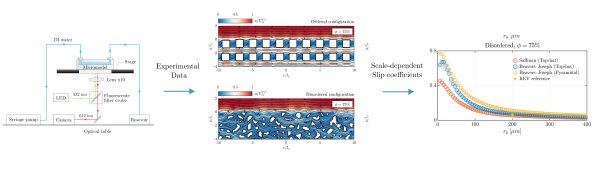
The interaction between a free-flow and a porous medium is frequently modeled using interfacial slip conditions, such as the Beavers–Joseph formulation. Despite extensive theoretical and numerical studies, the experimental determination of slip coefficients and their dependence on pore-scale geometry and averaging procedures remains insufficiently constrained. In this work, flow coupling at a fluid–porous interface is investigated using micro-particle image velocimetry (𝜇-PIV) measurements in Hele-Shaw-type microfluidic models. Both ordered and disordered porous media are examined, with bulk porosities of 55%, 75%, and 85%. Pore-scale velocity fields are systematically upscaled via spatial averaging to the representative elementary volume (REV) scale, enabling direct quantification
of slip velocities, interfacial velocity gradients, and the corresponding slip coefficients. The interfacial slip velocity is governed primarily by local pore geometry, whereas the Darcy velocity within the porous matrix depends strongly on bulk porosity and structural disorder. Both the Beavers–Joseph and Saffman slip coefficients vary not only with porosity but also with the size and shape of the averaging filter. At local and sub-REV scales, the two coefficients can differ by more than 100%, with convergence observed only after REV-scale averaging in low-permeability systems. In highly permeable ordered media, insufficient averaging can even yield non-physical negative slip coefficients. These findings show that slip coefficients are scale-dependent parameters rather than intrinsic material properties. Robust estimation therefore requires consistent REV-scale averaging and explicit reporting of the averaging procedure. More broadly, the results motivate standardized, geometry-aware protocols for determining and comparing interfacial slip conditions in porous media.
Predicting flow at fluid–porous interfaces remains challenging due to the scale dependence of interfacial slip parameters. Experiments across ordered and disordered porous structures demonstrate that slip coefficients depend on both pore-scale geometry and spatial averaging. These results establish the need for consistent averaging procedures to ensure reliable characterization and comparison of interfacial flow.
Downloads
References
1. Fatima Al Hameli, Hadi Belhaj, and Mohammed Al Dhuhoori. CO2 sequestration overview in geological formations: Trapping mechanisms matrix assessment. Energies, 15(20):7805, 2022. https://doi.org/10.3390/en15207805.
2. James Kofi Arthur. Flow through and over model porous media with or without inertial effects. University of Manitoba (Canada), 2012. URL: https://www.proquest.com/openview/ 5c70f05182780281619ffdcabcbc113e/1.pdf?cbl=18750&pq-origsite=gscholar.
3. Gordon S Beavers and Daniel D Joseph. Boundary conditions at a naturally permeable wall. Journal of fluid mechanics, 30(1):197–207, 1967. https://doi.org/10.1017/S0022112067001375.
4. GS Beavers, EM Sparrow, and BA Masha. Boundary condition at a porous surface which bounds a fluid flow. AIChE Journal, 20(3):596–597, 1974. https://doi.org/10.1002/aic.690200323.
5. Wim P. Breugem. The influence of wall permeability on laminar and turbulent flows: Theory and simulations. Ph.d. thesis, Delft University of Technology, 2004. URL: https://dutw1479.wbmt.tudelft.nl/~wim/phdthesis/.
6. Wim-Paul Breugem and Bendiks-Jan Boersma. Direct numerical simulations of turbulent flow over a permeable wall using a direct and a continuum approach. Physics of fluids, 17(2), 2005. https://doi.org/10.1063/1.1835771.
7. Hsun-Chuan Chan, WC Huang, Jan-Mou Leu, and Chan-Ji Lai. Macroscopic modeling of turbulent flow over a porous medium. International Journal of Heat and Fluid Flow, 28(5):1157–1166, 2007. https://doi.org/10.1016/j.ijheatfluidflow.2006.10.005.
8. M Chandesris and D Jamet. Boundary conditions at a planar fluid–porous interface for a poiseuille flow. International Journal of Heat and Mass Transfer, 49(13-14):2137–2150, 2006. https://doi.org/10.1016/j.ijheatmasstransfer.2005.12.010.
9. M Chandesris and D Jamet. Boundary conditions at a fluid–porous interface: an a priori estimation of the stress jump coefficients. International journal of heat and mass transfer, 50(17-18):3422–3436, 2007. https://doi.org/10.1016/j.ijheatmasstransfer.2007.01.053.
10. M Chandesris and D Jamet. Jump conditions and surface-excess quantities at a fluid/porous interface: a multi-scale approach. Transport in porous media, 78(3):419–438, 2009. https://doi.org/10.1007/s11242-008-9302-0.
11. Xiaodong Chen, Yongxian Zheng, Guo Wang, Yanzhi Wang, Xiangrong Luo, Qianhong Pan, Zhiguo Wang, and Wanzhuo Ping. Pore structure and fluid mobility of tight carbonate reservoirs in the western qaidam basin, china. Energy Science & Engineering, 11(10):3397–3412, 2023. https://doi.org/10.1002/ese3.1527.
12. Xu Chu, Wenkang Wang, Guang Yang, Alexandros Terzis, Rainer Helmig, and Bernhard Weigand. Transport of turbulence across permeable interface in a turbulent channel flow: interface-resolved direct numerical simulation. Transport in Porous Media, 136(1):165–189, 2021. https://doi.org/10.1007/s11242-020-01506-w.
13. Henry Darcy. Les fontaines publiques de la ville de Dijon: Exposition et application des principes à suivre et des formules à employer dans les questions de distribution d’eau: Ouvrage terminé par un appendice relatif aux fournitures d’eau de plusieurs villes, au filtrage des eaux et à la fabrication des tuyaux de fonte, de plomb, de tôle et de bitume, volume 2. Victor Dalmont, éditeur, 1856. URL: https://books.google.it/books?id=zCI4EpPPO1YC.
14. Mario Del Mastro, Rany Kabour, and Alexandros Terzis. Experimental validation of viscosity-invariant slip length at fluid–porous interfaces using water and oleic acid. Physics of Fluids, 37(8), 2025. https://doi.org/10.1063/5.0280010
15. Mario Del Mastro and Alexandros Terzis. An experimental investigation of boundary layer over permeable interfaces in hele-shaw micromodels. Physics of Fluids, 36(11), 2024. https://doi.org/10.1063/5.0238046.
16. Mario Del Mastro and Alexandros Terzis. On the exact solutions of darcy–brinkman model in rectangular hele–shaw channels under no-slip and slip boundary conditions. Physics of Fluids, 37(3), 2025. https://doi.org/10.1063/5.0256304.
17. Seonghyeon Hahn, Jongdoo Je, and Haecheon Choi. Direct numerical simulation of turbulent channel flow with permeable walls. Journal of Fluid Mechanics, 450:259–285, 2002. https://doi.org/10.1017/S0022112001006437.
18. John Pierre Herzig, Denis Maurice Leclerc, and P Le Goff. Flow of suspensions through porous media—application to deep filtration. Industrial & Engineering Chemistry, 62(5):8–35, 1970. https://doi.org/10.1021/ie50725a003.
19. Yan Jin and Andrey V Kuznetsov. Turbulence modeling for flows in wall bounded porous media: an analysis based on direct numerical simulations. Physics of Fluids, 29(4), 2017. https://doi.org/10.1063/1.4979062.
20. Jinliang Kang and Moran Wang. Brinkman double-layer model for flow at a free-porous interface. International Journal of Mechanical Sciences, 263:108770, 2024. https://doi.org/10.1016/j.ijmecsci.2023.108770.
21. Joel Koplik, Herbert Levine, and A Zee. Viscosity renormalization in the brinkman equation. The Physics of fluids, 26(10):2864–2870, 1983. https://doi.org/10.1063/5.0280010.
22. RE Larson and Jonathan JL Higdon. Microscopic flow near the surface of two-dimensional porous media. part 1. axial flow. Journal of Fluid Mechanics, 166:449–472, 1986. https://doi.org/10.1017/S0022112086000228.
23. RE Larson and Jonathan JL Higdon. Microscopic flow near the surface of two-dimensional porous media. part 2. transverse flow. Journal of Fluid Mechanics, 178:119–136, 1987. https://doi.org/10.1017/S0022112087001149.
24. Hejuan Liu, Chunhe Yang, Jianjun Liu, Zhengmeng Hou, Yachen Xie, and Xilin Shi. An overview of underground energy storage in porous media and development in china. Gas Science and Engineering, 117:205079, 2023. https://doi.org/10.1016/j.jgsce.2023.205079.
25. Fariza Mukasheva, Laura Adilova, Aibek Dyussenbinov, Bota Yernaimanova, Madi Abilev, and Dana Akilbekova. Optimizing scaffold pore size for tissue engineering: Insights across various tissue types. Frontiers in bioengineering and biotechnology, 12:1444986, 2024. https://doi.org/10.3389/fbioe.2024.1444986.
26. Graham Neale and Walter Nader. Practical significance of brinkman’s extension of darcy’s law: coupled parallel flows within a channel and a bounding porous medium. The Canadian Journal of Chemical Engineering, 52(4):475–478, 1974. https://doi.org/10.1002/cjce.5450520407.
27. J. Alberto Ochoa-Tapia and Stephen Whitaker. Momentum transfer at the boundary between a porous medium and a homogeneous fluid—i. theoretical development. International Journal of Heat and Mass Transfer, 38(14):2635–2646, 1995. https://doi.org/10.1016/0017-9310(94)00346-W.
28. J Alberto Ochoa-Tapia and Stephen Whitaker. Momentum transfer at the boundary between a porous medium and a homogeneous fluid—ii. comparison with experiment. International Journal of Heat and Mass Transfer, 38(14):2647–2655, 1995. https://doi.org/10.1016/0017-9310(94)00347-X.
29. J Alberto Ochoa-Tapia and Stephen Whitaker. Heat transfer at the boundary between a porous medium and a homogeneous fluid. International Journal of Heat and Mass Transfer, 40(11):2691–2707, 1997. https://doi.org/10.1016/S0017-9310(96)00250-5.
30. Michel Quintard and Stephen Whitaker. Transport in ordered and disordered porous media ii: Generalized volume averaging. Transport in Porous Media, 14(2):179–206, 1994. https://doi.org/10.1007/BF00615200.
31. Markus Raffel, Christian J. Kähler, Christian E. Willert, Steve T. Wereley, Fulvio Scarano, and Jürgen Kompenhans. Particle Image Velocimetry: A Practical Guide. Springer, 3rd edition, 2018. https://doi.org/10.1007/978-3-319-68852-7.
32. S Richardson. A model for the boundary condition of a porous material. part 2. Journal of Fluid Mechanics, 49(2):327–336, 1971. https://doi.org/10.1017/S002211207100209X.
33. Philip Geoffrey Saffman. On the boundary condition at the surface of a porous medium. Studies in applied mathematics, 50(2):93–101, 1971. https://doi.org/10.1002/sapm197150293.
34. Melik Sahraoui and Massoud Kaviany. Slip and no-slip velocity boundary conditions at interface of porous, plain media. International Journal of Heat and Mass Transfer, 35(4):927–943, 1992. https://doi.org/10.1016/0017-9310(92)90258-T.
35. Bo Tan, Chao Liu, Xiao Tan, Xueji You, Chaomeng Dai, Shuguang Liu, Jun Li, and Naiwen Li. Heavy metal transport driven by seawater-freshwater interface dynamics: The role of colloid mobilization and aquifer pore structure change. Water Research, 217:118370, 2022. https://doi.org/10.1016/j.watres.2022.118370.
36. GI t Taylor. A model for the boundary condition of a porous material. part 1. Journal of Fluid Mechanics, 49(2):319–326, 1971. https://doi.org/10.1017/S0022112071002088.
37. A Terzis, I Zarikos, K Weishaupt, G Yang, X Chu, R Helmig, and B Weigand. Microscopic velocity field measurements inside a regular porous medium adjacent to a low reynolds number channel flow. Physics of Fluids, 31(4), 2019. https://doi.org/10.1063/1.5092169.
38. William Thielicke and René Sonntag. Particle image velocimetry for matlab: Accuracy and enhanced algorithms in pivlab. Journal of Open Research Software, 9:12, 2021. https://doi.org/10.5334/jors.334.
39. William Thielicke and E. J. Stamhuis. Pivlab – towards user-friendly, affordable and accurate digital particle image velocimetry in matlab. Journal of Open Research Software, 2(1):e30, 2014. https://doi.org/http://dx.doi.org/10.5334/jors.bl.
40. FJ Valdés-Parada and Didier Lasseux. Flow near porous media boundaries including inertia and slip: A one-domain approach. Physics of Fluids, 33(7), 2021. https://doi.org/10.1063/5.0056345.
41. FJ Valdés-Parada and Didier Lasseux. A novel one-domain approach for modeling flow in a fluid-porous system including inertia and slip effects. Physics of Fluids, 33(2), 2021. https://doi.org/10.1063/5.0036812.
42. Guang Yang, Edward Coltman, Kilian Weishaupt, Alexandros Terzis, Rainer Helmig, and Bernhard Weigand. On the beavers–joseph interface condition for non-parallel coupled channel flow over a porous structure at high reynolds numbers. Transport in Porous Media, 128(2):431–457, 2019. https://doi.org/10.1007/s11242-019-01255-5.
Downloads
Published
Versions
- 2026-09-02 (2)
- 2026-07-15 (1)
Data Availability Statement
The data, code, and protocols supporting the findings of this study are available from the corresponding author upon reasonable request.
Issue
Section
License
Copyright (c) 2026 Mario Del Mastro, Alexandros Terzis

This work is licensed under a Creative Commons Attribution-NonCommercial-NoDerivatives 4.0 International License.
This article is published under the Creative Commons license indicated above. See the license link for details.
Article metadata are available under the CCo license.