
Crystal Growth in Porous Media
DOI:
https://doi.org/10.69631/9kd53x06Keywords:
Crystal nucleation, Crystal growth kinetics, Crystallization pressure, Reactive transport, Mineral precipitation, CO2 mineralization, Pore confinement, Machine learning, Surrogate modelling, Porous mediaAbstract
Crystalline silicate minerals and carbonates make up 90% to 95% of the Earth's lithosphere, the rigid outermost shell comprising the crust and uppermost solid mantle. Crystalline materials are continuously modified by fluid–rock interactions including crystal growth occurring along fractures and within pore spaces. Crystals form under conditions dictated by extrinsic factors, such as temperature, pressure, fluid composition, and pore confinement, as well as intrinsic factors such as crystal structure, chemical bonding, and anisotropy. While the thermodynamic stability and structure of crystals are well established, their rates of heterogeneous nucleation and growth remain poorly constrained. This is particularly true in porous media, where nucleation is frequently a distinct and rate-limiting step rather than a negligible precursor to growth, especially where non-classical pathways preclude a single, well-defined interfacial free energy.
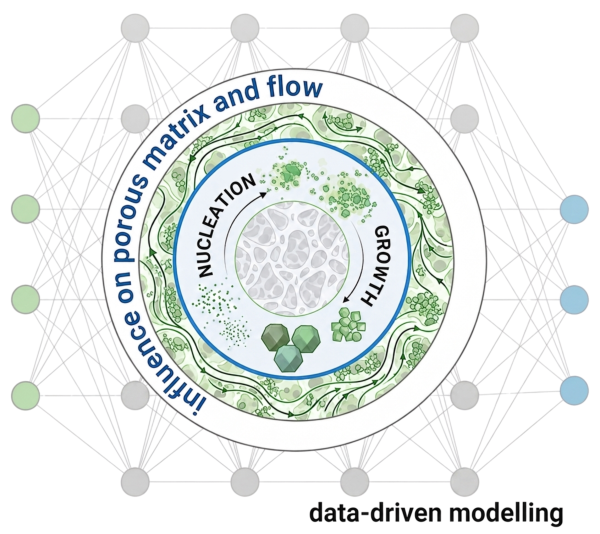
In this commentary, we outline how crystal nucleation and growth in porous media control pore-scale structure, flow, and transport, and we evaluate how these processes can be represented in numerical models across scales. We examine the distinct roles of nucleation pathways, growth kinetics, interfacial and confinement effects, and crystallization pressure in governing transient porosity, stress localization, and self-organized crystalline networks. Furthermore, we discuss how fluid flow and mixing modulate where and when these processes occur. These principles are illustrated through examples spanning well-controlled synthetic crystal growth in materials science to geo-energy and geoscience applications, such as basaltic CO2 mineralization, where probabilistic nucleation, reactive transport, and evolving pore architecture jointly control macroscopic behavior.
Finally, we assess the potential of machine learning and surrogate modeling approaches to bridge the persistent gap between molecular-scale mechanisms and field-scale predictions. By emphasizing mechanistic understanding over system-specific details, our goal is to help porous media scientists judge when crystallization is likely to matter, and to guide the selection of modeling approaches that remain both physically grounded and computationally tractable.
WHY THIS PAPER MATTERSCrystal nucleation and growth can progressively clog pore spaces, redirect fluid pathways, and transform the mechanical and transport behavior of porous rocks across scales. Is it possible to use information we have about nanoscale processes to predict reservoir-scale changes? This InterPore Commentary article synthesizes how confinement, interfacial free energies, and crystallization pressures control where crystals appear, how fast they grow, and when they damage or seal flow networks in natural and engineered systems. It then outlines how machine learning can be used to connect molecular, pore, and field scales for predictive modeling.
Downloads
References
1. Aminzadeh, A., Salasiya, P., Labuz, J. F., Nooraiepour, M., & Guzina, B. B. (2026). Ultrasonic sensing of the mechanical fingerprint of reactive transport in rock. International Journal of Rock Mechanics and Mining Sciences, 199, Article 106404. https://doi.org/10.1016/j.ijrmms.2026.106404
2. Anstine, D. M., & Isayev, O. (2023). Machine learning interatomic potentials and long-range physics. The Journal of Physical Chemistry. A, 127(11), 2417–2431. https://doi.org/10.1021/acs.jpca.2c06778
3. Arndt, N., & Ganino, C. (2011). Hydrothermal deposits, Metals and society (pp. 73–112). Springer Berlin Heidelberg. https://doi.org/10.1007/978-3-642-22996-1_4
4. Azizzadenesheli, K., Kovachki, N. B., Li, Z.-Y., Liu-Schiaffini, M., Kossaifi, J., & Anandkumar, A. (2024). Neural operators for accelerating scientific simulations and design. Nature Reviews Physics, 6(5), 320–328. https://doi.org/10.1038/s42254-024-00712-5
5. Batzner, S., Musaelian, A., Sun, L., Geiger, M., Mailoa, J. P., Kornbluth, M., Molinari, N., Smidt, T. E., & Kozinsky, B. (2022). E(3)-equivariant graph neural networks for data-efficient and accurate interatomic potentials. Nature Communications, 13(1), Article 2453. https://doi.org/10.1038/s41467-022-29939-5
6. Baxter, E. F., & DePaolo, D. J. (2000). Field measurement of slow metamorphic reaction rates at temperatures of 500∘ to 600∘C. Science, 288(5470), 1411–1414. https://doi.org/10.1126/science.288.5470.1411
7. Becker, G. F., & Day, A. L. (1916). Note on The linear force of growing crystals. In The Journal of Geology. JSTOR, 24(4), 313–333. https://doi.org/10.1086/622342
8. Beckingham, L. E. (2017). Evaluation of macroscopic porosity-permeability relationships in heterogeneous mineral dissolution and precipitation scenarios. Water Resources Research, 53(12), 10217–10230. https://doi.org/10.1002/2017WR021306
9. Benson, S. M., & Cook, P. (2005), Chapter 5. Underground geological storage. In B. Metz et al. (Eds.), IPCC special report on carbon dioxide capture and storage. Cambridge University Press.
10. Bons, P. D., Fusswinkel, T., Gomez-Rivas, E., Markl, G., Wagner, T., & Walter, B. (2014). Fluid mixing from below in unconformity-related hydrothermal ore deposits. Geology, 42(12), 1035–1038. https://doi.org/10.1130/G35708.1
11. Brady, A. B., Weber, J., Yuan, K., Allard, L. F., Avina, O., Ogaz, R., Chang, Y.-J., Rampal, N., Starchenko, V., Rother, G., Anovitz, L. M., Bañuelos, J. L., Wang, H.-W., & Stack, A. G. (2022). In situ observations of barium sulfate nucleation in nanopores. Crystal Growth and Design, 22(12), 6941–6951. https://doi.org/10.1021/acs.cgd.2c00592
12. Brandel, C., & ter Horst, J. H. (2015). Measuring induction times and crystal nucleation rates. Faraday Discussions, 179, 199–214. https://doi.org/10.1039/c4fd00230j
13. Breit, A., Waltersdorfer, L., Ekaputra, F. J., Sabou, M., Ekelhart, A., Iana, A., Paulheim, H., Portisch, J., Revenko, A. T., Teije, A. T., & Van Harmelen, F. (2023). International Workshop on Neural-Symbolic Learning and Reasoning. ACM Computing Surveys, 55(14s), 1–41. https://doi.org/10.1145/3586163
14. Brekke-Svaland, G., & Bresme, F. (2018). Interactions between hydrated calcium carbonate surfaces at nanoconfinement conditions. The Journal of Physical Chemistry C, 122(13), 7321–7330. https://doi.org/10.1021/ACS.JPCC.8B01557
15. Brunauer, S., Emmett, P. H., & Teller, E. (1938). Adsorption of gases in multimolecular layers. Journal of the American Chemical Society, 60(2), 309–319. https://doi.org/10.1021/JA01269A023
16. Burton, W. K., Cabrera, N., & Frank, F. C. (1951). The growth of crystals and the equilibrium structure of their surfaces. Philosophical Transactions of the Royal Society of London Series. Part A, 243(866), 299–358. https://doi.org/10.1098/rsta.1951.0006
17. Bussi, G., & Branduardi, D. (2015). Free-energy calculations with metadynamics: Theory and practice. Reviews in Computational Chemistry, 1–49. https://doi.org/10.1002/9781118889886.CH1
18. Bussi, G., & Laio, A. (2020). Using metadynamics to explore complex free-energy landscapes. Nature Reviews Physics, 2(4), 200–212. https://doi.org/10.1038/s42254-020-0153-0
19. Butt, H.-J., & Kappl, M. (2018). Surface and interfacial forces 2ème. John Wiley & Sons. https://doi.org/10.1002/9783527804351
20. Cacciarelli, D., & Kulahci, M. (2023). Active learning for data streams: A survey. Machine Learning, 113(1), 185–239. https://doi.org/10.1007/s10994-023-06454-2
21. Cao, H., Tan, C., Gao, Z., Xu, Y., Chen, G., Heng, P.-A., & Li, S. Z. (2024). A survey on generative diffusion models. IEEE Transactions on Knowledge and Data Engineering, 36(7), 2814–2830. https://doi.org/10.1109/TKDE.2024.3361474
22. Carreño-Márquez, I. J. A., Castillo-Sandoval, I., Pérez-Cázares, B. E., Fuentes-Cobas, L. E., Esparza-Ponce, H. E., Menéndez-Méndez, E., Fuentes-Montero, M. E., & Montero-Cabrera, M. E. (2021). Evolution of the astonishing Naica giant crystals in Chihuahua, Mexico. Minerals, 11(3), 292. https://doi.org/10.3390/MIN11030292
23. Chawla, N., & Ganju, E. (2025). Four-dimensional materials science: Time-resolved x-ray microcomputed tomography. MRS Bulletin, 50(4), 398–415. https://doi.org/10.1557/s43577-025-00859-1
24. Chen, C., & Ong, S. P. (2022). A universal graph deep learning interatomic potential for the periodic table. Nature Computational Science, 2(11), 718–728. https://doi.org/10.1038/s43588-022-00349-3
25. Chtchelkatchev, N. M., Ryltsev, R. E., Ankudinov, V. E., & Rozas, R. E. (2025). Machine-learning interatomic potential for barium sulfide: From thermodynamic properties to crystal growth kinetics. The Journal of Chemical Physics, 163(21), Article 214502. https://doi.org/10.1063/5.0304792
26. Correns, C. W. (1949). Growth and dissolution of crystals under linear pressure. Discussions of the Faraday Society, 5, 267. https://doi.org/10.1039/DF9490500267
27. Coussy, O. (2006). Deformation and stress from in-pore drying-induced crystallization of salt. Journal of the Mechanics and Physics of Solids, 54(8), 1517–1547. https://doi.org/10.1016/J.JMPS.2006.03.002
28. Darkins, R., Kim, Y.-Y., Green, D. C., Broad, A., Duffy, D. M., Meldrum, F. C., & Ford, I. J. (2022). Calcite kinetics for spiral growth and two-dimensional nucleation. Crystal Growth and Design, 22(7), 4431–4436. https://doi.org/10.1021/acs.cgd.2c00378
29. Debenedetti, P. G., Kim, Y.-Y., Meldrum, F. C., & Tanaka, H. (2024). Special topic preface: Nucleation—Current understanding approaching 150 years after Gibbs. The Journal of Chemical Physics, 160(10), Article 100401. https://doi.org/10.1063/5.0203119
30. Deng, B., Zhong, P., Jun, K., Riebesell, J., Han, K., Bartel, C. J., & Ceder, G. (2023). CHGNet as a pretrained universal neural network potential for charge-informed atomistic modelling. Nature Machine Intelligence, 5(9), 1031–1041. https://doi.org/10.1038/s42256-023-00716-3
31. Deng, H., & Poonoosamy, J. (2025). Mineral precipitation in porous media systems: Controlling factors and impacts on porous media evolution. Advances in Colloid and Interface Science, 348, Article 103745. https://doi.org/10.1016/j.cis.2025.103745
32. Deng, H., Poonoosamy, J., & Molins, S. (2022). A reactive transport modeling perspective on the dynamics of interface-coupled dissolution-precipitation. Applied Geochemistry, 137, Article 105207. https://doi.org/10.1016/j.apgeochem.2022.105207
33. Deng, H., Yu, C., Jiang, Q., Gu, C., & Luo, Y. (2025). Multi-parameter effects on CO2 mineralization in basalt: A numerical-sensitivity analysis of CO2 storage in basalt from Sichuan Basin, southwestern China. Energy, 335, Article 137803. https://doi.org/10.1016/j.energy.2025.137803
34. Dentz, M., Le Borgne, T., Englert, A., & Bijeljic, B. (2011). Mixing, spreading and reaction in heterogeneous media: A brief review. Journal of Contaminant Hydrology, 120–121, 1–17. https://doi.org/10.1016/j.jconhyd.2010.05.002
35. Deringer, V. L. (2020). Modelling and understanding battery materials with machine-learning-driven atomistic simulations. Journal of Physics: Energy, 2(4), Article 041003. https://doi.org/10.1088/2515-7655/abb011
36. Deringer, V. L., Bartók, A. P., Bernstein, N., Wilkins, D. M., Ceriotti, M., & Csányi, G. (2021). Gaussian process regression for materials and molecules. Chemical Reviews, 121(16), 10073–10141. https://doi.org/10.1021/acs.chemrev.1c00022
37. Deringer, V. L., Caro, M. A., & Csányi, G. (2019). Machine learning interatomic potentials as emerging tools for materials science. Advanced Materials, 31(46), Article e1902765. https://doi.org/10.1002/adma.201902765
38. Derluyn, H., Moonen, P., & Carmeliet, J. (2014). Deformation and damage due to drying-induced salt crystallization in porous limestone. Journal of the Mechanics and Physics of Solids, 63, 242–255. https://doi.org/10.1016/J.JMPS.2013.09.005
39. Derluyn, H., & Prat, M. (2024). Salt crystallization in porous media. John Wiley & Sons. https://doi.org/10.1002/9781394312436
40. Von Damm, K. L. (1990). Seafloor hydrothermal activity: Black smoker chemistry and chimneys. Annual Review of Earth and Planetary Sciences, 18(1), 173–204. https://doi.org/10.1146/ANNUREV.EA.18.050190.001133
41. Dąbrowski, K. M., Nooraiepour, M., Masoudi, M., Soomro, A. N., Smulski, R., Barbacki, J., Hellevang, H., & Nagy, S. (2026). Pore-scale salt precipitation during CO2 injection: How additives and interfacial tension govern crystallization? International Journal of Greenhouse Gas Control, 154, Article 104695. https://doi.org/10.1016/j.ijggc.2026.104695
42. Desarnaud, J., Bonn, D., & Shahidzadeh, N. (2016). The pressure induced by salt crystallization in confinement. Scientific Reports, 6(1), Article 30856. https://doi.org/10.1038/srep30856
43. Diao, Y., Myerson, A. S., Hatton, T. A., & Trout, B. L. (2011). Surface design for controlled crystallization: The role of surface chemistry and nanoscale pores in heterogeneous nucleation. Langmuir, 27(9), 5324–5334. https://doi.org/10.1021/la104351k
44. Dobberschütz, S., Nielsen, M. R., Sand, K. K., Civioc, R., Bovet, N., Stipp, S. L. S., & Andersson, M. P. (2018). The mechanisms of crystal growth inhibition by organic and inorganic inhibitors. Nature Communications, 9(1), Article 1578. https://doi.org/10.1038/s41467-018-04022-0
45. Donaldson, S. H., Røyne, A., Kristiansen, K., Rapp, M. V., Das, S., Gebbie, M. A., Lee, D. W., Stock, P., Valtiner, M., & Israelachvili, J. (2015). Developing a general interaction potential for hydrophobic and hydrophilic interactions. Langmuir, 31(7), 2051–2064. https://doi.org/10.1021/la502115g
46. Duruisseaux, V., Kossaifi, J., & Anandkumar, A. (2025). Fourier neural operators explained: A practical perspective. arXiv.org. https://doi.org/10.48550/arXiv.2512.01421
47. Dziadkowiec, J., Javadi, S., Bratvold, J. E., Nilsen, O., & Røyne, A. (2018). Surface forces apparatus measurements of interactions between rough and reactive calcite surfaces. Langmuir, 34(25), 7248–7263. https://doi.org/10.1021/acs.langmuir.8b00797
48. Dziadkowiec, J., Linga, G., Kalchgruber, L., Kavunga, S., Cheng, H.-W., Nilsen, O., Campsteijn, C., Pokroy, B., & Valtiner, M. (2024). Electrochemically assisted growth of hopper and tabular calcite under confinement. Crystal Growth and Design, 24(12), 4930–4943. https://doi.org/10.1021/acs.cgd.3c01433
49. Dziadkowiec, J., & Røyne, A. (2025). Ion-dependent calcium carbonate cohesion: Insights from surface forces measured between calcite surfaces. Reviews in Mineralogy and Geochemistry, 91A(1), 251–293. https://doi.org/10.2138/rmg.2025.91a.08
50. Dziadkowiec, J., Zareeipolgardani, B., Dysthe, D. K., & Røyne, A. (2019). Nucleation in confinement generates long-range repulsion between rough calcite surfaces. Scientific Reports, 9(1), Article 8948. https://doi.org/10.1038/s41598-019-45163-6
51. Elderfield, H., & Ganssen, G. (2000). Past temperature and 𝛿18o of surface ocean waters inferred from foraminiferal mg/ca ratios. Nature, 405(6785), 442–445. https://doi.org/10.1038/35013033
52. Elmorsy, M., El-Dakhakhni, W., & Zhao, B. (2022). Generalizable permeability prediction of digital porous media via a novel multi-scale 3D convolutional neural network. Water Resources Research, 58(3), Article WR031454, e2021. https://doi.org/10.1029/2021WR031454
53. Emiliani, C. (1955). Pleistocene temperatures. The Journal of Geology, 63(6), 538–578. https://doi.org/10.1086/626295
54. Espinosa, R. M., Franke, L., & Deckelmann, G. (2008). Model for the mechanical stress due to the salt crystallization in porous materials. Construction and Building Materials, 22(7), 1350–1367. https://doi.org/10.1016/J.CONBUILDMAT.2007.04.013
55. Espinosa-Marzal, R. M., & Scherer, G. W. (2010). Advances in understanding damage by salt crystallization. Accounts of Chemical Research, 43(6), 897–905. https://doi.org/10.1021/ar9002224
56. Falcon-Suarez, I. H., Livo, K., Callow, B., Marín-Moreno, H., Prasad, M., & Best, A. I. (2020). Geophysical early warning of salt precipitation during geological carbon sequestration. Scientific Reports, 10(1), Article 16472. https://doi.org/10.1038/s41598-020-73091-3
57. Stach, E., DeCost, B., Kusne, A. G., Hattrick-Simpers, J., Brown, K. A., Reyes, K. G., Schrier, J., Billinge, S., Buonassisi, T., Foster, I., Gomes, C. P., Gregoire, J. M., Mehta, A., Montoya, J., Olivetti, E., Park, C., Rotenberg, E., Saikin, S. K., Smullin, S., . . . Maruyama, B. (2021). Autonomous experimentation systems for materials development: A community perspective. Matter, 4(9), 2702–2726. https://doi.org/10.1016/j.matt.2021.06.036
58. Van Driessche, A. E. S., García-Ruiz, J. M., Delgado-López, J. M., & Sazaki, G. (2010). In situ observation of step dynamics on gypsum crystals. Crystal Growth and Design, 10(9), 3909–3916. https://doi.org/10.1021/cg100323e
59. Farajzadeh, R., & Niasar, V. (2026). On the importance of capillary-pressure gradient on water backflow during subsurface CO2 storage. Chemical Engineering Journal, 534, Article 175212. https://doi.org/10.1016/j.cej.2026.175212
60. Fatah, A., Mahmud, H. B., Bennour, Z., Gholami, R., & Hossain, M. (2022). Geochemical modelling of CO2 interactions with shale: Kinetics of mineral dissolution and precipitation on geological time scales. Chemical Geology, 592, Article 120742. https://doi.org/10.1016/j.chemgeo.2022.120742
61. Fazeli, H., Masoudi, M., Patel, R. A., Aagaard, P., & Hellevang, H. (2020). Pore-scale modeling of nucleation and growth in porous media. ACS Earth and Space Chemistry, 4(2), 249–260. https://doi.org/10.1021/acsearthspacechem.9b00290
62. Fellah, N., Dela Cruz, I. J. C., Alamani, B. G., Shtukenberg, A. G., Pandit, A. V., Ward, M. D., & Myerson, A. S. (2024). Crystallization and polymorphism under nanoconfinement. Crystal Growth and Design, 24(8), 3527–3558. https://doi.org/10.1021/acs.cgd.3c01082
63. Filiberto, L. H., Putnis, C. V., & Julia, M. (2023). Factors controlling reaction pathways during fluid–rock interactions. Contributions to Mineralogy and Petrology, 178(8), 53. https://doi.org/10.1007/s00410-023-02037-5
64. Flatt, R. J. (2002). Salt damage in porous materials: How high supersaturations are generated. Journal of Crystal Growth, 242(3–4), 435–454. https://doi.org/10.1016/S0022-0248(02)01429-X
65. Flatt, R. J., & Scherer, G. W. (2008). Thermodynamics of crystallization stresses in def. Cement and Concrete Research, 38(3), 325–336. https://doi.org/10.1016/J.CEMCONRES.2007.10.002
66. Flatt, R. J., Steiger, M., & Scherer, G. W. (2007). A commented translation of the paper by CW Correns and W. Steinborn on crystallization pressure. Environmental Geology, 52(2), 187–203. https://doi.org/10.1007/S00254-006-0509-5
67. Fuller, R. C., Prevost, J. H., & Piri, M. (2006). Three-phase equilibrium and partitioning calculations for CO2 sequestration in saline aquifers. Journal of Geophysical Research: Solid Earth, 111(B6). https://doi.org/10.1029/2005JB003618
68. Gal, M., & Rubinfeld, D. L. (2018). Data standardization. SSRN Electronic Journal, 94(4), 737–770. https://doi.org/10.2139/ssrn.3326377
69. Garcia-Garcia, A., Orts, S., Oprea, S., Villena-Martinez, V., & Rodríguez, J. G. (2017). A review on deep learning techniques applied to semantic segmentation. arXiv.org. https://doi.org/10.48550/arXiv.1704.06857
70. Gardner, J., Wheeler, J., & Mariani, E. (2021). Interactions between deformation and dissolution-precipitation reactions in plagioclase feldspar at greenschist facies. Lithos, 396–397, Article 106241. https://doi.org/10.1016/J.LITHOS.2021.106241
71. Gebauer, D., Raiteri, P., Gale, J. D., & Cölfen, H. (2018). On classical and non-classical views on nucleation. American Journal of Science, 318(9), 969–988. https://doi.org/10.2475/09.2018.05
72. Giuntoli, F., Menegon, L., & Warren, C. J. (2018). Replacement reactions and deformation by dissolution and precipitation processes in amphibolites. Journal of Metamorphic Geology, 36(9), 1263–1286. https://doi.org/10.1111/jmg.12445
73. Goan, E., & Fookes, C. (2020). Bayesian neural networks: An introduction and survey. In K. L. Mengersen, P. Pudlo, C. P. Robert (Eds.), Case Studies in Applied Bayesian Data Science (pp. 45–87). Springer International Publishing. https://doi.org/10.1007/978-3-030-42553-1_3
74. Gratier, J.-P., Frery, E., Deschamps, P., Røyne, A., Renard, F., Dysthe, D., Ellouz-Zimmerman, N., & Hamelin, B. (2012). How travertine veins grow from top to bottom and lift the rocks above them: The effect of crystallization force. Geology, 40(11), 1015–1018. https://doi.org/10.1130/G33286.1
75. Gratz, A. J., & Hillner, P. E. (1993). Poisoning of calcite growth viewed in the atomic force microscope (AFM). Journal of Crystal Growth, 129(3–4), 789–793. https://doi.org/10.1016/0022-0248(93)90515-X
76. Griffin, L. J. (1951). Cxxxiii. microscopic studies on beryl crystals.—II. Dislocations and the growth of prism faces. The London, Edinburgh, and Dublin Philosophical Magazine and Journal of Science, 42(335), 1337–1352. https://doi.org/10.1080/14786445108560951
77. Guo, Y., Liu, Y., Georgiou, T., & Lew, M. S. (2017). A review of semantic segmentation using deep neural networks. International Journal of Multimedia Information Retrieval, 7(2), 87–93. https://doi.org/10.1007/s13735-017-0141-z
78. Guren, M. G., Sveinsson, H. A., Hafreager, A., Jamtveit, B., Malthe-Sørenssen, A., & Renard, F. (2021). Molecular dynamics study of confined water in the periclase–brucite system under conditions of reaction-induced fracturing. Geochimica et Cosmochimica Acta, 294, 13–27. https://doi.org/10.1016/j.gca.2020.11.016
79. Harrison, A. D., Whale, T. F., Carpenter, M. A., Holden, M. A., Neve, L., O’Sullivan, D., Vergara Temprado, J. V., & Murray, B. J. (2016). Not all feldspars are equal: A survey of ice nucleating properties across the feldspar group of minerals. Atmospheric Chemistry and Physics, 16(17), 10927–10940. https://doi.org/10.5194/acp-16-10927-2016
80. Hasson, D., Drak, A., & Semiat, R. (2001). Inception of caso4 scaling on RO membranes at various water recovery levels. Desalination, 139(1–3), 73–81. https://doi.org/10.1016/S0011-9164(01)00296-X
81. Haymon, R. M. (1983). Growth history of hydrothermal black smoker chimneys. Nature, 301(5902), 695–698. https://doi.org/10.1038/301695A0
82. He, W., Jiang, Z., Xiao, T., Xu, Z., & Li, Y. (2026). A survey on uncertainty quantification methods for deep learning. ACM Computing Surveys, 58(7), 1–35. https://doi.org/10.1145/3786319
83. Hellevang, H., & Aagaard, P. (2013). Can the long-term potential for carbonatization and safe long-term CO2 storage in sedimentary formations be predicted? Applied Geochemistry, 39, 108–118. https://doi.org/10.1016/J.APGEOCHEM.2013.09.012
84. Hellevang, H., Fischer, C., Nooraiepour, M., Molins, S., Masoudi, M., & Prasianakis, N. I. (2026). Bridging nanoscopic surface heterogeneity and macroscopic nucleation rates: A perspective on probabilistic approaches. Crystal Growth and Design. https://doi.org/10.1021/acs.cgd.6c00312
85. Hellevang, H., Haile, B. G., & Tetteh, A. (2017). Experimental study to better understand factors affecting the CO2 mineral trapping potential of basalt. Greenhouse Gases: Science and Technology, 7(1), 143–157. https://doi.org/10.1002/GHG.1619
86. Hellevang, H., Miri, R., & Haile, B. G. (2014). New insights into the mechanisms controlling the rate of crystal growth. Crystal Growth and Design, 14(12), 6451–6458. https://doi.org/10.1021/cg501294w
87. Hellevang, H., Pham, V. T. H., & Aagaard, P. (2013). Kinetic modelling of CO2–water–rock interactions. International Journal of Greenhouse Gas Control, 15, 3–15. https://doi.org/10.1016/J.IJGGC.2013.01.027
88. Henley, R. W., & Ellis, A. J. (1983). Geothermal systems ancient and modern: A geochemical review. Earth-Science Reviews, 19(1), 1–50. https://doi.org/10.1016/0012-8252(83)90075-2
89. Heřmanská, M., Voigt, M. J., Marieni, C., Declercq, J., & Oelkers, E. H. (2022). A comprehensive and internally consistent mineral dissolution rate database: Part I: Primary silicate minerals and glasses. Chemical Geology, 597, Article 120807. https://doi.org/10.1016/j.chemgeo.2022.120807
90. Holdsworth, C. M., John, C. M., Snæbjörnsdóttir, S. Ó., Johnson, G., Sigfússon, B., Leslie, R., Haszeldine, R. S., & Gilfillan, S. M. V. (2024). Reconstructing the temperature and origin of CO2 mineralisation in CarbFix calcite using clumped, carbon and oxygen isotopes. Applied Geochemistry, 162, Article 105925. https://doi.org/10.1016/j.apgeochem.2024.105925
91. Hawchar, B. M., Honorio, T., Vandamme, M., Osselin, F., Pereira, J., Mercury, L., Brochard, L., & Brochard, L., . . . Brochard, L. (2025). Exploring crystallization pressure limits via molecular simulation. The Journal of Chemical Physics, 163(21), Article 214708. https://doi.org/10.1063/5.0282117
92. Hawchar, B. M., Mercury, L., Honorio, T., Vandamme, M., Osselin, F., Pereira, J.-M., & Brochard, L. (2026). Fluorescence-based detection of apparent crystallization pressure in microfluidic channels. Journal of Crystal Growth, 694, Article 128749. https://doi.org/10.1016/j.jcrysgro.2026.128749
93. Hopkinson, L., Kristova, P., Rutt, K., & Cressey, G. (2012). Phase transitions in the system MgO−CO2−H2O during CO2 degassing of Mg-bearing solutions. Geochimica et Cosmochimica Acta, 76, 1–13. https://doi.org/10.1016/J.GCA.2011.10.023
94. Huerta, E. A., Blaiszik, B., Brinson, L. C., Bouchard, K. E., Diaz, D., Doglioni, C., Duarte, J. M., Emani, M., Foster, I. T., Fox, G., Harris, P., Heinrich, L., Jha, S., Katz, D. S., Kindratenko, V., Kirkpatrick, C. R., Lassila-Perini, K., Madduri, R. K., Neubauer, M. S., . . . Zhu, R. (2023). Fair for ai: An interdisciplinary and international community building perspective. Scientific Data, 10(1), Article 487. https://doi.org/10.1038/s41597-023-02298-6
95. Israelachvili, N. (1985). Intermolecular and surface forces. Academic Press. https://doi.org/10.1016/b978-0-12-391927-4.10024-6
96. Jamero, J., Zarrouk, S. J., & Mroczek, E. (2018). Mineral scaling in two-phase geothermal pipelines: Two case studies. Geothermics, 72, 1–14. https://doi.org/10.1016/j.geothermics.2017.10.015
97. Jannesarahmadi, S., Aminzadeh, M., Helmig, R., Or, D., & Shokri, N. (2024). Quantifying salt crystallization impact on evaporation dynamics from porous surfaces. Geophysical Research Letters, 51(22), Article GL111080, e2024. https://doi.org/10.1029/2024GL111080
98. Jha, P. K. (2026). From theory to application: A practical introduction to neural operators in scientific computing. Mathematics, 14(13), 2421. https://doi.org/10.3390/math14132421
99. Jiang, Q., & Ward, M. D. (2014). Crystallization under nanoscale confinement. Chemical Society Reviews, 43(7), 2066–2079. https://doi.org/10.1039/c3cs60234f
100. Jospin, L. V., Laga, H., Boussaid, F., Buntine, W., & Bennamoun, M. (2022). Hands-on bayesian neural networks—A tutorial for deep learning users. IEEE Computational Intelligence Magazine, 17(2), 29–48. https://doi.org/10.1109/MCI.2022.3155327
101. Kahraman, S. (2001). Evaluation of simple methods for assessing the uniaxial compressive strength of rock. International Journal of Rock Mechanics and Mining Sciences, 38(7), 981–994. https://doi.org/10.1016/S1365-1609(01)00039-9
102. Kalinina, I., Gozhyj, A., Bidyuk, P., Gozhyi, V., Korobchynskyi, M., & Nadraga, V. (2025). A systematic approach to data normalization and standardization in machine learning problems. In S. Babichev, V. Lytvynenko (Eds.), Lecture notes in data engineering, computational intelligence, and decision-making, volume 2 (pp. 206–219). Springer Nature Switzerland. https://doi.org/10.1007/978-3-031-88483-2_11
103. Kapoor, A., Grauman, K., Urtasun, R., & Darrell, T. (2007). Active learning with gaussian processes for object categorization. In IEEE International Conference on Computer Vision (pp. 1–8). https://doi.org/10.1109/ICCV.2007.4408844
104. Kelemen, P. B., & Hirth, G. (2012). Reaction-driven cracking during retrograde metamorphism: Olivine hydration and carbonation. Earth and Planetary Science Letters, 345–348, 81–89. https://doi.org/10.1016/J.EPSL.2012.06.018
105. Keriven, N., & Peyré, G. (2019). Universal invariant and equivariant graph neural networks. Neural Information Processing Systems, 32.
106. Khan, S., Naseer, M., Hayat, M., Zamir, S. W., Khan, F. S., & Shah, M. (2022). Transformers in vision: A survey. ACM Computing Surveys, 54(10s), 1–41. https://doi.org/10.1145/3505244
107. Khandoozi, S., Hazlett, R., & Fustic, M. (2023). A critical review of CO2 mineral trapping in sedimentary reservoirs—From theory to application: Pertinent parameters, acceleration methods and evaluation workflow. Earth-Science Reviews, 244, Article 104515. https://doi.org/10.1016/j.earscirev.2023.104515
108. Kim, K., Kim, D., Na, Y., Song, Y., & Wang, J. (2023). A review of carbon mineralization mechanism during geological CO2 storage. Heliyon, 9(12), Article e23135. https://doi.org/10.1016/j.heliyon.2023.e23135
109. Kim, K.-Y., Han, W. S., Oh, J., Kim, T., & Kim, J.-C. (2012). Characteristics of salt-precipitation and the associated pressure build-up during CO2 storage in saline aquifers. Transport in Porous Media, 92(2), 397–418. https://doi.org/10.1007/s11242-011-9909-4
110. Kiselev, A., Bachmann, F., Pedevilla, P., Cox, S. J., Michaelides, A., Gerthsen, D., & Leisner, T. (2017). Active sites in heterogeneous ice nucleation—The example of k-rich feldspars. Science, 355(6323), 367–371. https://doi.org/10.1126/science.aai8034
111. Kohler, F., Pierre-Louis, O., & Dysthe, D. K. (2022). Crystal growth in confinement. Nature Communications, 13(1), Article 6990. https://doi.org/10.1038/s41467-022-34330-5
112. Kotsiantis, S. (2007). Supervised machine learning: A review of classification techniques. Informatica, 160(1), 3–24.
113. Van Houdt, G., Mosquera, C., & Nápoles, G. (2020). A review on the long short-term memory model. Artificial Intelligence Review, 53(8), 5929–5955. https://doi.org/10.1007/s10462-020-09838-1
114. Kästner, J. (2011). Umbrella sampling. WIREs Computational Molecular Science, 1(6), 932–942. https://doi.org/10.1002/wcms.66
115. Koudelková, V., Wolf, B., Hrbek, V., & Vítů, T. (2020). Experimental measurement of disjoining force at the glass–salt interface: A direct evidence of salt degradation potential caused by crystallization pressure. Journal of Cultural Heritage, 42, 1–7. https://doi.org/10.1016/j.culher.2019.10.003
116. Kovachki, N., Li, Z., Liu, B., Azizzadenesheli, K., Bhattacharya, K., Stuart, A., & Anandkumar, A. (2023). Neural operator: Learning maps between function spaces with applications to PDEs. Journal of Machine Learning Research, 24(89), 1–97.
117. Kunther, W., Lothenbach, B., & Skibsted, J. (2015). Influence of the ca/si ratio of the c–s–h phase on the interaction with sulfate ions and its impact on the ettringite crystallization pressure. Cement and Concrete Research, 69, 37–49. https://doi.org/10.1016/J.CEMCONRES.2014.12.002
118. Lakshminarayanan, B., Pritzel, A., & Blundell, C. (2016). Simple and scalable predictive uncertainty estimation using deep ensembles. Neural Information Processing Systems, 30. https://doi.org/10.48550/arXiv.1612.01474
119. Lambart, S., Savage, H. M., Robinson, B. G., & Kelemen, P. B. (2018). Experimental investigation of the pressure of crystallization of ca (OH) 2: Implications for the reactive cracking process. Geochemistry, Geophysics, Geosystems, 19(9), 3448–3458. https://doi.org/10.1029/2018GC007609
120. Lavalle, J. (1853). Recherches sur la formation lente des cristaux à la température ordinaire. Comptes Rendus Hebdomadaires des Séances de l’Académie des Sciences, 36, 493–495.
121. Le Borgne, T., Dentz, M., & Villermaux, E. (May 2013). Stretching, coalescence, and mixing in porous media. Physical Review Letters, 110(20), Article 204501. https://doi.org/10.1103/PhysRevLett.110.204501
122. Leemann, A., Góra, M., Lothenbach, B., & Heuberger, M. (2024). Alkali silica reaction in concrete-revealing the expansion mechanism by surface force measurements. Cement and Concrete Research, 176, Article 107392. https://doi.org/10.1016/j.cemconres.2023.107392
123. Li, C., Liu, Z., Goonetilleke, E. C., & Huang, X. (2021). Temperature-dependent kinetic pathways of heterogeneous ice nucleation competing between classical and non-classical nucleation. Nature Communications, 12(1), Article 4954. https://doi.org/10.1038/s41467-021-25267-2
124. Li, L., Kohler, F., Dziadkowiec, J., Røyne, A., Espinosa Marzal, R. M. E., Bresme, F., Jettestuen, E., & Dysthe, D. K. (2022). Limits to crystallization pressure. Langmuir, 38(37), 11265–11273. https://doi.org/10.1021/acs.langmuir.2c01325
125. Li, Q., Fernandez-Martinez, A., Lee, B., Waychunas, G. A., & Jun, Y.-S. (2014). Interfacial energies for heterogeneous nucleation of calcium carbonate on mica and quartz. Environmental Science and Technology, 48(10), 5745–5753. https://doi.org/10.1021/es405141j
126. Li, Z., Kovachki, N., Azizzadenesheli, K., Liu, B., Bhattacharya, K., Stuart, A., & Anandkumar, A. (2020). Fourier neural operator for parametric partial differential equations. International Conference on Learning Representations.
127. Li, Z., Liu, F., Yang, W., Peng, S., & Zhou, J. (2022). A survey of convolutional neural networks: Analysis, applications, and prospects. IEEE Transactions on Neural Networks and Learning Systems, 33(12), 6999–7019. https://doi.org/10.1109/TNNLS.2021.3084827
128. Linga, G., Pierce, K., Moura, M., Mathiesen, J., Renard, F., & Le Borgne, T. (2026). Dynamic multiphase flow triggers chaotic mixing in porous media. Proceedings of the National Academy of Sciences of the United States of America, 123(34), Article e2612884123. https://doi.org/10.1073/pnas.2612884123
129. Liu, S., Yu, Y., Zhang, T., Liu, H., Liu, X., & Meng, D. (2025). Architectures, variants, and performance of neural operators: A comparative review. Neurocomputing, 648, Article 130518. https://doi.org/10.1016/j.neucom.2025.130518
130. Liu, Z., Chen, S., Chen, Y., Zhong, L., Tao, R., Niu, Y., Yu, Z., & Coogan, L. A. (2025). Timing of carbon uptake during seafloor alteration: Insight from in situ U-Pb dating at DSDP sites 417A and 417D. Chemical Geology, 674, Article 122571. https://doi.org/10.1016/j.chemgeo.2024.122571
131. Lyu, X., & Ren, X. (2024). Microstructure reconstruction of 2D/3D random materials via diffusion-based deep generative models. Scientific Reports, 14(1), Article 5041. https://doi.org/10.1038/s41598-024-54861-9
132. Joyce, H. J., Gao, Q., Hoe Tan, H., Jagadish, C., Kim, Y., Zou, J., Smith, L. M., Jackson, H. E., Yarrison-Rice, J. M., Parkinson, P., & Johnston, M. B. (2011). International Conference on Microwave and Photonics. Progress in Quantum Electronics, 35(2–3), 23–75. https://doi.org/10.1016/j.pquantelec.2011.03.002
133. Ma, T., Deng, H., Kang, P., Feng, Y., Yang, X., Zhao, L., Li, X., Wang, D., Chen, X., Yang, Z., Qiu, W., Ji, J., & Liu, Y. (2026). Flow-driven regulation of caco3 precipitation and fracture evolution in heterogeneous fractures. Geochimica et Cosmochimica Acta, 419, 225–240. https://doi.org/10.1016/j.gca.2026.03.001
134. MacLeod, B. P., Parlane, F. G. L., Morrissey, T. D., Häse, F., Roch, L. M., Dettelbach, K. E., Moreira, R., Yunker, L. P. E., Rooney, M. B., Deeth, J. R., Lai, V., Ng, G. J., Situ, H., Zhang, R. H., Elliott, M. S., Haley, T. H., Dvorak, D. J., Aspuru-Guzik, A., Hein, J. E., & Berlinguette, C. P. (2020). Self-driving laboratory for accelerated discovery of thin-film materials. Science Advances, 6(20), Article eaaz8867. https://doi.org/10.1126/sciadv.aaz8867
135. Marcato, A., Boccardo, G., & Marchisio, D. (2022). From computational fluid dynamics to structure interpretation via neural networks: An application to flow and transport in porous media. Industrial and Engineering Chemistry Research, 61(24), 8530–8541. https://doi.org/10.1021/acs.iecr.1c04760
136. Masoudi, M., Fazeli, H., Miri, R., & Hellevang, H. (2021). Pore scale modeling and evaluation of clogging behavior of salt crystal aggregates in CO2-rich phase during carbon storage. International Journal of Greenhouse Gas Control, 111, Article 103475. https://doi.org/10.1016/j.ijggc.2021.103475
137. Masoudi, M., Nooraiepour, M., Deng, H., & Hellevang, H. (2024). Mineral precipitation and geometry alteration in porous structures: How to upscale variations in permeability–porosity relationship? Energy and Fuels, 38(11), 9988–10001. https://doi.org/10.1021/acs.energyfuels.4c01432
138. Matter, J. M., Stute, M., Snæbjörnsdottir, S. Ó., Oelkers, E. H., Gislason, S. R., Aradottir, E. S., Sigfusson, B., Gunnarsson, I., Sigurdardottir, H., Gunnlaugsson, E., Axelsson, G., Alfredsson, H. A., Wolff-Boenisch, D., Mesfin, K., Fernandez de la Reguera Taya, D., Hall, J., Dideriksen, K., & Broecker, W. S. (2016). Rapid carbon mineralization for permanent disposal of anthropogenic carbon dioxide emissions. Science, 352(6291), 1312–1314. https://doi.org/10.1126/science.aad8132
139. McGuiggan, P. M., & Israelachvili, J. N. (1990). Adhesion and short-range forces between surfaces. Part ii: Effects of surface lattice mismatch. Journal of Materials Research, 5(10), 2232–2243. https://doi.org/10.1557/JMR.1990.2232
140. Meldrum, F. C., & O’Shaughnessy, C. (2020). Crystallization in confinement. Advanced Materials, 32(31), Article e2001068. https://doi.org/10.1002/adma.202001068
141. Miri, R., & Hellevang, H. (2016). Salt precipitation during CO2 storage—A review. International Journal of Greenhouse Gas Control, 51, 136–147. https://doi.org/10.1016/J.IJGGC.2016.05.015
142. Miri, R., van Noort, R., Aagaard, P., & Hellevang, H. (2015). New insights on the physics of salt precipitation during injection of CO2 into saline aquifers. International Journal of Greenhouse Gas Control, 43, 10–21. https://doi.org/10.1016/J.IJGGC.2015.10.004
143. Mo, Y., Wu, Y., Yang, X., Liu, F., & Liao, Y. (2022). Review the state-of-the-art technologies of semantic segmentation based on deep learning. Neurocomputing, 493, 626–646. https://doi.org/10.1016/j.neucom.2022.01.005
144. Mordvintsev, A., Randazzo, E., Niklasson, E., & Levin, M. (2020). Growing neural cellular automata. Distill, 5(2), e23. https://doi.org/10.23915/DISTILL.00023
145. Morrow, J. D., Gardner, J. L. A., & Deringer, V. L. (2023). How to validate machine-learned interatomic potentials. The Journal of Chemical Physics, 158(12), Article 121501. https://doi.org/10.1063/5.0139611
146. Mottl, M. J., & Wheat, C. G. (1994). Hydrothermal circulation through Mid-Ocean Ridge flanks: Fluxes of heat and magnesium. Geochimica et Cosmochimica Acta, 58(10), 2225–2237. https://doi.org/10.1016/0016-7037(94)90007-8
147. Mueller, T., Hernandez, A., & Wang, C. (2020). Machine learning for interatomic potential models. The Journal of Chemical Physics, 152(5), Article 050902. https://doi.org/10.1063/1.5126336
148. Müller-Steinhagen, H., Malayeri, M. R., & Watkinson, A. P. (2011). Heat exchanger fouling: Mitigation and cleaning strategies. Heat Transfer Engineering, 32(3–4), 189–196. https://doi.org/10.1080/01457632.2010.503108
149. Munshi, A. M., Dheeraj, D. L., Fauske, V. T., Kim, D. C., Huh, J., Reinertsen, J. F., Ahtapodov, L., Lee, K. D., Heidari, B., van Helvoort, A. T., Fimland, B. O., & Weman, H. (2014). Position-controlled uniform GaAs nanowires on silicon using nanoimprint lithography. Nano Letters, 14(2), 960–966. https://doi.org/10.1021/nl404376m
150. Nader, F. H. (2017). Numerical modelling of diagenesis. In Multi-scale quantitative diagenesis and impacts on heterogeneity of carbonate reservoir rocks (pp. 71–125). Springer International Publishing. https://doi.org/10.1007/978-3-319-46445-9_4
151. Naiff, D., Schaeffer, B. P., Pires, G., Stojkovic, D., Rapstine, T., & Ramos, F. (2026). Controlled latent diffusion models for 3D porous media reconstruction. Computers & Geosciences, 206, Article 106038. https://doi.org/10.1016/j.cageo.2025.106038
152. Naillon, A., Joseph, P., & Prat, M. (2018). Ion transport and precipitation kinetics as key aspects of stress generation on pore walls induced by salt crystallization. Physical Review Letters, 120(3), Article 034502. https://doi.org/10.1103/PhysRevLett.120.034502
153. Naseer, M., Ranasinghe, K., Khan, S. H., Hayat, M., Khan, F., & Yang, M.-H. (2021). Intriguing properties of vision transformers. Neural Information Processing Systems, 34, 23296–23308.
154. Noiriel, C., & Renard, F. (2022). Four-dimensional x-ray micro-tomography imaging of dynamic processes in geosciences. Comptes Rendus. Géoscience, 354(G2), 255–280. https://doi.org/10.5802/crgeos.137
155. Noiriel, C., Renard, F., Doan, M.-L., & Gratier, J.-P. (2010). Intense fracturing and fracture sealing induced by mineral growth in porous rocks. Chemical Geology, 269(3–4), 197–209. https://doi.org/10.1016/J.CHEMGEO.2009.09.018
156. Nooraiepour, M. (2026). Anisotropic permeability tensor prediction from porous media microstructure via physics-informed progressive transfer learning with hybrid CNN-transformer. arXiv.org. https://doi.org/10.48550/arXiv.2603.17532
157. Nooraiepour, M., Both, J. W., Kadeethum, T., & Sadeghnejad, S. (2026). Partial differential equations in the age of machine learning: A critical synthesis of classical, machine learning, and hybrid methods. arXiv.org. https://doi.org/10.48550/arXiv.2603.07655
158. Nooraiepour, M., Fazeli, H., Miri, R., & Hellevang, H. (2018). Effect of CO2 phase states and flow rate on salt precipitation in shale Caprocks-A microfluidic study. Environmental Science and Technology, 52(10), 6050–6060. https://doi.org/10.1021/acs.est.8b00251
159. Nooraiepour, M., Masoudi, M., Derluyn, H., Senechal, P., Moonen, P., & Hellevang, H. (2026). Halite precipitates as porous crystalline networks, not dispersed crystals: Self-enhancing growth mechanisms during CO₂ storage in saline aquifers. Chemical Engineering Journal, 543, Article 178165. https://doi.org/10.1016/j.cej.2026.178165
160. Nooraiepour, M., Masoudi, M., & Hellevang, H. (2021). Probabilistic nucleation governs time, amount, and location of mineral precipitation and geometry evolution in the porous medium. Scientific Reports, 11(1), Article 16397. https://doi.org/10.1038/s41598-021-95237-7
161. Nooraiepour, M., Masoudi, M., & Hellevang, H. (2026). Carbon mineralization in CO2-seawater–basalt systems: Reactive transport dynamics and vesicular pore architecture controls. Langmuir, 42(16), 11435–11456. https://doi.org/10.1021/acs.langmuir.6c00958, https://pubmed.ncbi.nlm.nih.gov/41983432/
162. Nooraiepour, M., Masoudi, M., Shokri, N., & Hellevang, H. (2021). Probabilistic nucleation and crystal growth in porous medium: New insights from calcium carbonate precipitation on primary and secondary substrates. ACS Omega, 6(42), 28072–28083. https://doi.org/10.1021/acsomega.1c04147
163. Nooraiepour, M., Polański, K., Masoudi, M., Kuczyński, S., Derluyn, H., Nogueira, L. P., Bohloli, B., Nagy, S., & Hellevang, H. (2024). Potential for 50% mechanical strength decline in sandstone reservoirs due to salt precipitation and CO2-brine interactions during carbon sequestration. Rock Mechanics and Rock Engineering, 58(1), 1239–1269. https://doi.org/10.1007/s00603-024-04223-8
164. Norouzi, A. M., Babaei, M., Han, W. S., Kim, K.-Y., & Niasar, V. (2021). CO 2 -plume geothermal processes: A parametric study of salt precipitation influenced by capillary-driven backflow. Chemical Engineering Journal, 425, Article 130031. https://doi.org/10.1016/J.CEJ.2021.130031
165. Norouzi, A. M., Niasar, V., Gluyas, J. G., & Babaei, M. (2022). Analytical solution for predicting salt precipitation during CO 2 injection into saline aquifers in presence of capillary pressure. Water Resources Research, 58(6), Article WR032612, e2022. https://doi.org/10.1029/2022wr032612
166. Oelkers, E. H., & Gislason, S. R. (2001). The mechanism, rates and consequences of basaltic glass dissolution: An experimental study of the dissolution rates of basaltic glass as a function of aqueous al, si and oxalic acid concentration at 25°c and ph = 3 and 11. Geochimica et Cosmochimica Acta, 65(21), 3671–3681. https://doi.org/10.1016/S0016-7037(01)00664-0
167. Ogino, T., Suzuki, T., & Sawada, K. (1987). The formation and transformation mechanism of calcium carbonate in water. Geochimica et Cosmochimica Acta, 51(10), 2757–2767. https://doi.org/10.1016/0016-7037(87)90155-4
168. Olgiati, M., Altmann, F., Zelenka, M., Dziadkowiec, J., Kretschmer, A., Celebi, A. T., Mears, L. L. E., Backus, E. H. G., & Valtiner, M. (2026). Entropic-dielectric interplay governs ion adsorption in inner electric double layers. Science Advances, 12(20), Article eaee9469. https://doi.org/10.1126/sciadv.aee9469
169. Olsson, J., Stipp, S. L. S., Makovicky, E., & Gislason, S. R. (2014). Metal scavenging by calcium carbonate at the Eyjafjallajökull volcano: A carbon capture and storage analogue. Chemical Geology, 384, 135–148. https://doi.org/10.1016/J.CHEMGEO.2014.06.025
170. O’Shea, K., & Nash, R. (2015). An introduction to convolutional neural networks. arXiv.org. https://doi.org/10.48550/arXiv.1511.08458
171. Ott, H., Roels, S. M., & de Kloe, K. D. (2015). Salt precipitation due to supercritical gas injection: I. Capillary-driven flow in unimodal sandstone. International Journal of Greenhouse Gas Control, 43, 247–255. https://doi.org/10.1016/J.IJGGC.2015.01.005
172. Ott, H., Snippe, J., & de Kloe, K. D. (2021). Salt precipitation due to supercritical gas injection: Ii. Capillary transport in multi porosity rocks. International Journal of Greenhouse Gas Control, 105, Article 103233. https://doi.org/10.1016/J.IJGGC.2020.103233
173. Ouyang, W., Feng, Z., Zhang, F., Xia, Z., & Shen, X. (2025). CO2 sequestration and mineralization in basalts: Insights from a deep learning-based surrogate model. Engineering Geology, 354, Article 108173. https://doi.org/10.1016/j.enggeo.2025.108173
174. Palandri, J. L., & Kharaka, Y. K. (2004). A compilation of rate parameters of water-mineral interaction kinetics for application to geochemical modeling [Technical report]. Open-File Report. United States Geological Survey, 1068. https://doi.org/10.3133/ofr20041068
175. Park, J. J., Florence, P., Straub, J., Newcombe, R., & Lovegrove, S. (2019). Deepsdf: Learning continuous signed distance functions for shape representation. In 2019 IEEE/CVF conference on computer vision and pattern recognition (CVPR) (pp. 165–174). Institute of Electrical and Electronics Engineers. https://doi.org/10.1109/CVPR.2019.00025
176. Park, N., & Kim, S. (2022). How do vision transformers work? International Conference on Learning Representations.
177. Parvin, S., Masoudi, M., Sundal, A., & Miri, R. (2020). Continuum scale modelling of salt precipitation in the context of CO2 storage in saline aquifers with MRST compositional. International Journal of Greenhouse Gas Control, 99, Article 103075. https://doi.org/10.1016/j.ijggc.2020.103075
178. Pátzay, G., Stáhl, G., Kármán, F. H., & Kálmán, E. (1998). Modeling of scale formation and corrosion from geothermal water. Electrochimica Acta, 43(1–2), 137–147. https://doi.org/10.1016/S0013-4686(97)00242-9
179. Peng, H., Rajyaguru, A., Curti, E., Grolimund, D., Churakov, S. V., & Prasianakis, N. I. (2025). Machine learning-enhanced modeling of calcium carbonate nucleation in porous media under counter-diffusion conditions. Water Resources Research, 61(11), Article WR040484, e2025. https://doi.org/10.1029/2025WR040484
180. Peng, H., Rajyaguru, A., Curti, E., Grolimund, D., Churakov, S. V., & Prasianakis, N. I. (2026). Bridging in-situ chemical imaging and pore-scale reactive transport modelling: Mechanistic insight into caco3 polymorph dynamics. Geochimica et Cosmochimica Acta, 418, 35–49. https://doi.org/10.1016/j.gca.2026.02.029
181. Pham, V. T. H., Lu, P., Aagaard, P., Zhu, C., & Hellevang, H. (2011). On the potential of CO2–water–rock interactions for CO2 storage using a modified kinetic model. International Journal of Greenhouse Gas Control, 5(4), 1002–1015. https://doi.org/10.1016/J.IJGGC.2010.12.002
182. Pina, C. M., Becker, U., Risthaus, P., Bosbach, D., & Putnis, A. (1998). Molecular-scale mechanisms of crystal growth in barite. Nature, 395(6701), 483–486. https://doi.org/10.1038/26718
183. Piskunova, N. N. (2022). Nanoscale crystal growth processes triggered by captured solid impurity particles, 603 Article 127013. Social Science Research Network. https://doi.org/10.2139/ssrn.4198260
184. Plümper, O., & Putnis, A. (2009). The complex hydrothermal history of granitic rocks: Multiple feldspar replacement reactions under subsolidus conditions. Journal of Petrology, 50(5), 967–987. https://doi.org/10.1093/PETROLOGY/EGP028
185. Plümper, O., Røyne, A., Magrasó, A., & Jamtveit, B. (2012). The interface-scale mechanism of reaction-induced fracturing during serpentinization. Geology, 40(12), 1103–1106. https://doi.org/10.1130/G33390.1
186. Plümper, O., Wallis, D., Teuling, F., Moulas, E., Schmalholz, S. M., Amiri, H., & Müller, T. (2022). High-magnitude stresses induced by mineral-hydration reactions. Geology, 50(12), 1351–1355. https://doi.org/10.1130/G50493.1
187. Pokharel, R., Popa, I. C., de Kok, Y., & King, H. E. (2023). Enhanced nesquehonite formation and stability in the presence of dissolved silica. Environmental Science and Technology, 58(1), 362–370. https://doi.org/10.1021/acs.est.3c06939
188. Poonoosamy, J., Westerwalbesloh, C., Deissmann, G., Mahrous, M., Curti, E., Churakov, S. V., Klinkenberg, M., Kohlheyer, D., von Lieres, E., Bosbach, D., & Prasianakis, N. I. (2019). A microfluidic experiment and pore scale modelling diagnostics for assessing mineral precipitation and dissolution in confined spaces. Chemical Geology, 528, Article 119264. https://doi.org/10.1016/J.CHEMGEO.2019.07.039
189. Power, I. M., Kenward, P. A., Dipple, G. M., & Raudsepp, M. (2017). Room temperature magnesite precipitation. Crystal Growth and Design, 17(11), 5652–5659. https://doi.org/10.1021/acs.cgd.7b00311
190. Prieto, M. (2014). Nucleation and supersaturation in porous media (revisited). Mineralogical Magazine, 78(6), 1437–1447. https://doi.org/10.1180/minmag.2014.078.6.11
191. Pruess, K., & García, J. E. (2002). Multiphase flow dynamics during CO2 disposal into saline aquifers. Environmental Geology, 42(2–3), 282–295. https://doi.org/10.1007/S00254-001-0498-3
192. Pruess, K., & Müller, N. (2009). Formation dry-out from CO 2 injection into saline aquifers: 1. Effects of solids precipitation and their mitigation. Water Resources Research, 45(3). https://doi.org/10.1029/2008WR007101
193. Publio, G., Esteves, D., Lawrynowicz, A., Panov, P., Soldatova, L., Soru, T., Vanschoren, J., & Zafar, H. (2018). Ml-schema: Exposing the semantics of machine learning with schemas and ontologies. International Conference on Machine Learning.
194. Putnis, A. (2009). Mineral replacement reactions. Reviews in Mineralogy and Geochemistry, 70(1), 87–124. https://doi.org/10.2138/rmg.2009.70.3
195. Putnis, A. (2015). Transient porosity resulting from fluid-mineral interaction and its consequences. Reviews in Mineralogy and Geochemistry, 80(1), 1–23. https://doi.org/10.2138/RMG.2015.80.01
196. Qin, D., He, Z., Li, P., & Zhang, S. (2022). Liquid–liquid phase separation in nucleation process of biomineralization. Frontiers in Chemistry, 10, Article 834503. https://doi.org/10.3389/fchem.2022.834503
197. Radha, A. V., & Navrotsky, A. (2013). Thermodynamics of carbonates. Reviews in Mineralogy and Geochemistry, 77(1), 73–121. https://doi.org/10.2138/rmg.2013.77.3
198. Radha, S. K., Kuehlkamp, A., & Nabrzyski, J. (2025). Advancing transparency and responsibility in machine learning: The critical role of FAIR principles—A comprehensive review. ACM Journal on Responsible Computing, 2(4), 1–38. https://doi.org/10.1145/3768151
199. Raiteri, P., & Gale, J. D. (2010). Water is the key to nonclassical nucleation of amorphous calcium carbonate. Journal of the American Chemical Society, 132(49), 17623–17634. https://doi.org/10.1021/ja108508k
200. Ranganathan, M., & Weeks, J. D. (2013). Theory of impurity induced step pinning and recovery in crystal growth from solutions. Physical Review Letters, 110(5), Article 055503. https://doi.org/10.1103/PHYSREVLETT.110.055503
201. Razki, S., Benboudjema, F., Bourdot, A., Langlois, S., Fau, A., Hafid, F., & Honorio, T. (2025). Crystallization pressure in ASR expansion quantified by thermodynamic modeling and micromechanics. Cement and Concrete Research, 193, Article 107878. https://doi.org/10.1016/j.cemconres.2025.107878
202. Ren, P., Xiao, Y., Chang, X., Huang, P.-Y., Li, Z., Gupta, B. B., Chen, X., & Wang, X. (2021). A survey of deep active learning. ACM Computing Surveys, 54(9), 1–40. https://doi.org/10.1145/3472291
203. Renard, F., Ortoleva, P., & Gratier, J. P. (1997). Pressure solution in sandstones: Influence of clays and dependence on temperature and stress. Tectonophysics, 280(3–4), 257–266. https://doi.org/10.1016/S0040-1951(97)00039-5
204. Renard, F., Røyne, A., & Putnis, C. V. (2019). Timescales of interface-coupled dissolution-precipitation reactions on carbonates. Geoscience Frontiers, 10(1), 17–27. https://doi.org/10.1016/J.GSF.2018.02.013
205. Rijniers, L. A., Huinink, H. P., Pel, L., & Kopinga, K. (2005). Experimental evidence of crystallization pressure inside porous media. Physical Review Letters, 94(7), Article 075503. https://doi.org/10.1103/PHYSREVLETT.94.075503
206. Rodriguez-Blanco, J. D., Shaw, S., & Benning, L. G. (2011). The kinetics and mechanisms of amorphous calcium carbonate (ACC) crystallization to calcite, via vaterite. Nanoscale, 3(1), 265–271. https://doi.org/10.1039/C0NR00589D
207. Rodriguez-Navarro, C., & Doehne, E. (1999). Salt weathering: Influence of evaporation rate, supersaturation and crystallization pattern. Earth Surface Processes and Landforms, 24(3), 191–209. https://doi.org/10.1002/(SICI)1096-9837(199903)24:3<191::AID-ESP942>3.0.CO;2-G
208. Rombach, R., Blattmann, A., Lorenz, D., Esser, P., & Ommer, B. (2022). High-resolution image synthesis with latent diffusion models. In 2022 IEEE/CVF conference on computer vision and pattern recognition (CVPR) (pp. 10674–10685). Institute of Electrical and Electronics Engineers. https://doi.org/10.1109/CVPR52688.2022.01042
209. Røyne, A., & Dysthe, D. K. (2012). Rim formation on crystal faces growing in confinement. Journal of Crystal Growth, 346(1), 89–100. https://doi.org/10.1016/J.JCRYSGRO.2012.03.019
210. Røyne, A., Jamtveit, B., Mathiesen, J., & Malthe-Sørenssen, A. (2008). Controls on rock weathering rates by reaction-induced hierarchical fracturing. Earth and Planetary Science Letters, 275(3–4), 364–369. https://doi.org/10.1016/J.EPSL.2008.08.035
211. Ruiz-Agudo, C., Ruiz-Agudo, E., Putnis, C. V., & Putnis, A. (2015). Mechanistic principles of barite formation: From nanoparticles to micron-sized crystals. Crystal Growth and Design, 15(8), 3724–3733. https://doi.org/10.1021/acs.cgd.5b00315
212. Ruiz-Agudo, E., King, H. E., Patiño-Lopez, L. D., Putnis, C. V., Geisler, T., Rodriguez-Navarro, C., & Putnis, A. (2016). Control of silicate weathering by interface-coupled dissolution-precipitation processes at the mineral-solution interface. Geology, 44(7), 567–570. https://doi.org/10.1130/G37856.1
213. Ruiz-Agudo, E., Putnis, C. V., & Putnis, A. (2014). Coupled dissolution and precipitation at mineral–fluid interfaces. Chemical Geology, 383, 132–146. https://doi.org/10.1016/J.CHEMGEO.2014.06.007
214. Rutter, E. H. (1976). A Discussion on natural strain and geological structure—The kinetics of rock deformation by pressure solution. Philosophical Transactions of the Royal Society of London Series. Part A, 283(1312), 203–219. https://doi.org/10.1098/rsta.1976.0079
215. Sabo, M. S., & Beckingham, L. E. (2021). Porosity-permeability evolution during simultaneous mineral dissolution and precipitation. Water Resources Research, 57(6), Article WR029072, e2020. https://doi.org/10.1029/2020WR029072
216. Sainath, T. N., Vinyals, O., Senior, A., & Sak, H. (2015). Convolutional, Long Short-Term Memory, fully connected Deep Neural Networks. In 2015 IEEE international conference on acoustics, speech and signal processing (ICASSP) (pp. 4580–4584). Institute of Electrical and Electronics Engineers. https://doi.org/10.1109/ICASSP.2015.7178838
217. Saldi, G. D., Schott, J., Pokrovsky, O. S., Gautier, Q., & Oelkers, E. H. (2012). An experimental study of magnesite precipitation rates at neutral to alkaline conditions and 100–200°c as a function of ph, aqueous solution composition and chemical affinity. Geochimica et Cosmochimica Acta, 83, 93–109. https://doi.org/10.1016/j.gca.2011.12.005
218. Mahmud Sujon, K., Binti Hassan, R., Tusnia Towshi, Z., Othman, M. A., Abdus Samad, M., & Choi, K. (2024). When to use standardization and normalization: Empirical evidence from machine learning models and xai. IEEE Access, 12, 135300–135314. https://doi.org/10.1109/ACCESS.2024.3462434
219. Saldi, G. D., Schott, J., Pokrovsky, O. S., & Oelkers, E. H. (2010). An experimental study of magnesite dissolution rates at neutral to alkaline conditions and 150 and 200°c as a function of ph, total dissolved carbonate concentration, and chemical affinity. Geochimica et Cosmochimica Acta, 74(22), 6344–6356. https://doi.org/10.1016/j.gca.2010.07.012
220. Santos, J. E., Xu, D., Jo, H., Landry, C. J., Prodanović, M., & Pyrcz, M. J. (2020). Poreflow-net: A 3D convolutional neural network to predict fluid flow through porous media. Advances in Water Resources, 138, Article 103539. https://doi.org/10.1016/j.advwatres.2020.103539
221. Santos-Florez, P. A., Yanxon, H., Kang, B., Yao, Y., & Zhu, Q. (2022). Size-dependent nucleation in crystal phase transition from machine learning metadynamics. Physical Review Letters, 129(18), Article 185701. https://doi.org/10.1103/PhysRevLett.129.185701
222. Satorras, V. G., Hoogeboom, E., & Welling, M. (2021). E (n) equivariant graph neural networks. In International Conference on Machine Learning (pp. 9323–9332). PMLR.
223. Scherer, G. W. (1999). Crystallization in pores. Cement and Concrete Research, 29(8), 1347–1358. https://doi.org/10.1016/S0008-8846(99)00002-2
224. Scherer, G. W. (2004). Stress from crystallization of salt. Cement and Concrete Research, 34(9), 1613–1624. https://doi.org/10.1016/J.CEMCONRES.2003.12.034
225. Schiro, M., Ruiz-Agudo, E., & Rodriguez-Navarro, C. (2012). Damage mechanisms of porous materials due to in-pore salt crystallization. Physical Review Letters, 109(26), Article 265503. https://doi.org/10.1103/PHYSREVLETT.109.265503
226. Schöngart, J., Kulenkampff, J., & Fischer, C. (2024). Positron emission tomography quantifies crystal surface reactivity during sorption reactions. Chemical Geology, 665, Article 122305. https://doi.org/10.1016/j.chemgeo.2024.122305
227. Schott, J., Pokrovsky, O. S., & Oelkers, E. H. (2009). The link between mineral dissolution/precipitation kinetics and solution chemistry. Reviews in Mineralogy and Geochemistry, 70(1), 207–258. https://doi.org/10.2138/RMG.2009.70.6
228. Schulz, E., Speekenbrink, M., & Krause, A. (2016). A tutorial on gaussian process regression: Modelling, exploring, and exploiting functions. bioRxiv, 85, 1–16. https://doi.org/10.1101/095190
229. Schwartz, M. O., & Ploethner, D. (2000). Removal of heavy metals from mine water by carbonate precipitation in the Grootfontein-Omatako canal, Namibia. Environmental Geology, 39(10), 1117–1126. https://doi.org/10.1007/S002549900082
230. Sekine, K., Okamoto, A., & Hayashi, K. (2011). In situ observation of the crystallization pressure induced by halite crystal growth in a microfluidic channel. American Mineralogist, 96(7), 1012–1019. https://doi.org/10.2138/am.2011.3765
231. Serafeimidis, K., & Anagnostou, G. (2014). On the crystallisation pressure of gypsum. Environmental Earth Sciences, 72(12), 4985–4994. https://doi.org/10.1007/s12665-014-3366-7
232. Shokri-Kuehni, S. M. S., Vetter, T., Webb, C., & Shokri, N. (2017). New insights into saline water evaporation from porous media: Complex interaction between evaporation rates, precipitation, and surface temperature. Geophysical Research Letters, 44(11), 5504–5510. https://doi.org/10.1002/2017GL073337
233. Siegesmund, S., & Snethlage, R. (Eds.). (2014). Stone in architecture: Properties, durability. Springer Berlin Heidelberg. https://doi.org/10.1007/978-3-642-45155-3
234. Singh, A., Thakur, N., & Sharma, A. (2016). A review of supervised machine learning algorithms. In International Conference on Computing for Sustainable Global Development (pp. 1310–1315). Institute of Electrical and Electronics Engineers.
235. Sinha, S., Bharill, N., Patel, O. P., & Jetta, M. (2025). Active learning with gaussian process regression for solving non-linear time-dependent partial differential equations. Engineering Applications of Artificial Intelligence, 160, Article 111879. https://doi.org/10.1016/j.engappai.2025.111879
236. Sivaraman, G., Krishnamoorthy, A. N., Baur, M., Holm, C., Stan, M., Csányi, G., Benmore, C., & Vázquez-Mayagoitia, Á. (2020). Machine-learned interatomic potentials by active learning: Amorphous and liquid hafnium dioxide. npj Computational Materials, 6(1), 104. https://doi.org/10.1038/s41524-020-00367-7
237. Smeets, P. J. M., Finney, A. R., Habraken, W. J. E. M., Nudelman, F., Friedrich, H., Laven, J., De Yoreo, J. J., Rodger, P. M., & Sommerdijk, N. A. J. M. (2017). A classical view on nonclassical nucleation. Proceedings of the National Academy of Sciences of the United States of America, 114(38), E7882–E7890. https://doi.org/10.1073/pnas.1700342114
238. Smith, A. M., Lee, A. A., & Perkin, S. (2016). The electrostatic screening length in concentrated electrolytes increases with concentration. The Journal of Physical Chemistry Letters, 7(12), 2157–2163. https://doi.org/10.1021/acs.jpclett.6b00867
239. Snæbjörnsdóttir, S. Ó., Oelkers, E. H., Mesfin, K., Aradóttir, E. S., Dideriksen, K., Gunnarsson, I., Gunnlaugsson, E., Matter, J. M., Stute, M., & Gislason, S. R. (2017). The chemistry and saturation states of subsurface fluids during the in situ mineralisation of CO2 and H2S at the carbFix site in SW-Iceland. International Journal of Greenhouse Gas Control, 58, 87–102. https://doi.org/10.1016/J.IJGGC.2017.01.007
240. Snæbjörnsdóttir, S. Ó., Sigfússon, B., Marieni, C., Goldberg, D., Gíslason, S. R., & Oelkers, E. H. (2020). Carbon dioxide storage through mineral carbonation. Nature Reviews Earth and Environment, 1(2), 90–102. https://doi.org/10.1038/s43017-019-0011-8
241. Sorace, S. (1996). Long-term tensile and bending strength of natural building stones. Materials and Structures, 29(7), 426–435. https://doi.org/10.1007/BF02485993
242. Soret, M., Précigout, J., Stünitz, H., Raimbourg, H., Plümper, O., Osselin, F., Lee, A., & Rividi, N. (2025). Deep crustal deformation driven by reaction-induced weakening. Nature Communications, 16(1), Article 6407. https://doi.org/10.1038/s41467-025-60692-7
243. Sosso, G. C., Sudera, P., Backes, A. T., Whale, T. F., Fröhlich-Nowoisky, J., Bonn, M., Michaelides, A., & Backus, E. H. G. (2022). The role of structural order in heterogeneous ice nucleation. Chemical Science, 13(17), 5014–5026. https://doi.org/10.1039/d1sc06338c
244. Spanos, N., & Koutsoukos, P. G. (1998). The transformation of vaterite to calcite: Effect of the conditions of the solutions in contact with the mineral phase. Journal of Crystal Growth, 191(4), 783–790. https://doi.org/10.1016/S0022-0248(98)00385-6
245. Spitznagel, M., & Keuper, J. (2026). A new kind of network? review and reference implementation of neural cellular automata. Trans. Mach. Learn. Res. https://doi.org/10.48550/arXiv.2604.24990
246. Starchenko, V. (2022). Pore-scale modeling of mineral growth and nucleation in reactive flow. Frontiers in Water, 3, Article 800944. https://doi.org/10.3389/frwa.2021.800944
247. Steefel, C. I., Appelo, C. A. J., Arora, B., Jacques, D., Kalbacher, T., Kolditz, O., Lagneau, V., Lichtner, P. C., Mayer, K. U., Meeussen, J. C. L., Molins, S., Moulton, D., Shao, H., Šimůnek, J., Spycher, N., Yabusaki, S. B., & Yeh, G. T. (2015). Reactive transport codes for subsurface environmental simulation. Computational Geosciences, 19(3), 445–478. https://doi.org/10.1007/s10596-014-9443-x
248. Steiger, M. (2005). Crystal growth in porous materials—i: The crystallization pressure of large crystals. Journal of Crystal Growth, 282(3–4), 455–469. https://doi.org/10.1016/J.JCRYSGRO.2005.05.007
249. Sudret, B., Marelli, S., & Wiart, J. (2017). Surrogate models for uncertainty quantification: An overview. In European Conference on Antennas and Propagation (pp. 793–797). Institute of Electrical and Electronics Engineers, Institute of Electrical and Electronics Engineers. https://doi.org/10.23919/EUCAP.2017.7928679
250. Taber, S. (1916). The growth of crystals under external pressure. American Journal of Science, s4–41(246), 532–556. https://doi.org/10.2475/AJS.S4-41.246.532
251. Talman, S., Shokri, A. R., Chalaturnyk, R., & Nickel, E. (2020), Chapter 11. Salt precipitation at an active CO 2 injection site Y. Wu, J. J. Carroll, M. Hao, W. Zhu (Eds.), Gas injection into geological formations and related topics (pp. 183–199). John Wiley & Sons. https://doi.org/10.1002/9781119593324.ch11
252. Tartakovsky, A. M., Redden, G., Lichtner, P. C., Scheibe, T. D., & Meakin, P. (2008). Mixing-induced precipitation: Experimental study and multiscale numerical analysis. Water Resources Research, 44(6). https://doi.org/10.1029/2006WR005725
253. Teagle, D. A. H., Bickle, M. J., & Alt, J. C. (2003). Recharge flux to ocean-ridge black smoker systems: A geochemical estimate from ODP hole 504b. Earth and Planetary Science Letters, 210(1–2), 81–89. https://doi.org/10.1016/S0012-821X(03)00126-2
254. Teng, H. H., Dove, P. M., & De Yoreo, J. J. (2000). Kinetics of calcite growth: Surface processes and relationships to macroscopic rate laws. Geochimica et Cosmochimica Acta, 64(13), 2255–2266. https://doi.org/10.1016/S0016-7037(00)00341-0
255. Tom, G., Schmid, S. P., Baird, S. G., Cao, Y., Darvish, K., Hao, H., Lo, S., Pablo-García, S., Rajaonson, E. M., Skreta, M., Yoshikawa, N., Corapi, S., Akkoc, G. D., Strieth-Kalthoff, F., Seifrid, M., & Aspuru-Guzik, A. (2024). Self-driving laboratories for chemistry and materials science. Chemical Reviews, 124(16), 9633–9732. https://doi.org/10.1021/acs.chemrev.4c00055
256. Tripathy, R. K., & Bilionis, I. (2018). Deep UQ: Learning deep neural network surrogate models for high dimensional uncertainty quantification. Journal of Computational Physics, 375, 565–588. https://doi.org/10.1016/j.jcp.2018.08.036
257. Tuluk, A., de Ronde, E., Steiger, M., Lubelli, B., Meekes, H., & Vlieg, E. (2026). A study of the mechanism behind crystal lifting: Crystallization pressure of confined KAl(SO4)2⋅12H2O crystals. Journal of Crystal Growth, 691, Article 128669. https://doi.org/10.1016/j.jcrysgro.2026.128669
258. Vengrenovitch, R. D. (1982). On the Ostwald ripening theory. Acta Metallurgica, 30(6), 1079–1086. https://doi.org/10.1016/0001-6160(82)90004-9
259. Verma, A. R. (1951). Growth spiral patterns on carborundum crystals. Nature, 168(4279), 783–784. https://doi.org/10.1038/168783b0
260. Vissers, R. L. M., & Wolterbeek, T. K. T. (2020). Native copper formation in mine-prop wood from Cyprus Illustrates displacive growth by force of crystallization. Journal of Structural Geology, 130, Article 103927. https://doi.org/10.1016/j.jsg.2019.103927
261. Wang, J. (2023). An intuitive tutorial to gaussian process regression. Computing in Science and Engineering, 25(4), 4–11. https://doi.org/10.1109/MCSE.2023.3342149
262. Wang, J., Wang, X., & Xu, D. (2025). Machine learning insights into calcium phosphate nucleation and aggregation. Acta Biomaterialia, 195, 547–558. https://doi.org/10.1016/j.actbio.2025.02.036
263. Wang, Z., Hu, M., & Steefel, C. (2024). Pore-scale modeling of reactive transport with coupled mineral dissolution and precipitation. Water Resources Research, 60(6), Article WR036122, e2023. https://doi.org/10.1029/2023WR036122
264. Weber, J., Bracco, J. N., Yuan, K., Starchenko, V., & Stack, A. G. (2021). Studies of mineral nucleation and growth across multiple scales: Review of the current state of research using the example of barite (BaSO 4). ACS Earth and Space Chemistry, 5(12), 3338–3361. https://doi.org/10.1021/acsearthspacechem.1c00055
265. Weyl, P. K. (1959). Pressure solution and the force of crystallization: A phenomenological theory. Journal of Geophysical Research, 64(11), 2001–2025. https://doi.org/10.1029/JZ064I011P02001
266. White, S. K., Spane, F. A., Schaef, H. T., Miller, Q. R. S., White, M. D., Horner, J. A., & McGrail, B. P. (2020). Quantification of CO2 mineralization at the Wallula basalt pilot project. Environmental Science and Technology, 54(22), 14609–14616. https://doi.org/10.1021/acs.est.0c05142
267. Willard, J., Jia, X., Xu, S., Steinbach, M., & Kumar, V. (2020). Integrating physics-based modeling with machine learning: A survey. arXiv.org, 1(1), 1–34. https://doi.org/10.48550/arXiv.2003.04919
268. Wojke, N., Bewley, A., & Paulus, D. (2017). Simple online and realtime tracking with a deep association metric. In International Conference on Information Photonics (pp. 3645–3649). https://doi.org/10.1109/ICIP.2017.8296962
269. Wolthers, M., Nehrke, G., Gustafsson, J. P., & Van Cappellen, P. (2012). Calcite growth kinetics: Modeling the effect of solution stoichiometry. Geochimica et Cosmochimica Acta, 77, 121–134. https://doi.org/10.1016/j.gca.2011.11.003
270. Wu, H., Fang, W.-Z., Kang, Q., Tao, W.-Q., & Qiao, R. (2019). Predicting effective diffusivity of porous media from images by deep learning. Scientific Reports, 9(1), Article 20387. https://doi.org/10.1038/s41598-019-56309-x
271. Wu, H., Jayne, R. S., Bodnar, R. J., & Pollyea, R. M. (2021). Simulation of CO2 mineral trapping and permeability alteration in fractured basalt: Implications for geologic carbon sequestration in mafic reservoirs. International Journal of Greenhouse Gas Control, 109, Article 103383. https://doi.org/10.1016/J.IJGGC.2021.103383
272. Xu, R., Li, R., Ma, J., He, D., & Jiang, P. (2017). Effect of mineral dissolution/precipitation and CO2 exsolution on CO2 transport in geological carbon storage. Accounts of Chemical Research, 50(9), 2056–2066. https://doi.org/10.1021/acs.accounts.6b00651
273. Xu, T., Apps, J. A., & Pruess, K. (2003). Reactive geochemical transport simulation to study mineral trapping for CO 2 disposal in deep arenaceous formations. Journal of Geophysical Research: Solid Earth, 108(B2). https://doi.org/10.1029/2002JB001979
274. Yalcin, S. E., Legg, B. A., Yeşilbaş, M., Malvankar, N. S., & Boily, J.-F. (2020). Direct observation of anisotropic growth of water films on minerals driven by defects and surface tension. Science Advances, 6(30), Article eaaz9708. https://doi.org/10.1126/sciadv.aaz9708
275. Yan, B., Harp, D. R., Chen, B., Hoteit, H., & Pawar, R. J. (2022). A gradient-based deep neural network model for simulating multiphase flow in porous media. Journal of Computational Physics, 463, Article 111277. https://doi.org/10.1016/j.jcp.2022.111277
276. Yang, F., Yuan, K., Stack, A. G., & Starchenko, V. (2022). Numerical study of mineral nucleation and growth on a substrate. ACS Earth and Space Chemistry, 6(7), 1655–1665. https://doi.org/10.1021/acsearthspacechem.1c00376
277. Yang, W., Chen, M. A., Lee, S. H., & Kang, P. K. (2024). Fluid inertia controls mineral precipitation and clogging in pore to network-scale flows. Proceedings of the National Academy of Sciences of the United States of America, 121(28), Article e2401318121. https://doi.org/10.1073/pnas.2401318121
278. Yoon, H., Valocchi, A. J., Werth, C. J., & Dewers, T. (2012). Pore-scale simulation of mixing-induced calcium carbonate precipitation and dissolution in a microfluidic pore network. Water Resources Research, 48(2). https://doi.org/10.1029/2011WR011192
279. Zachariah, Z., Espinosa-Marzal, R. M., Spencer, N. D., & Heuberger, M. P. (2016). Stepwise collapse of highly overlapping electrical double layers. Physical Chemistry Chemical Physics, 18(35), 24417–24427. https://doi.org/10.1039/c6cp04222h
280. Zamani, N., Landa-Marbán, D. L., Sandve, T. H., & Gasda, S. E. (2026). Unraveling salt precipitation mechanisms in geological CO2 storage: Insights into dominant driving forces. InterPore Journal, 3(2), IPJ150526–IPJ150522. https://doi.org/10.69631/zhna7r09
281. Zhang, C., Dehoff, K., Hess, N., Oostrom, M., Wietsma, T. W., Valocchi, A. J., Fouke, B. W., & Werth, C. J. (2010). Pore-scale study of transverse mixing induced CaCO₃ precipitation and permeability reduction in a model subsurface sedimentary system. Environmental Science and Technology, 44(20), 7833–7838. https://doi.org/10.1021/es1019788
282. Zhang, H. L. A., Kelly, J. W., Krumhansl, J. L., & Papenguth, H. W. (1999). San099-19465 kinetics and mechanisms of formation of magnesite from hydromagnesite in brine [Technical report]. Sandia National Laboratories.
283. Zhang, J., & Nancollas, G. H. (1998). Kink density and rate of step movement during growth and dissolution of anabcrystal in a nonstoichiometric solution. Journal of Colloid and Interface Science, 200(1), 131–145. https://doi.org/10.1006/jcis.1997.5357
284. Zhang, S., & DePaolo, D. J. (2017). Rates of CO2 mineralization in geological carbon storage. Accounts of Chemical Research, 50(9), 2075–2084. https://doi.org/10.1021/acs.accounts.7b00334
285. Zhang, Y., Sun, P., Jiang, Y., Yu, D., Weng, F., Yuan, Z., Luo, P., Liu, W., & Wang, X. (2022). ByteTrack: Multi-object tracking by associating every detection box. In S. Avidan, G. Brostow, M. Cissé, G. M. Farinella, T. Hassner (Eds.), Computer vision—ECCV 2022: 17th European conference, Tel Aviv, Israel, October 23–27, 2022, proceedings, part XXII (pp. 1–21). Springer Nature Switzerland. https://doi.org/10.1007/978-3-031-20047-2_1
286. Zhao, X., Wang, L., Zhang, Y., Han, X., Deveci, M., & Parmar, M. (2024). A review of convolutional neural networks in computer vision. Artificial Intelligence Review, 57(4), 1. https://doi.org/10.1007/s10462-024-10721-6
287. Zheng, X., Cordonnier, B., Zhu, W., Renard, F., & Jamtveit, B. (2018). Effects of confinement on reaction-induced fracturing during hydration of periclase. Geochemistry, Geophysics, Geosystems, 19(8), 2661–2672. https://doi.org/10.1029/2017gc007322
288. Zhou, S., Wang, L., Chen, K., & Bate, B. (May 2026). Spectral induced polarization signatures of calcium carbonate precipitation in microfluidic chips: A numerical modeling study. In Poster presented at the Interpore2026 Conference.
289. Zhou, W., & Fischer, C. (2025). How crystal surface reactivity controls the evolution of surface microtopography during dissolution. ACS Earth and Space Chemistry, 9(11), 2558–2566. https://doi.org/10.1021/acsearthspacechem.5c00161
290. Zhou, X.-H., McClure, J. E., Chen, C., & Xiao, H. (2022). Neural network–based pore flow field prediction in porous media using super resolution. Physical Review Fluids, 7(7), Article 074302. https://doi.org/10.1103/physrevfluids.7.074302
291. Zhu, L., Bijeljic, B., & Blunt, M. J. (2025). Diffusion model-based generation of three-dimensional multiphase pore-scale images. Transport in Porous Media, 152(3), 1. https://doi.org/10.1007/s11242-025-02158-4
292. Zhu, Y., Zabaras, N., Koutsourelakis, P.-S., & Perdikaris, P. (2019). Physics-constrained deep learning for high-dimensional surrogate modeling and uncertainty quantification without labeled data. Journal of Computational Physics, 394, 56–81. https://doi.org/10.1016/j.jcp.2019.05.024
Downloads
Published
Issue
Section
License
Copyright (c) 2026 Helge Hellevang, Mohammad Nooraiepour, Anton Sednev-Lugovets, Joanna Dziadkowiec

This work is licensed under a Creative Commons Attribution-NonCommercial-NoDerivatives 4.0 International License.
This article is published under the Creative Commons license indicated above. See the license link for details.
Article metadata are available under the CCo license.