
A New Timestep Criterion for the Simulation of Immiscible Two-Phase Flow with IMPES Solvers
DOI:
https://doi.org/10.69631/4cawkg52Keywords:
Timestep criterion, Immiscible two-phase flow, IMplicit Pressure Explicit Saturation methods, IMPES solver, Compressible fluid phases, Computational fluid dynamics, Capillary effects, Two-phase Darcy equations, Courant-Friedrichs-Lewy, CFL condition, Buckley-Leverett problemAbstract
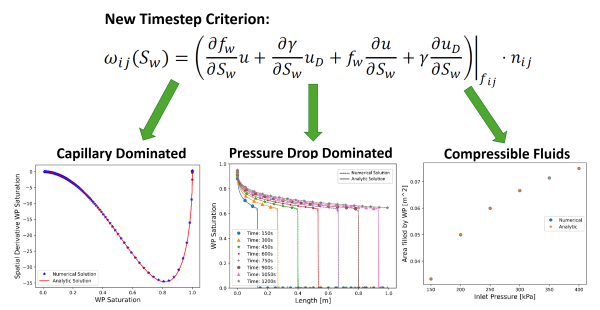
We present an IMplicit Pressure Explicit Saturation (IMPES) solver and a novel timestep criterion for the simulation of immiscible two-phase flow involving compressible fluid phases. The novel timestep criterion uses the Courant-Friedrichs-Lewy (CFL) condition and employs numerically com-puted velocity derivatives to adapt the timestep size, regardless of the dominant flow characteristics.
The solver combined with this timestep criterion demonstrates both effi-ciency and robustness across a range of flow scenarios, including pressure drop dominated and capillary dominated flows with compressible and incompressible fluid phases, without the need to adjust any numerical parameters. Furthermore, it successfully reaches the expected stationary states in a case involving discontinuous porous media parameters such as porosity, permeabilities, and capillary pressure function.
Comparison with the established Coats timestep criterion reveals that our approach requires fewer time iterations while maintaining comparable accuracy on the Buckley-Leverett problem and a gravity-capillary equaliza-tion example with a known stationary state. Additionally, in an example with air compression, the new timestep criterion leads to a significantly improved non-wetting phase mass conservation compared to the Coats criterion.
WHY THIS PAPER MATTERSAccurately simulating how fluids move through complex materials like soil, rock, or battery parts is a major challenge for engineers, as computer mod-els can often become slow or unstable when conditions change. Our work introduces a smart method that automatically adjusts the simulation’s pace, ensuring it remains fast and reliable even when dealing with difficult sce-narios like highly compressible fluid phases or drastically changing porous materials. These findings help experts in fields like carbon storage, ground-water protection, and green energy manufacturing achieve more precise predictions with less computing power, accelerating the development of critical new technologies.
Downloads
References
1. Peter Bastian. (1999) Numerical Computation of Multiphase Flows in Porous Media. Habilitation Thesis, Christian-Albrechts-Universitat Kiel, Kiel.
2. Peter Bastian. A fully-coupled discontinuous galerkin method for two-phase flow in porous media with discontinuous capillary pressure. Computational Geosciences, 18:779–796, 2014.
doi:10.1007/s10596-014-9426-y.
3. Michael J Best and Nilotpal Chakravarti. Active set algorithms for isotonic regression; a unifying framework. Mathematical Programming, 47(1):425–439, 1990. doi:10.1007/BF01580873.
4. Sergey Bochkanov. minbleic subpackage of ALGLIB, 1999. URL: www.alglib.net/optimization/boundandlinearlyconstrained.php.
5. Konstantin Brenner, Clément Cancès, and Danielle Hilhorst. Finite volume approximation for an immiscible two-phase flow in porous media with discontinuous capillary pressure. Computational Geosciences, 17:573–597, 2013. doi:10.1007/s10596-013-9345-3.
6. Royal Harvard Brooks. Hydraulic properties of porous media. Colorado State University, 1965.
7. Se E Buckley and MCi Leverett. Mechanism of fluid displacement in sands. Transactions of the AIME, 146(01):107–116, 1942. doi:10.2118/942107-G.
8. Hui Cao. Development of techniques for general purpose simulators. Stanford University, 2002.
9. Huangxin Chen, Jisheng Kou, Shuyu Sun, and Tao Zhang. Fully mass-conservative IMPES schemes for incompressible two-phase flow in porous media. Computer Methods in Applied Mechanics and Engineering, 350:641–663, 2019. doi:10.1016/j.cma.2019.03.023.
10. Jie Chi, Mengfei Zhang, Zexin Su, Min Shuang, Zongxu Dong, Fengyun Cui, Deyu Jiang, Haoran Zhang, Minghan Jiang, and ZiYa Wang. Effect of gas compressibility during nitrogen immiscible flooding. Physics of Fluids, 37(1), 2025. doi:10.1063/5.0245731.
11. KH Coats. IMPES stability: selection of stable timesteps. SPE Journal, 8(02):181–187, 2003.
doi:10.2118/84924-PA.
12. Arthur Thomas Corey. Mechanics of immiscible fluids in porous media. Water Resources Publication, 1994.
13. Stéphane Dellacherie. Checkerboard modes and wave equation. In Proceedings of ALGORITMY, volume 2009, pages 71–80, 2009.
14. N Djilali and PC Sui. Transport phenomena in fuel cells: from microscale to macroscale. International Journal of Computational Fluid Dynamics, 22(1-2):115–133, 2008. doi:10.1080/10618560701740017.
15. Mohamed F El-Amin. Iterative numerical scheme for non-isothermal two-phase flow in heterogeneous porous media. Algorithms, 12(6):117, 2019. doi:10.3390/a12060117.
16. Florian J Günter, Josef Keilhofer, Christof Rauch, Stefan Rössler, Michael Schulz, Wolfgang Braunwarth, Ralph Gilles, Rüdiger Daub, and Gunther Reinhart. Influence of pressure and temperature on the electrolyte filling of lithium-ion cells: Experiment, model and method. Journal of power sources, 517:230668, 2022. doi:10.1016/j.jpowsour.2021.230668.
17. Jan Hagemeister, Florian J Günter, Thomas Rinner, Franziska Zhu, Alexander Papst, and Rüdiger Daub. Numerical models of the electrolyte filling process of lithium-ion batteries to accelerate and improve the process and cell design. Batteries, 8(10):159, 2022. doi:10.3390/batteries8100159.
18. Ola Harkegard. Efficient active set algorithms for solving constrained least squares problems in aircraft control allocation. In Proceedings of the 41st IEEE Conference on Decision and Control, 2002., volume 2, pages 1295–1300. IEEE, 2002. doi:10.1109/CDC.2002.1184694.
19. Rainer Helmig and Ralf Huber. Comparison of galerkin-type discretization techniques for two-phase flow in heterogeneous porous media. Advances in Water Resources, 21(8):697–711, 1998.
doi:10.1016/S0309-1708(97)00023-7.
20. Pierre Horgue, Cyprien Soulaine, Jacques Franc, Romain Guibert, and Gérald Debenest. An open-source toolbox for multiphase flow in porous media. Computer Physics Communications, 187:217–226, 2015. doi:10.1016/j.cpc.2014.10.005.
21. Patrick Jenny, Seong H Lee, and Hamdi A Tchelepi. Adaptive fully implicit multi-scale finite-volume method for multi-phase flow and transport in heterogeneous porous media. Journal of Computational Physics, 217(2):627–641, 2006. doi:10.1016/j.jcp.2006.01.028.
22. Jiamin Jiang and Jie Yang. Coupled fluid flow and geomechanics modeling of stress-sensitive production behavior in fractured shale gas reservoirs. International Journal of Rock Mechanics and Mining Sciences, 101:1–12, 2018. doi:10.1016/j.ijrmms.2017.11.003.
23. Jiamin Jiang and Rami M Younis. An efficient fully-implicit multislope muscl method for multiphase flow with gravity in discrete fractured media. Advances in Water Resources, 104:210–222, 2017. doi:10.1016/j.advwatres.2017.04.009.
24. A Krechel and K Stüben. Operator dependent interpolation in algebraic multigrid. In Multigrid Methods V: Proceedings of the Fifth European Multigrid Conference held in Stuttgart, Germany, October 1–4, 1996, pages 189–211. Springer, 1998. doi:10.1007/978-3-642-58734-4_11.
25. Sadok Lamine and Michael G Edwards. Multidimensional upwind schemes and higher resolution methods for three-component two-phase systems including gravity driven flow in porous media on unstructured grids. Computer Methods in Applied Mechanics and Engineering, 292:171–194, 2015. doi:10.1016/j.cma.2014.12.022.
26. Alexander Laugier and József Garai. Derivation of the ideal gas law. Journal of Chemical Education, 84(11):1832, 2007. doi:10.1021/ed084p1832.
27. SH Lee, C Wolfsteiner, and HA Tchelepi. Multiscale finite-volume formulation for multiphase flow in porous media: black oil formulation of compressible, three-phase flow with gravity. Computational Geosciences, 12:351–366, 2008. doi:10.1007/s10596-007-9069-3.
28. Bo Lu and Mary F Wheeler. Iterative coupling reservoir simulation on high performance computers.
Petroleum Science, 6:43–50, 2009. doi:10.1007/s12182-009-0008-x.
29. Tianran Ma, Keni Zhang, Weijun Shen, Chaobin Guo, and Hao Xu. Discontinuous and continuous galerkin methods for compressible single-phase and two-phase flow in fractured porous media. Advances in Water Resources, 156:104039, 2021. doi:10.1016/j.advwatres.2021.104039.
30. Rafael March, Florian Doster, and Sebastian Geiger. Assessment of co2 storage potential in naturally fractured reservoirs with dual-porosity models. Water Resources Research, 54(3):1650–1668, 2018. doi:10.1002/2017WR022159.
31. Véronique Michaud. A review of non-saturated resin flow in liquid composite moulding processes.
Transport in Porous Media, 115(3):581–601, 2016. doi:10.1007/s11242-016-0629-7.
32. Florice Nzikou Mouketou and Andrei Kolesnikov. Modelling and simulation of multiphase flow applicable to processes in oil and gas industry. Chemical Product and Process Modeling, 14(1):20170066, 2019. doi:10.1515/cppm-2017-0066.
33. Carlos A de Moura and Carlos S Kubrusly. The Courant-Friedrichs-Lewy (CFL) condition: 80 years after its discovery. Birkhäuser Basel, 2012.
34. Tom Myers. Potential contaminant pathways from hydraulically fractured shale to aquifers.
Groundwater, 50(6):872–882, 2012. doi:10.1111/j.1745-6584.2012.00933.x.
35. George SH Pau, Ann S Almgren, John B Bell, and Michael J Lijewski. A parallel second-order adaptive mesh algorithm for incompressible flow in porous media. Philosophical Transactions of the Royal Society A: Mathematical, Physical and Engineering Sciences, 367(1907):4633–4654, 2009.
36. George Shu Heng Pau, John B Bell, Ann S Almgren, Kirsten M Fagnan, and Michael J Lijewski. An adaptive mesh refinement algorithm for compressible two-phase flow in porous media. Computational Geosciences, 16:577–592, 2012. doi:10.1007/s10596-011-9270-2.
37. Carlos Redondo, Gonzalo Rubio, and Eusebio Valero. On the efficiency of the IMPES method for two phase flow problems in porous media. Journal of Petroleum Science and Engineering, 164:427–436, 2018. doi:10.1016/j.petrol.2018.01.066.
38. Feng Ren, Guowei Ma, Yang Wang, Lifeng Fan, and Hehua Zhu. Two-phase flow pipe network method for simulation of co2 sequestration in fractured saline aquifers. International Journal of Rock Mechanics and Mining Sciences, 98:39–53, 2017. doi:10.1016/j.ijrmms.2017.07.010.
39. Chae M Rhie and Wei-Liang Chow. Numerical study of the turbulent flow past an airfoil with trailing edge separation. AIAA journal, 21(11):1525–1532, 1983. doi:10.2514/3.8284.
40. Theresa Schollenberger, Christian Rohde, and Rainer Helmig. Two-phase pore-network model for evaporation-driven salt precipitation–representation and analysis of pore-scale processes. arXiv preprint arXiv:2503.22533, 2025. doi:10.48550/arXiv.2503.22533.
41. Pengtao Sun, Guangri Xue, Chaoyang Wang, and Jinchao Xu. Fast numerical simulation of two-phase transport model in the cathode of a polymer electrolyte fuel cell. Communications in computational physics, 6(1):49, 2009. doi:10.4208/cicp.2009.v6.p49.
42. M Th Van Genuchten. A closed-form equation for predicting the hydraulic conductivity of unsaturated soils. Soil science society of America journal, 44(5):892–898, 1980. doi:10.2136/sssaj1980.03615995004400050002x.
43. Chunyang Zhao, Bo Yang, Shilong Wang, Chi Ma, Sibao Wang, and Fengyang Bi. Three-dimensional numerical simulation of meso-scale-void formation during the mold-filling process of lcm. Applied Composite Materials, 26:1121–1137, 2019. doi:10.1007/s10443-019-09770-w.
Downloads
Published
Versions
- 2026-09-02 (2)
- 2026-07-01 (1)
Data Availability Statement
The developed code of this work cannot be publicly shared as it is part of a commercial software product.
Issue
Section
License
Copyright (c) 2026 Dominik Burr, Stefan Rief, Konrad Steiner

This work is licensed under a Creative Commons Attribution-NonCommercial-NoDerivatives 4.0 International License.
This article is published under the Creative Commons license indicated above. See the license link for details.
Article metadata are available under the CCo license.