
Unraveling Coupled Salt Transport and Damage Mechanisms in Porous Limestone from Core to Pore Scale using 4D X-ray Tomography and Advanced Image Analysis
DOI:
https://doi.org/10.69631/2337kj19Keywords:
Salt transport & in-pore salt crystallization , Porous limestone, X-ray microtomography, Digital volume correlation, Deep-learning segmentationAbstract
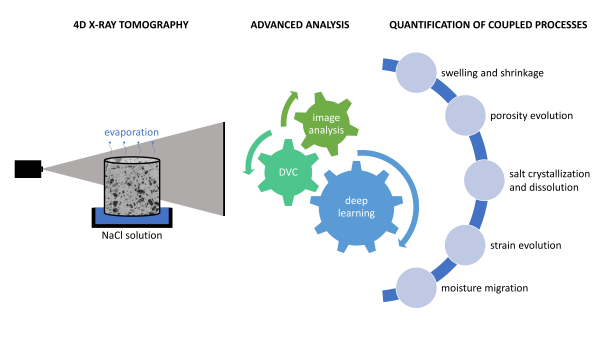
In this study, time-resolved X-ray microtomography is employed to improve the understanding of coupled hydro-chemo-mechanical processes involved in saline weathering of natural stone. A Savonnières limestone sample, hydrophobically treated at its upper surface, was saturated with a NaCl solution and subjected to a controlled drying and deliquescence cycle while being imaged at a resolution of 9.4 µm/voxel. The volumetric deformations, induced during the cycles, were extracted from the time-resolved 3D images using Digital Volume Correlation (DVC). In combination with deep-learning-based segmentation of distinct pore families, including those below the image resolution, the associated transport and crystallization mechanisms are elucidated at the pore scale. The results reveal that salt crystallization in the hydrophobized region of the sample generates internal stresses leading to fracture formation, while deliquescence promotes partial crack closure due to matrix swelling and salt dissolution. In the untreated part of the sample, shrinkage and swelling was observed during drying and deliquescence, respectively. A chronology of the kinetics of these transport processes was further identified across the different pore families. Overall, this work demonstrates that the combination of X-ray microtomography with advanced image-processing techniques enables in-depth analysis of complex, intertwined phenomena in porous media, even when they occur partly in pores smaller than the image resolution.
WHY THIS PAPER MATTERSSalt silently cracks stone buildings and monuments from the inside out, threatening cultural heritage worldwide. Using X-ray imaging without a contrast agent, we developed a novel analysis workflow that reveals how salt is transported and creates cracks at a microscopic scale. This workflow opens new ways for scientists to study similar complex processes in porous materials. The insights inform conservation experts and engineers as they develop strategies to protect materials, buildings, and structures from salt weathering.
Downloads
References
1. Arif, M., Lebedev, M., Barifcani, A., & Iglauer, S. (2017). CO2 storage in carbonates: Wettability of calcite. International Journal of Greenhouse Gas Control, 62, 113–121. https://doi.org/10.1016/j.ijggc.2017.04.014
2. Bikkina, P. K. (2011). Contact angle measurements of CO2–water–quartz/calcite systems in the perspective of carbon sequestration. International Journal of Greenhouse Gas Control, 5(5), 1259–1271. https://doi.org/10.1016/j.ijggc.2011.07.001
3. Comet Technologies Canada, Inc. (2022). Dragonfly (Version 2022.2 Build 1409) [Computer software]. https://dragonfly.comet.tech/
4. Denecker, M. (2014). Le rôle des sulfates de sodium dans l’altération des pierres du patrimoine bâti: Méthodes indirectes d’identification pour l’approche expérimentale [Doctoral dissertation]. Université de Cergy Pontoise. Article tel-01164706. https://dx.doi.org/10.70675/e3ec7ce6ze4aaz4a39zbdbbz6bbb06a7d789
5. Derluyn, H. (2012). Salt transport and crystallization in porous limestone: Neutron–X-ray imaging and poromechanical modeling [Doctoral dissertation], ETH Zurich. https://doi.org/10.3929/ethz-a-007578301
6. Derluyn, H. (2024). Experimental observations on salt crystallization in geomaterials. In H. Derluyn & M. Prat (Eds.), Salt crystallization in porous media (pp. 99–125). ISTE - Wiley. ISBN 978-1-78945-114-6. https://doi.org/10.1002/9781394312436.ch5
7. Derluyn, H., Griffa, M., Mannes, D., Jerjen, I., Dewanckele, J., Vontobel, P., Sheppard, A., Derome, D., Cnudde, V., Lehmann, E., & Carmeliet, J. (2013). Characterizing saline uptake and salt distributions in porous limestone with neutron radiography and X-ray micro-tomography. Journal of Building Physics, 36(4), 353–374. https://doi.org/10.1177/1744259112473947
8. Derluyn, H., Vontobel, P., Mannes, D., Derome, D., Lehmann, E., & Carmeliet, J. (2019). Saline water evaporation and crystallization-induced deformations in building stone: Insights from high-resolution neutron radiography. Transport in Porous Media, 128(3), 895–913. https://doi.org/10.1007/s11242-018-1151-x
9. Dessandier, D. (2000). Guide méthodologique de sélection des pierres des monuments en termes de durabilité et compatibilité. (Report no. BRGM/RP-50137-FR). BRGM. https://pierres-info.fr/biblio-taille_de_pierre/guide-selection-pierres.pdf
10. Dierick, M., Van Loo, D., Masschaele, B., Van Den Bulcke, J., Van Acker, J., Cnudde, V., & Van Hoorebeke, L. (2014). Recent micro-CT scanner developments at UGCT. Nuclear Instruments and Methods in Physics Research Section. Part B, 324, 35–40. https://doi.org/10.1016/j.nimb.2013.10.051
11. Dupas-Langlet, M. (2013). De la déliquescence au mottage des poudres cristallines: Cas du chlorure de sodium [Doctoral dissertation]. Université de Technologie de Compiègne. https://theses.fr/2013COMP2094
12. Espinosa-Marzal, R. M., Hamilton, A., McNall, M., Whitaker, K., & Scherer, G. W. (2011). The chemomechanics of crystallization during rewetting of limestone impregnated with sodium sulfate. Journal of Materials Research, 26(12), 1472–1481. https://doi.org/10.1557/jmr.2011.137
13. Flatt, R. J. (2002). Salt damage in porous materials: How high supersaturations are generated. Journal of Crystal Growth, 242(3–4), 435–454. https://doi.org/10.1016/S0022-0248(02)01429-X
14. Fronteau, G. (2000). Comportements télégéniques des principaux calcaires de Champagne-Ardenne, en relation avec leur faciès de dépôt et leur séquençage diagénétique [Doctoral dissertation]. Université de Reims Champagne-Ardennes. https://orage.univ-lorraine.fr/s/orage/item/6004
15. Fronteau, G., Moreau, C., Thomachot-Schneider, C., & Barbin, V. (2010). Variability of some Lutetian building stones from the Paris Basin, from characterisation to conservation. Engineering Geology, 115(3–4), 158–166. https://doi.org/10.1016/j.enggeo.2009.08.001
16. Hajiabadi, S. H., Bedrikovetsky, P., Borazjani, S., & Mahani, H. (2021). Well injectivity during CO2 geosequestration: A review of hydro-physical, chemical, and geomechanical effects. Energy and Fuels, 35(11), 9240–9267. https://doi.org/10.1021/acs.energyfuels.1c00931
17. Hanor, J. S. (1994). Origin of saline fluids in sedimentary basins. Geological Society, London, Special Publications, 78(1), 151–174. https://doi.org/10.1144/GSL.SP.1994.078.01.13
18. Jacob, R., & Saylor, B. Z. (2016). CO2 solubility in multi-component brines containing NaCl, KCl, CaCl2 and MgCl2 at 297 K and 1–14 MPa₂ and MgCl₂. Chemical Geology, 424, 86–95. https://doi.org/10.1016/j.chemgeo.2016.01.013
19. Koç, M. M., Aslan, N., Kao, A. P., & Barber, A. H. (2019). Evaluation of X-ray tomography contrast agents: A review of production, protocols, and biological applications. Microscopy Research and Technique, 82(6), 812–848. https://doi.org/10.1002/jemt.23225
20. Lebedev, M., Wilson, M. E. J., & Mikhaltsevitch, V. (2014). An experimental study of solid matrix weakening in water-saturated Savonnières limestone. Geophysical Prospecting, 62(6), 1253–1265. https://doi.org/10.1111/1365-2478.12168
21. Lubelli, B., Van Hees, R. P. J., Huinink, H. P., & Groot, C. J. W. P. (2006). Irreversible dilation of NaCl-contaminated lime-cement mortar due to crystallization cycles. Cement and Concrete Research, 36(4), 678–687. https://doi.org/10.1016/j.cemconres.2005.10.008
22. Martin, S. T. (2000). Phase transitions of aqueous atmospheric particles. Chemical Reviews, 100(9), 3403–3454. https://doi.org/10.1021/cr990034t
23. Nakashima, Y., & Nakano, T. (2014). Optimizing contrast agents with respect to reducing beam hardening in nonmedical X-ray computed tomography experiments. Journal of X-Ray Science and Technology, 22(1), 91–103. https://doi.org/10.3233/XST-130411
24. Noiriel, C., Renard, F., Doan, M.-L., & Gratier, J.-P. (2010). Intense fracturing and fracture sealing induced by mineral growth in porous rocks. Chemical Geology, 269(3–4), 197–209. https://doi.org/10.1016/j.chemgeo.2009.09.018
25. Nooraiepour, M., Polański, K., Masoudi, M., Kuczyński, S., Derluyn, H., Parreiras Nogueira; L., Bohloli, B., Nagy, S., Hellevang, H. (2025). Potential for 50% Mechanical Strength Decline in Sandstone Reservoirs Due to Salt Precipitation and CO2–Brine Interactions During Carbon Sequestration, Rock Mechanics and Rock Engineering, 58: 1239-1269. https://doi.org/10.1007/s00603-024-04223-8
26. Pimienta, L., Esteban, L., Sarout, J., Liu, K., Dautriat, J., Delle Piane, C., & Clennell, M. B. (2017). Supercritical CO 2 injection and residence time in fluid-saturated rocks: Evidence for calcite dissolution and effects on rock integrity. International Journal of Greenhouse Gas Control, 67, 31–48. https://doi.org/10.1016/j.ijggc.2017.09.014
27. Rijniers, L. A., Huinink, H. P., Pel, L., & Kopinga, K. (2005). Experimental evidence of crystallization pressure inside porous media. Physical Review Letters, 94(7), Article 075503. https://doi.org/10.1103/PhysRevLett.94.075503
28. Rodríguez-Navarro, C., & Doehne, E. (1999). Salt weathering: Influence of evaporation rate, supersaturation and crystallization pattern. Earth Surface Processes and Landforms, 24(3), 191–209. https://doi.org/10.1002/(SICI)1096-9837(199903)24:3<191::AID-ESP942>3.0.CO;2-G
29. Rodríguez-Navarro, C., Doehne, E., & Sebastián, E. (2000). How does sodium sulfate crystallize? Implications for the decay and testing of building materials. Cement and Concrete Research, 30(10), 1527–1534. https://doi.org/10.1016/S0008-8846(00)00381-1
30. Roels, S. (2000). Modelling unsaturated moisture transport in heterogeneous limestone [Doctoral dissertation] Katholieke Universiteit Leuven, ISBN: 90-5682-264-0. https://lib.is/lbsn9922227300101471/representation?libis=11:1:1&lang=en
31. Roels, S., Elsen, J., Carmeliet, J., & Hens, H. (2001). Characterisation of pore structure by combining mercury porosimetry and micrography. Materials and Structures/Matériaux et Constructions, 34(236), 76–82. https://doi.org/10.1007/BF02481555
32. Ronneberger, O., Fischer, P., & Brox, T. (2015). U-net: Convolutional networks for biomedical image segmentation. In N. Navab, J. Hornegger, W. M. Wells, A. F. Frangi (Eds.), Medical image computing and computer-assisted intervention—MICCAI 2015 (pp. 234–241). Springer International Publishing. https://doi.org/10.1007/978-3-319-24574-4_28
33. Ruiz-Agudo, E., Mees, F., Jacobs, P., & Rodríguez-Navarro, C. (2007). The role of saline solution properties on porous limestone salt weathering by magnesium and sodium sulfates. Environmental Geology, 52(2), 269–281. https://doi.org/10.1007/s00254-006-0476-x
34. Sari, M., Sarout, J., Poulet, T., Dautriat, J., & Veveakis, M. (2022). The brittle–ductile transition and the formation of compaction bands in the Savonnières limestone: Impact of the stress and pore fluid. Rock Mechanics and Rock Engineering, 55(11), 6541–6553. https://doi.org/10.1007/s00603-022-02963-z
35. Shahidzadeh-Bonn, N., Desarnaud, J., Bertrand, F., Chateau, X., & Bonn, D. (2010). Damage in porous media due to salt crystallization. Physical Review. E, Statistical, Nonlinear, and Soft Matter Physics, 81, Article 066110. https://doi.org/10.1103/PhysRevE.81.066110
36. Stamati, O., Andò, E., Roubin, E., Cailletaud, R., Wiebicke, M., Pinzon, G., et al. (2020). SPAM: software for practical analysis of materials. Journal of Open Source Software, 5(51), 2286. https://doi.org/10.21105/joss.02286
37. Steiger, M. (2005). Crystal growth in porous materials—I: The crystallization pressure of large crystals. Journal of Crystal Growth, 282(3–4), 455–469. https://doi.org/10.1016/j.jcrysgro.2005.05.007
38. Warren, J. K. (2010). Evaporites through time: Tectonic, climatic and eustatic controls in marine and nonmarine deposits. Earth-Science Reviews, 98(3–4), 217–268. https://doi.org/10.1016/j.earscirev.2009.11.004
39. Zeiler, M. D. (2012). ADADELTA: An adaptive learning rate method. arXiv preprint arXiv:1212.5701. arXiv. http://arxiv.org/abs/1212.5701
Downloads
Additional Files
Published
Data Availability Statement
The datasets generated and analyzed during the current study are available from the corresponding authors upon request.
The DVC analysis uses an open-source software, SPAM, its source code is publicly available on https://gitlab.com/spam-project/spam.
All relevant methodological details and protocols are described within the article.
Issue
Section
License
Copyright (c) 2026 Syrine Ben Elhadj Hamida, Marijn A Boone, Veerle Cnudde, Peter Moonen, Hannelore Derluyn

This work is licensed under a Creative Commons Attribution-NonCommercial-NoDerivatives 4.0 International License.
This article is published under the Creative Commons license indicated above. See the license link for details.
Article metadata are available under the CCo license.